

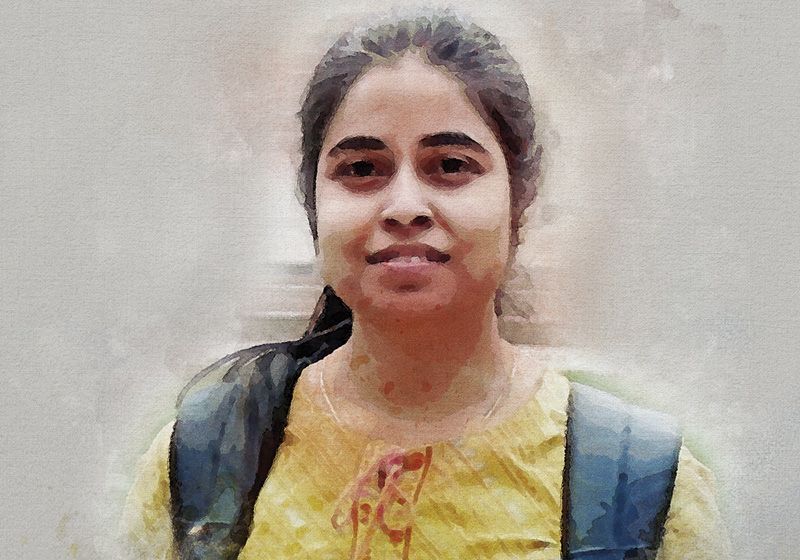
This postdoc’s research sheds light on how tiny protein organelles manage molecular traffic, with implications for engineering synthetic pathways.
Q | Write a brief introduction to yourself including the lab you work in and your research background.
I’m Neetu Yadav, a postdoctoral researcher in Dr. Josh Vermaas’s lab at Michigan State University. My work focuses on computational biophysics and molecular simulations, particularly exploring how metabolites move through protein-based organelles like bacterial microcompartments. In the Vermaas lab, I use molecular dynamics and enhanced sampling approaches to study the transport of biologically important molecules. My research has broader implications for understanding biomolecular interactions and for engineering novel biohybrids.
Q | How did you first get interested in science and/or your field of research?
My interest in science began with a simple curiosity; I wanted to understand how living systems work at the most fundamental level. Growing up, I was fascinated by the idea that life is governed by molecules we cannot see, and I found myself asking questions about how cells organize such intricate processes with precision. As I advanced in my studies, I became especially drawn to the intersection of biology and computation, where invisible molecular movements can be revealed through simulations. During graduate school, I discovered the power of molecular dynamics to capture processes like the effect of environmental conditions on protein and lipid membrane structure, and I was captivated by how these tools could complement experimental biology. This sense of discovery continues to motivate my current postdoctoral work, where I study the transfer of molecules inside bacterial microcompartments (BMCs). For me, research is not just problem-solving—it is the pursuit of uncovering unseen stories within biology.
Q | Tell us about your favorite research project you’re working on.
One of the projects I’m most excited about looks at how molecules move across bacterial microcompartment (BMC) shells. BMCs are tiny protein-based organelles that act like nanoscale reaction chambers, housing enzymes that carry out important metabolic processes. Even though they play a crucial role in cells, we still don’t fully understand how molecules get in and out of these shells. In this project, I use computer simulations to explore how different molecules—such as RuBP, gases like CO₂ and O₂, ions like HCO₃⁻, and small molecules involved in specific metabolic pathways (NrfA and the 2 Aminophenol pathway)—cross the protein shell. I’m fascinated by how size, charge, and interactions with the shell influence whether a molecule can pass through. Beyond revealing fundamental insights about BMCs, this work has real-world implications; understanding and engineering these organelles could improve synthetic metabolic pathways or prevent the accumulation of harmful intermediates. What I love most is combining computation, hypothesis testing, and visualization. To me, science is the adventure of discovering what happens behind the scenes in biology.
Q | What do you find most exciting about your research project?
The most exciting part of my scientific journey has been discovering the invisible world of molecular interactions and seeing how computational tools can bring it to life. During graduate school, I was captivated by the ability of molecular dynamics simulations to reveal how proteins and peptides change shape under different conditions—information that is often impossible to capture experimentally. Each simulation felt like opening a tiny window into the hidden machinery of cells, where every interaction tells a story about function and regulation. This sense of discovery only grew during my postdoctoral work, where I study metabolite transport across bacterial microcompartment shells. Watching, at the atomic level, how molecules navigate protein pores and interact with complex environments has been both challenging and deeply rewarding. Beyond the scientific insights, what excites me most is the combination of creativity, problem-solving, and visualization—turning abstract concepts into tangible models that can guide experiments and applications. For me, the journey has been about continually uncovering the unseen layers of life and sharing that excitement with others.
Q | If you could be a laboratory instrument, which one would you be and why?
I would be a computer. Computers are at the heart of almost every modern scientific discovery—they store knowledge, run simulations, analyze massive datasets, and connect researchers across the world. I relate to the way a computer can switch between being highly logical and highly creative: one moment solving equations, the next visualizing molecular interactions or generating new hypotheses. In my own research, computers are more than just tools; they are the window into the invisible molecular world, allowing me to watch how metabolites move through protein shells and uncover patterns that experiments alone can’t reveal. What excites me about being a “computer” is not just processing information but enabling others to build on that knowledge. A computer is versatile, collaborative, and endlessly adaptable—qualities I try to bring to my own scientific journey. Plus, like a computer, I’m happiest when I’m learning new things and pushing the limits of what’s possible.
Are you a researcher who would like to be featured in the “Postdoc Portraits” series? Send in your application here.
