
Close Menu
My Blog

    Subscribe to Updates

    Get the latest creative news from FooBar about art, design and business.

    What's Hot

    Nautilus debuts Voyager platform in push toward next-gen proteomics

    March 1, 2026

    First-in-Human Success for Prenatal Stem Cell Therapy in Spina Bifida

    February 28, 2026

    Pressure-Driven Pathway Links Liver Congestion to Fibrosis and Cancer

    February 28, 2026
    Facebook X (Twitter) Instagram
    X (Twitter) YouTube
    My BlogMy Blog
    Sunday, March 1
    • Home
    • About Us
    • Healthy Living
    • DNA & Genetics
    • Podcast
    • Shop
    My Blog
    Home»Probiotics»New Frontiers in Therapeutic Delivery Unveiled at GA Congress
    Probiotics

    New Frontiers in Therapeutic Delivery Unveiled at GA Congress

    adminBy adminSeptember 10, 2025No Comments3 Mins Read
    Facebook Twitter Pinterest LinkedIn Tumblr WhatsApp VKontakte Email
    New Frontiers in Therapeutic Delivery Unveiled at GA Congress
    Share
    Facebook Twitter LinkedIn Pinterest Email


    Scientists and industry met for the 73rd International Congress and Annual Meeting of the Society for Medicinal Plant and Natural Product Research (GA) in Naples, Italy, from Sept. 1 to 3.

    Providing a keynote presentation on new encapsulation techniques, Professor Ennio Tasciotti, director of human longevity program at the San Raffaele Scientific Institute for Research, Hospitalization and Healthcare (IRCCS), illustrated the applications of nano and micro formulations to boost therapeutic properties of plant-derived actives.

    Once active ingredients enter the human body, they have to remain stable through multiple biological systems before release at the optimum time, he explained.

    Tasciotti’s team has therefore developed a range of solutions to protect active ingredients within a range of applications—from vaccinations to ingestible liquid, pills or capsules.

    He explained that when developing solutions for use within injectable drugs or vaccinations, the molecules need to be nanoscopic. When formulating ingredients for ingestion, the size constrainst are more relaxed, allowing for the use of microencapsulation and opening opportunities for innovation.

    His team has created a menu of creative microencapsulation solutions to meet the needs of different ingredients. These are: mononuclear, multi-walled, multinuclear core, mixed polymer matrix, coated mixed multinuclear core, coated matrix particle, patchy microparticl, and double-compartment capsule.

    “A mixed polymer matrix, for example, brings together many nano-particles congealed together and aggregated loosely so they are not very stable but in the right environment will open-up and release “like a drop bomb of active ingredient.”

    He added: “The beauty is all of these can be modeled and programmed according to whatever release you want, whether its hours, days, weeks—we go all the way to months.”

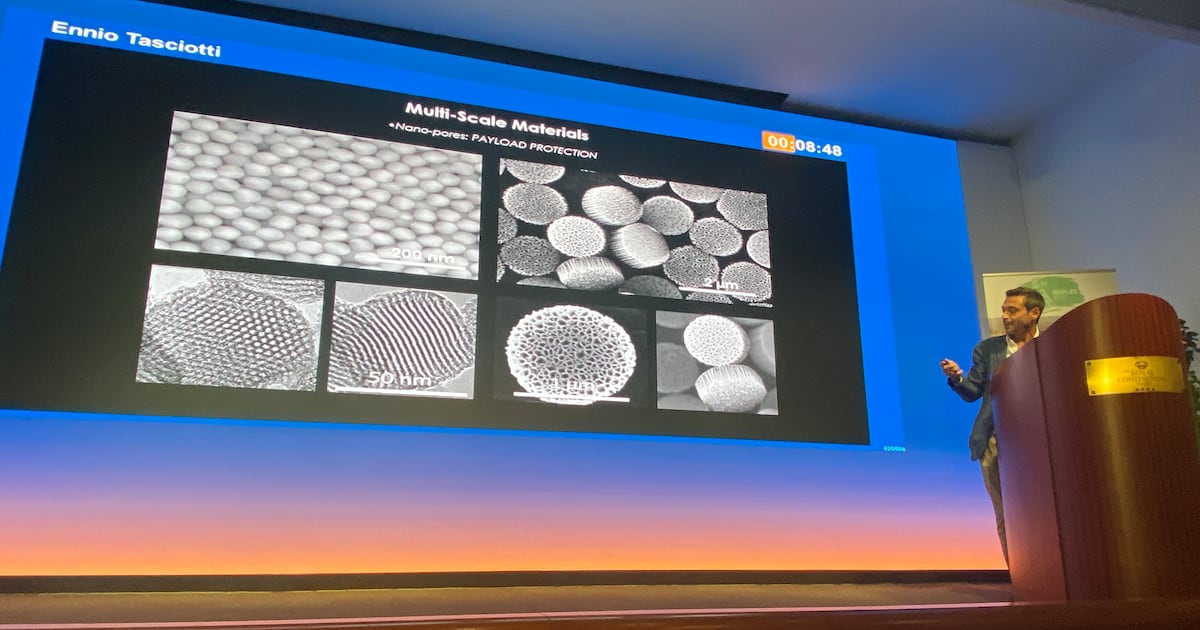
    His team has further developed a “multi-scale material” field of research since 2001 in which they are “creating objects within objects, like a Russian doll effect,” starting with molecules 50 nano meters in size.

    “It takes time for these molecules to diffuse out, and this is good for sustained release, Tasciotti said. ”But if you put these inside the pores of a larger structure so you go from 50 nm to one or two microns, ghat gives another layer of control. You can develop very controlled synthetic ways to put a fixed number of cells within these structures.”

    He further discussed the growing interest in plant-derived exosome-like nanoparticles (PDENs), also referred to as PELNs.

    “Cells already make their own versions of nanoparticles, called exosomes or extracellular vesicles—the little structure that every cell has,” he said.

    “Plants also have exosomes. I believe these could be a beautiful alternative to some of the formulation issues because they regulate inflammation, they can cross talk between species so seem to be good for human biology.

    PDENs have been found to modulate gene expression and immune responses. For example, grape-derived exosomes have been shown to regulate triglyceride levels, and ginger-derived exosomes reduce inflammation in colitis models.

    Research has also concluded that, compared with synthetic nanoparticles and mammalian cell derived exosomes (MDEs), PELNs have lower toxicity and immunogenicity and possess excellent biocompatibility.

    Some nutraceutical pioneers already using this method include Italian supplier Exolab and Spanish supplier PhNóva.

    What’s more, Tasciotti said companies should find it ‘easy’ to patent protect plant exosomes innovations.

    “There is not an issue with patenting plant exosomes because this is a technology so this allows you to protect your discovery,” he said.

    Congress Delivery Frontiers Therapeutic Unveiled
    Share. Facebook Twitter Pinterest LinkedIn Tumblr WhatsApp Email
    Previous ArticleSirio Pharma to boost Australian growth with new GMP certificate
    Next Article Assisted dying: Doctors discuss implementation ahead of critical Lords debate
    admin
    • Website

    Related Posts

    100 IPA Newsletters Later: Setting the Global Standard for Biotics

    February 24, 2026

    Fido Needs an Antibiotic: Are There Strategies to Maintain Gut Integrity and Restore Gut Microbiota?

    February 24, 2026

    Why CoQ10 Production Depends on Microbial Balance

    February 23, 2026

    Internal Disorder in Lipid Nanoparticles May Improve Cargo Delivery in Cells

    February 21, 2026
    Leave A Reply Cancel Reply

    Our Picks

    9 Time-Saving Kitchen Gadgets for Fall at Amazon

    September 5, 2025

    Why Exercise Is So Important For Heart Health, From An MD

    September 5, 2025

    An Engineered Protein Helps Phagocytes Gobble Up Diseased Cells

    September 5, 2025

    How To Get Rid Of Hangnails + Causes From Experts

    September 5, 2025
    • Facebook
    • Twitter
    • Pinterest
    • Instagram
    • YouTube
    • Vimeo
    Don't Miss
    Longevity

    Nautilus debuts Voyager platform in push toward next-gen proteomics

    By adminMarch 1, 20260

    Company’s new benchtop system promises a clearer view of proteins following validation at a leading…

    First-in-Human Success for Prenatal Stem Cell Therapy in Spina Bifida

    February 28, 2026

    Pressure-Driven Pathway Links Liver Congestion to Fibrosis and Cancer

    February 28, 2026

    A cellular atlas of aging comes into focus

    February 28, 2026

    Subscribe to Updates

    Get the latest creative news from SmartMag about art & design.

    About Us

    At FineGut, our mission is simple: to enhance your self-awareness when it comes to your gut health. We believe that a healthy gut is the foundation of overall well-being, and understanding the brain–gut connection can truly transform the way you live.

    Our Picks

    9 Time-Saving Kitchen Gadgets for Fall at Amazon

    September 5, 2025

    Why Exercise Is So Important For Heart Health, From An MD

    September 5, 2025

    An Engineered Protein Helps Phagocytes Gobble Up Diseased Cells

    September 5, 2025
    Gut Health

    Nautilus debuts Voyager platform in push toward next-gen proteomics

    March 1, 2026

    First-in-Human Success for Prenatal Stem Cell Therapy in Spina Bifida

    February 28, 2026

    Pressure-Driven Pathway Links Liver Congestion to Fibrosis and Cancer

    February 28, 2026
    X (Twitter) YouTube
    • Contact us
    • Privacy Policy
    • Disclaimer
    • Terms and Conditions
    © 2026 finegut.com. Designed by Pro.

    Type above and press Enter to search. Press Esc to cancel.