

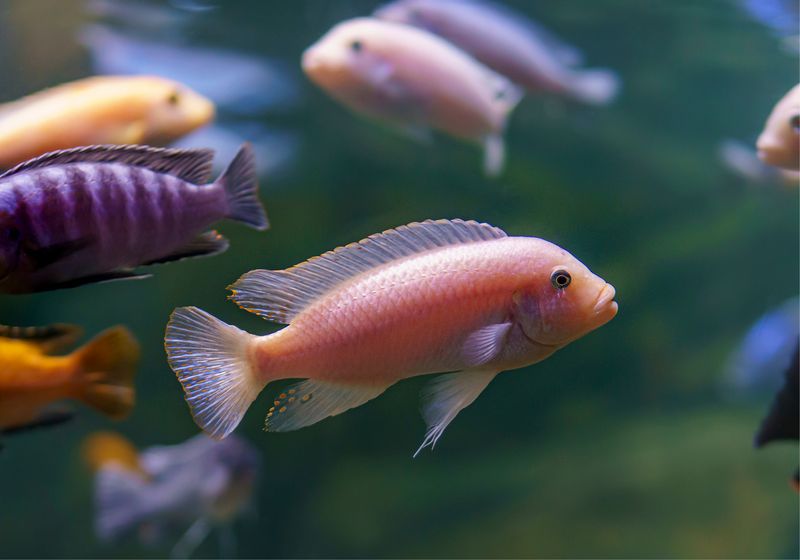
There are concerned, overprotective parents, and then there are cichlid fish. After a male cichlid fertilizes the female’s eggs, she holds her entire brood of embryos inside her mouth for two weeks until they are ready to hatch. Sometimes even after they hatch, she will protect the little hatchlings inside her mouth for a bit longer, until they are ready to make their own way. Giving new meaning to sacrificial parenting, the whole time, her mouth filled to the brim with baby fish, the mother fish will starve—foregoing food for the sake of her future progeny. And yet, there’s another side to their parenting; like many other creatures in the wild, they also devour their own children.
“There’s some sort of a switch in the brain that as soon as the eggs get taken up and fertilized, they stop feeding,” said Hans Hoffman, a biologist at the University of Texas. “They won’t feed again until two weeks later, when they release the eggs, then within hours it switches back and they start feeding again, including [sometimes] their own babies.”
Scientists have long been fascinated by these seemingly contradictory behaviors and the brain regions involved in regulating each of them. How does a cichlid mother’s brain decide to switch from eating food to voluntarily starving for her babies, to finally, in some cases, cannibalizing her own young? Does eating her own babies help the mother fish in any way? And finally, what do cichlid fish—with their unique mouthbrooding tactics—teach us about the evolution of parental behaviors in animals?
Different Regions for Diverse Behaviors
Scientists have studied the neural circuitry underlying maternal care and infanticide in mammalian model systems, but how some fish can switch from caring for to consuming their offspring is less well known. To fill this gap, the late Karen Maruska, who was interested in the neural basis of social behavior in cichlid fish, started exploring this area a few years ago.
Maruska, who was a biologist at Louisiana State University, wanted to understand how the African cichlid fish Astatotilapia burtoni’s internal nutritional state affects its neural function and behavioral output. In a 2020 study, she and her team compared the brains of mouthbrooding female fish with fed (high energy) and starved (low energy) non-mouthbrooding females.1 They stained for the neural activation marker pS6 to determine which brain regions were active in each of these three groups.
They found that various brain regions were differentially activated in the three individual cases, suggesting that the neural activation patterns during mouthbrooding-associated starvation were distinct from those that were active during general starvation or low energy states. However, some brain regions associated with mouthbrooding overlapped with those involved in the energetic state of the fish, suggesting that maternal care and energetics had both distinct and shared neural circuitry in the fish brain.
Cichlid mothers can starve for weeks as they carry their babies in their mouth.
Adrian Indermaur/University of Basel
Modifying the existing feeding circuits for regulating the energetics associated with mouthbrooding may have contributed to the evolution of parental care in the cichlids, according to the authors. In a 2023 Journal of Experimental Biology study, Maruska’s team analyzed co-activation of brain regions involved in mouthbrooding, post-release maternal care—which is when the mother allows the hatched fish to swim back into her mouth—and infanticide.2 During infanticide, the mother can sometimes consume the hatched fish, or the fry, that she is protecting in her mouth.
Scientists had previously found that a brain region called the ventromedial nucleus of the hypothalamus (VMH), is both involved in aggressive behaviors and implicated in infanticide in male mice.3 But Maruska’s team found that infanticide-exhibiting females show lesser activation than mouthbrooding females in the anterior tuberal nucleus (ATn)—the VMH counterpart in the cichlids. Based on these findings, the authors conclude that infanticide may arise not out of aggression, but could be due to other factors, like hunger.
Broadly, looking at brain activity in nine different brain regions, they found distinct activation patterns in different brain regions in all three behaviors. The circuitry underlying infanticide seemed particularly different from the one regulating mouthbrooding and maternal care—suggesting that when it comes to parenting, there is a switch from care to consumption in the fish.
“The idea is to identify cell populations or brain regions involved in regulating parental behavior, and ideally then go in and look at particular pathways, molecules, and genes that are critically important for that,” explained Hoffman. “And this is where Suzy Renn’s work comes in.”
Renn, a biologist at Reed College, analyzes transcriptomic data, to study how the expression of tens of thousands of genes could be regulating mouthbrooding and starvation behaviors. In 2023, she and her team found that genes involved in inflammation and immune system activation were also upregulated in mouthbrooding females.4 “What we’re seeing is a trade-off between immune function and maternal care,” explained Renn. “If you’re going to put your energy into being a mother, you’re compromising some of your immune function.” When immune function is negatively affected, cells can end up overcompensating by upregulating their immune system genes.
They also found that the neurotensin and galanin genes are highly expressed during mouthbrooding, and their expression decreases after the baby fish are released. Both genes code for neuropeptides and have been associated with parental behavior in previous work involving birds and mice. Notably, Maruska’s team had also previously found that neurons expressing the neuropeptide galanin are active in a particular brain region called the preoptic area during mouthbrooding.5
“The next step would be to experimentally test some of these pathways by knocking out the gene or doing pharmacology or so on,” said Hoffman. “And to my knowledge, that hasn’t been done.”
De-stressing Mouthbrooding Mothers
At times, starvation may cause cichlid mothers to blur the line between care and consumption even before the fish are born.

Peter Dijkstra, a behavioral ecologist at Central Michigan University, studies the correlation between oxidative stress and maternal care in cichlid fish.
Peter Dijkstra
Peter Dijkstra, a behavioral ecologist at Central Michigan University, found that mouthbrooding females show higher levels of oxidative stress as compared to the non-brooding ones, especially in the early stages of maternal care.6 This kind of stress occurs when the production of harmful reactive oxygen species overwhelms the body’s antioxidant systems. The process can damage DNA, tissues, and accelerate aging. The transition from not carrying offspring to starting to mouthbrood seemed to be very costly for the fish, in terms of oxidative damage to their DNA.
“I always tell people, whenever you start doing something new, it’s actually really challenging, like a new job or anything that’s new, it is like, ‘Oh gosh, I have to get used to everything.” explained Dijkstra. “And these females must enter a phase of long-term starvation, right? So, all sorts of changes are taking place, and they must metabolically adjust. And so, we think that is costly.”
In a follow-up study, the researchers wanted to carefully track oxidative DNA damage and any protective antioxidant activity over the course of mouthbrooding. To analyze overall antioxidant protection, they measured plasma total antioxidant capacity, which is the ability to neutralize any harmful free radicals. They also measured the activity of an enzyme called superoxide dismutase (SOD), since they knew that this enzyme’s activity is usually ramped up in response to any oxidative stress.
They began by standardizing the number of eggs in all the females they were testing. For this, Jacob Sawecki, then a postdoctoral scholar in Dijkstra’s lab, removed all the fertilized eggs from the mother and returned exactly 25 of them to her mouth. But as the researchers systematically followed the cichlid mothers over the course of their mouthbrooding period, they discovered that the mothers had figured out a way to cope with this stress.
When Sawecki sampled the females at different stages, to keep track of the number of eggs in their mouths, he noticed that they had fewer eggs than they had started with. He was sure of having put in 25 eggs but sometimes found only 21 or fewer.
That’s when they realized that they had serendipitously stumbled onto filial cannibalism; the cichlid mothers were actually snacking on some of the eggs they had been mouthbrooding.7 The mothers that cannibalized more eggs had higher antioxidant activity in their livers. The authors speculate that this antioxidant boost helps them both survive the ongoing mouthbrooding and live longer to have more babies in the future.
“We speculate that eating babies can boost their health in a way that increases antioxidant function, and so perhaps that can help these females to be successful in the future [as well],” says Dijkstra.
Males that Mouthbrood
Much of Dijkstra’s other work has focused on studying social dominance in male cichlid fish, and how that contributes to oxidative stress.8 And in most cases, the males are generally more concerned with mating and asserting social dominance rather than parenting. But it turns out, there are some unique cases where the cichlid fathers can also become mouthbrooders.

Scott Juntti, a researcher at the University of Maryland, studies social behaviors in cichlid fish.
Scott Juntti
Scott Juntti, a biologist studying social behavior at the University of Maryland, was initially interested in mating behavior in cichlids. He was particularly interested in a pheromone called Prostaglandin F2A. Cichlid females release this pheromone when they are ready to lay eggs and males respond to the released pheromone using their olfactory neurons, thus finding attractive females that are ready to mate.
In the process of studying how the males responded to the pheromone, Juntti and his team identified and mutated two molecules—an ion channel Cnga2b in the sensory neurons and the olfactory receptor Or113a, both of which helped the males in detecting the female pheromone. But not only did these mutations mess with the pheromone sensing in the males, but they turned the cichlid fathers from deadbeat dads to devoted ones.9
“The thing that really just blew our minds was that in these olfactory mutant animals—whether we silence a whole swath of olfactory receptor neurons or just this one class that expresses a single receptor—we found males that were carrying eggs in their mouths,” said Juntti.
They realized that there is an “olfactory inhibition of parental care” in males, as long as the pheromone receptor is active, the males are keener on mating. But as soon as the receptor or neurons don’t work as well, this inhibition is lifted, and the males also start mouthbrooding.
The males are not as devoted as the females though. Though the males do pick up the eggs and hold onto them for hours, and sometimes days, in many cases they end up eating most of the eggs. As Juntti noted, there must be some other sex-specific factor that’s causing the females to hold on to the eggs for a longer period of time.
An Emerging Non-Model Organism in Neuroscience
With unique parenting strategies that involve the mother starving for days to protect offspring and sometimes snacking on their own offspring to cope with oxidative stress; cichlid fish continue to intrigue scientists with their baffling biology. “I would just encourage everybody who’s doing science, and doing neuroscience, to stop and watch the [fish’s] behaviors,” said Renn.
“As I think about the future of research in neuroscience generally, there’s a huge opportunity for working with these less-studied model organisms that show amazing social behaviors,” said Juntti. “And now that we have a lot more tools for genetic sequencing and manipulation, [we’re] uncovering a lot of new and very exciting mechanisms.”
“That’s going to be pretty exciting to watch in the future, not just in cichlids but in many, many other species,” he added.
- Maruska KP, et al. Neural activation patterns associated with maternal mouthbrooding and energetic state in an African cichlid fish. Neuroscience. 2020;446:199-212.
- Ray EJ, et al. Neural activation patterns associated with mouthbrooding, maternal care, infanticide and fry release in an African cichlid fish. J Exp Biol. 2023;226(6):jeb244854.
- Renier N, et al. Mapping of brain activity by automated volume analysis of immediate early genes. Cell. 2016;165(7):1789-1802.
- Faber-Hammond JJ, Renn SCP. Transcriptomic changes associated with maternal care in the brain of mouthbrooding cichlid Astatotilapia burtoni reflect adaptation to self-induced metabolic stress. J Exp Biol. 2023;226(4):jeb244734.
- Butler JM, et al. Galanin neuron activation in feeding, parental care, and infanticide in a mouthbrooding African cichlid fish. Horm Behav. 2020;126:104870.
- Sawecki J, et al. Reproduction and maternal care increase oxidative stress in a mouthbrooding cichlid fish. Behav Ecol. 2019;30(6):1662–1671.
- Sawecki J, Dijkstra PD. Mothers modify the cost of reproduction by dynamic changes in antioxidant function and filial cannibalism. Biol Lett. 2022;18(9):20220319.
- Dijkstra PD, et al. Oxidative stress in the brain is regulated by social status in a highly social cichlid fish. Front Behav Neurosci. 2024;18:1477984.
- Li CY, et al. A pheromone receptor in cichlid fish mediates attraction to females but inhibits male parental care. Curr Biol. 2024;34(17):3866-3880.e7.
