

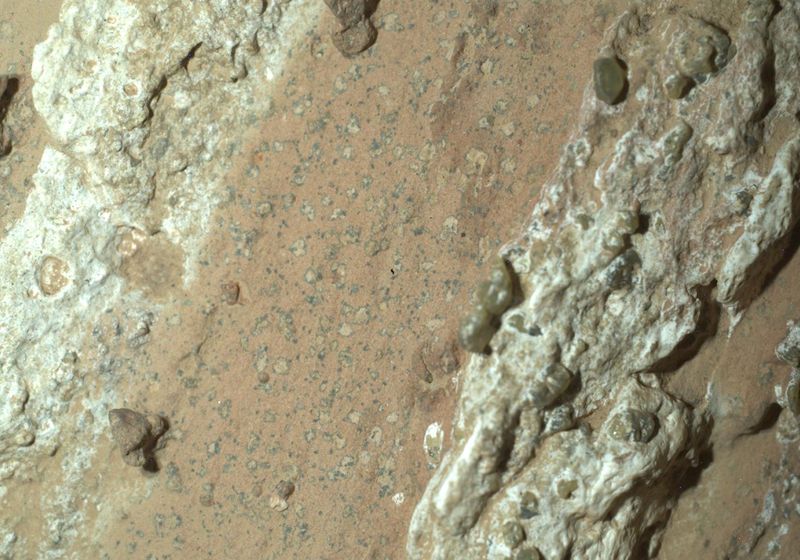
Rocks in a Martian crater held minerals that microorganisms produce, offering a potential biosignature for former life on the red planet.
Image credit:NASA/JPL-Caltech/MSSS
On the rocky, dusty surface of Mars, life and liquid water are absent as far as scientists can tell. However, researchers suspect that, long ago, rivers and lakes of liquid water covered the Martian surface, and they have been eager to determine whether life lived within them.
Since such life would likely have been microbial, scientists can’t look for fossils. Instead, they study the mineral makeup of the rocks left behind in ancient riverbeds to hunt for molecular clues of biological chemistry. Recently, results from one site provided the best evidence so far that living organisms once occupied some of the surface of Mars in the form of two minerals in the same location that they found organic carbon.1 This potential biosignature, published in Nature, excited researchers and Mars enthusiasts alike.
When living things metabolize nutrients into energy, they shuttle electrons around on different chemicals in what are called reduction-oxidation (redox) reactions. Humans and most other animals oxidize glucose and reduce oxygen, but microbes are more varied in their electron donors and acceptors. Some use metals, like iron and sulfur. When these compounds are reduced under the right conditions, they can react and form precipitates that can be detected later.
In 2020, NASA launched Perseverance, a rover that would drive around the rocky terrain and study areas of interest in Jezero Crater, which scientists hypothesize used to be a river. “The main goal of this mission is to try to understand whether or not Mars was once a habitable place,” explained Morgan Cable, a chemist at the NASA Jet Propulsion Laboratory and coauthor on the study.
In one region, Perseverance found a rock formation that had discolored spots that weren’t the typical red color of most Martian rocks. “Whenever we see things that are not red, a lot of times, that means it’s your different minerals or iron that has gained an electron that’s become reduced,” Cable said. The pattern of the spots also suggested to the researchers that chemical reactions formed the irregular masses rather than sedimentation, which would have formed layers of discoloration.
Using X-ray and Raman and spectroscopy, Perseverance identified two minerals (pink and green spots) on a Martian rock that provide a potential biosignature for former life on Mars.
NASA/JPL-Caltech
The craft studied the chemical composition of these spotted rocks using X-ray diffraction and Raman spectroscopy and found organic carbon in the same location as reduced iron in the form of iron phosphate and iron sulfide. Previous rover missions also identified phosphate deposits, but Perseverance used instruments that allowed it to study these minerals with spatial resolution.
“So they’re able to look at the relationship of the iron sulfide and the iron phosphate and see that they were formed together,” said Christopher House, a geochemist from Pennsylvania State University who was not involved in the study. “The iron got reduced. The sulfur got reduced. The phosphate got precipitated, all in some common process.”
Lyle Whyte, a polar microbiologist at McGill University who also wasn’t involved with the study, added, “We know of similar types of things that happen on Earth in a very Mars-like environments that are anaerobic [and] low temperature.” He studies some of these types of extremophiles in the Arctic circle.
“We know that these microbes, in fact, these so-called sulfate-reducing bacteria and iron-reducing bacteria are in the top 10 list of microbial suspects that could live on what is hypothesized to be the ancient Mars environment. So, it all kind of comes together sort of nicely,” Whyte said.
While this points toward these compounds being evidence for biological chemistry on Mars, these minerals can also be produced by abiotic processes, which the researchers acknowledged. “On Earth, we tend to see these [rock patterns] as being affected by microbes, but that’s only in places where we have lower temperatures and not very acidic conditions,” Cable said. “To eliminate abiotic hypotheses, we had looked to see, okay, well, could rock have been exposed to high temperatures?”
By studying the rest of the rock’s chemical composition and looking back at previous studies, the team concluded that it was unlikely that the area was exposed to these high temperatures.2 Additionally, one of the compounds was ferrous iron phosphate. “It’s a mineral that on Earth is always associated with very, very strongly reducing conditions because of organic matter being present,” House said. By analyzing the other minerals in the area, such as the presence of gypsum, an oxidized mineral, the NASA team determined that the river was not itself a reduced environment.
Whyte said that the study was exciting and that the team did a nice job of considering and excluding some nonbiological processes that could have produced the same minerals.
Referencing the late planetary scientist Carl Sagan about confirming life in another place after excluding all other possibilities, Cable said that’s what the team tried to do in their study. “So far, it looks like most of the explanations not involving life are not consistent with the data,” she said.
Although exciting, the researchers are far from concluding that microbial life definitively existed on Mars. Cable said that they want to confirm the findings with additional testing and sample more rocks in the area. Ultimately, the researchers’ goal is to return some rocky samples to Earth, where scientists can analyze the source of the carbon molecules.
Nonetheless, the findings bring researchers one step closer to understanding the possibility of life beyond Earth. “It’s really quite a wonderful story that this little spot on Mars tells us,” House said.
Cable agreed. “This helps us put a picture together of, billions of years ago, what might have been happening in a much warmer, wetter environment. And it’s only because we made these measurements together with these two completely separate instruments that we have this much more convincing story of what might have happened on Mars a few billion years ago,” Cable said. She added that, since much of this period is missing in Earth’s geological history due to tectonic activity eliminating those rocks, “Mars gives us a window into part of Earth’s past that has been erased.”
“There’s so many cool questions that we can really start to—not think about like in the sort of hypothetical—but start to do tests in the lab on some of these samples to try to answer. [It] is pretty exciting.”
