

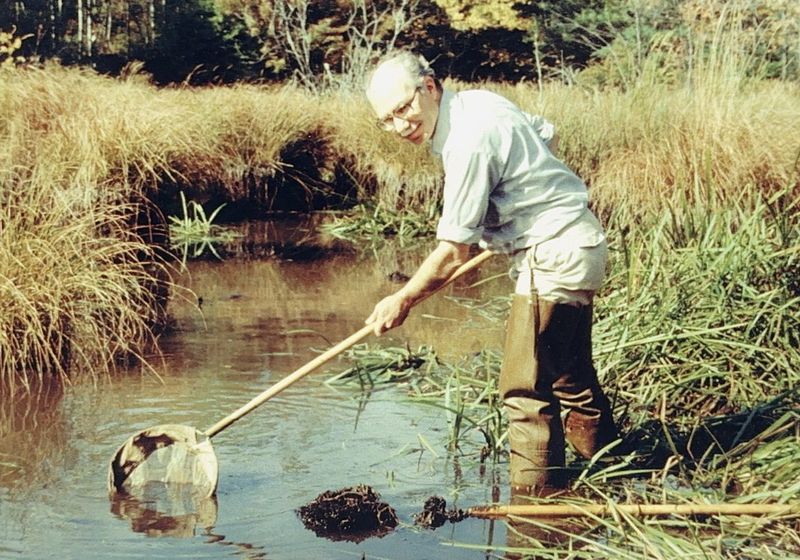
Joseph Gall, the father of modern cell biology, received the 2025 Golden Goose Award posthumously for the societal impacts of his basic research.
Image credit:Joseph Gall’s family
The Golden Goose Award ceremony took place this evening (September 16). The award, hosted and co-founded by the American Association for the Advancement of Science, recognizes federally funded research that may sound odd or silly at first but has led to notable societal benefits.
“[The Golden Goose awardees’] stories are great examples of how federal funding for fundamental research pays off,” said Barbara Snyder, president of the Association of American Universities, which co-founded the Golden Goose Award, during the ceremony’s welcome address.
One of this year’s awardees was the late Joseph Gall, whom many may know as the “father of modern cell biology.” Gall’s key contributions to science include the co-development of in situ hybridization, a technique that’s now routinely used to detect genetic abnormalities in various medical conditions, from Down’s syndrome to cancer.
Gall never formally trained in cell or molecular biology, but his background as an avid naturalist equipped him to investigate various biological phenomena in a wide range of organisms, such as frogs and pond scum. When Gall passed away last September, he left a lasting scientific legacy, embodied by both his published works and prolific mentees.
“His love for his work was inspired by nature, and he had such a detailed knowledge of it because he really loved reading,” said Zehra Nizami, a cell biologist at PartitionBio, a biotechnology company that develops new systems for drug delivery. Nizami worked with Gall for over a decade, first as a graduate student, then as a postdoctoral fellow.
Young Joseph Gall, a budding cell biologist, converted his bedroom into a laboratory to study the wildlife around him.
Joseph Gall’s family
Driven by his passion for the natural world, young Gall collected plants, insects, and frogs that lived around his family’s farmhouse in Northern Virgina. At 14 years old, Gall received his very first microscope from his father. Then, assisted by both of his parents and older brother, Gall turned his bedroom into a laboratory, where he perfected his microscopy techniques. Lacking a formal mentor, Gall relied on textbooks, nature, and his microscope to study the inner lives of plant and animal cells.
As a graduate student at Yale University in the early 1950s, Gall became interested in chromosome structures. He wanted to visualize giant chromosomes, called lampbrush chromosomes because of their shape, which are found in the egg cells of many animals, such as frogs and beetles. At the time, Yale University didn’t have the right kind of microscope to prepare and analyze these samples properly, so Gall, with the help of his uncle, built his own. Gall focused on lampbrush chromosomes for his thesis project, then continued to study these structures as a zoology instructor at the University of Minnesota.
Ten years after earning his PhD, Gall returned to Yale University as a professor. He immersed himself in molecular biology techniques and trained female scientists before either was considered common practice.
“Somebody noted how many students were women from Joe’s lab and named us the Gall girls,” said Susan Gerbi, a biochemist at Brown University and Gall’s former graduate student, in a recorded video.
Nizami, who joined Gall’s lab in the 2000s, didn’t experience this firsthand. However, through Gall’s decennial birthday celebrations, which were attended by many of his lab alumni, Nizami had gotten to know some of Gall’s female mentees who faced challenges in their scientific careers because of their gender—one of them was Gerbi. “They were astounded that Joe didn’t treat them differently,” Nizami said. “Joe always attributed it to his mom, who inspired his love of nature. He thought that was why he was so good about it, but I think he was just a really nice bloke.”

Joseph Gall was a cell biologist for about 70 years. He was widely respected by his colleagues and loved by his mentees.
Joseph Gall’s family
In 1969, Gall and his student, the late geneticist Mary-Lou Pardue, co-developed in situ hybridization while studying frog cells.1 This technique allows scientists to detect specific nucleotide sequences in cells using radioactive (and now fluorescent) probes. Today, both scientists and clinicians still regularly use in situ hybridization to visualize DNA or RNA in cells.
“That’s near and dear to my heart,” said Gerbi, who was diagnosed with breast cancer in 2006. Using in situ hybridization, scientists could detect extra copies of HER2, a cancer-causing gene. While this diagnosis was once fatal, it is now treatable by immunotherapy. But Gall couldn’t have foreseen these medical advances at the time, Gerbi said. Nizami agreed, “Joe developed [in situ hybridization] out of pure curiosity.”
In the mid 1970s, biochemist Elizabeth Blackburn, now at the University of California, San Francisco, joined Gall’s laboratory as a postdoctoral fellow. Gall advised Blackburn to use pond scum as a model organism for her research on telomeres, regions of repetitive sequences at the ends of linear chromosomes, which are often likened to protective plastic caps that prevent shoelaces from fraying.
Building upon her work in Gall’s lab, Blackburn went on to discover telomerase, an enzyme that replenishes telomeres to ensure that cells don’t lose valuable genetic information.2 Blackburn’s discovery of telomeres and telomerase eventually won her the Nobel Prize in 2009, which she shared with her then student, Carol Greider, now a molecular biologist at the University of California, Santa Cruz. Today, scientists still extensively study the roles of telomeres and telomerase, especially in the context of ageing and cancer.
“Joe derived great joy from his work, but he never squandered the trust that the public put in him,” Nizami said. “His research was funded by the government—by the people—and he was very keen on societal contributions and strongly believed in giving back.”
