

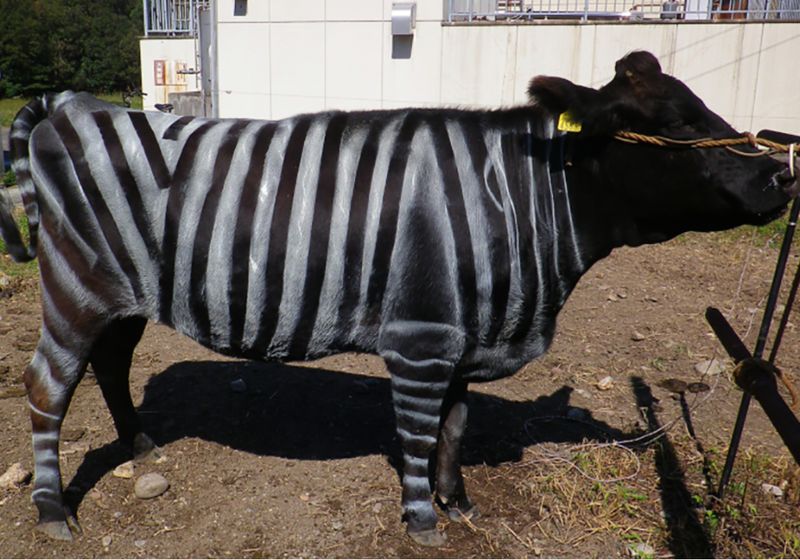
Japanese researchers received the 2025 Ig Nobel Prize in biology for showing that black cows painted with white stripes repel flies better than their counterparts that didn’t look like zebras.
Image credit:Tomoki Kojima et al., 2019, PLoS One, CC-BY 4.0
The 35th First Annual Ig Nobel Prize was announced on September 18, 2025. Ten prizes were awarded to researchers whose works “[make] people laugh, then think.” Considering this year’s “digestion” theme, at least one of the winning works—the physics of pasta sauce, fittingly also makes people hungry.1 The organizers also seemed considerate enough to mind the appetites of other species, such as the lowly biting flies.
The 2025 Ig Nobel prize in biology honored Japanese researchers who discovered that black cows painted with vertical white stripes were less desirable to biting flies than their counterparts that didn’t look like zebras.2 This work, led by Tomoki Kojima, a researcher at the Aichi Agricultural Research Center, may offer a more environmentally friendly way (than pesticides) to repel cattle pests. The researchers’ findings also support a leading theory on why zebras evolved stripes, an open question in wildlife research.
“I couldn’t believe it,” Kojima said about receiving the prize. “I thought I was dreaming.”
Farmers often prohibit Wagyu cows from grazing to avoid pests, such as biting flies, which could transmit diseases and stress cows to a point at which they’re unable to reproduce successfully. When a cattle farmer approached Kojima for advice on how to rid his Wagyu cows of flies, Kojima started racking his brain for ideas.
“One day, I learned from a TV program about the hypotheses regarding the function of zebra stripes,” Kojima shared. This led him to discover work by Tim Caro, an evolutionary biologist at the University of Bristol.
Inspired by a 2014 study which indicates that zebra stripes likely evolved to deter pests, Kojima painted black cows with white stripes to resemble zebras and hoped that it could help cattle farmers.
Sahana Sitaraman
In a 2014 study, Caro’s team evaluated correlations between zebras’ striping patterns and various environmental factors, such as climate and the distribution of large predators as well as pests.3 The researchers found that stripes likely evolved to help zebras deter pests, rather than hide from predators, cool themselves, or recognize each other. Their result aligned with previous reports by others, which indicated that flies tend to avoid black-and-white striped surfaces.4-7
Kojima wondered if cows coated with black-and-white stripes could be better at repelling pests. “[Caro’s] paper gave me the idea for our study,” he said.
To test this hypothesis, Kojima’s team recruited three black cows (Wagyu cows are often black). They painted one with white stripes, one with black stripes, and left one unpainted. The researchers touched up the painted cows’ stripes every morning for three consecutive days. Kojima’s team noted that freehand painting of zebra stripes only took about five minutes per cow.
For 30 minutes twice a day (in the morning and evening), the researchers observed the cows and counted fly-repelling behaviors, such as head throws, leg stamps, and tail flicks. At the end of each observation period, the team took pictures of the cows so they could count the numbers of flies that landed on the cows’ bodies and legs.
The researchers did these two more times so that each cow experienced all three conditions. Then, a year later, to increase the study’s sample size, the team recruited three more black cows that weren’t part of the previous year’s experiment.
Kojima’s team found that the cows with painted white stripes had significantly fewer flies on their bodies and lower frequency of fly-swatting behaviors than the other two groups of cows. This indicates that zebra-like appearance could indeed make cows less attractive to biting flies. Why? Some researchers speculate that black-and-white stripes visually confuse flies, making them less likely to approach, but Kojima believes further studies are needed to reach a conclusive answer.
Since Kojima’s work came out in 2019, Japanese farmers have put their unusual method to the test. Kojima’s team chose short-lasting paint in their experiment so they could easily switch between treatments on each cow, but the farmers used paint that could last for more than a month.
“I don’t think there are potential health hazards [from paint],” Kojima said, as researchers and farmers commonly paint cattle to be able to identify them from a distance. He added, “[Painting] is a cheap, easy, and animal welfare-friendly method.”
“I was skeptical at first, but I was really surprised that no insects came,” a cattle farmer said in their three-year survey response, reported by the Japanese daily newspaper Asahi Shimbun in 2024. “There was no bullying from other cows, which I was worried about.”
Turns out, as funny as they may look, the zebra cows may not be laughingstock after all.
