

Study highlights functional preservation in patients and signals the potential for pre-symptomatic intervention.
For decades Huntington’s disease has stood as both a genetic certainty and a model of accelerated cellular aging; new clinical trial data now show that decline can be delayed. Results released by uniQure demonstrate that AMT-130, an experimental gene therapy delivered in a single neurosurgical session, slowed clinical progression by 75 percent over three years in treated patients [1].
The pivotal Phase I/II study compared treated patients with propensity score-matched external controls from the Enroll-HD dataset. High-dose AMT-130 met its primary endpoint, showing a statistically significant slowing of disease progression at 36 months on the composite Unified Huntington’s Disease Rating Scale (cUHDRS). The therapy also met a key secondary endpoint by slowing decline on Total Functional Capacity (TFC) and showed favorable trends across a wider battery of cognitive and motor measures [1].
Longevity.Technology: Huntington’s is often described as a genetic curse, but the disease also carries the hallmarks of accelerated aging – mitochondrial dysfunction, DNA damage and cellular wear that echo wider geroscience themes. In patients and in models of the disease, markers of accelerated cellular aging have been observed, suggesting that aging biology is not just a parallel process but an active contributor to onset and progression. That is why today’s announcement matters beyond a single rare condition: a 75% slowing of progression demonstrates that neurodegeneration can be modified, and that function – mobility, cognition, independence – can be preserved. The challenge now is access; this is complex, costly neurosurgery, not a pill. Yet as a proof-of-principle, it changes the conversation: preventive gene therapy in at-risk individuals, and by extension the broader slowing of age-linked neurodegeneration, has moved from aspiration to evidence.
Professor Sarah Tabrizi, professor of clinical neurology, director of the University College London Huntington’s Disease Centre and joint head of the department of neurodegenerative disease, said: “I am thrilled that this pivotal study of AMT-130 showed statistically significant effects on both cUHDRS and TFC at 36 months, supported by mean CSF NfL remaining below baseline. I believe these groundbreaking data are the most convincing in the field to date and underscore potential disease-modifying effects in Huntington’s disease, where an urgent need persists. These data indicate that AMT-130 has the potential to meaningfully slow disease progression – offering long-awaited hope to individuals and families impacted by this devastating disease.”
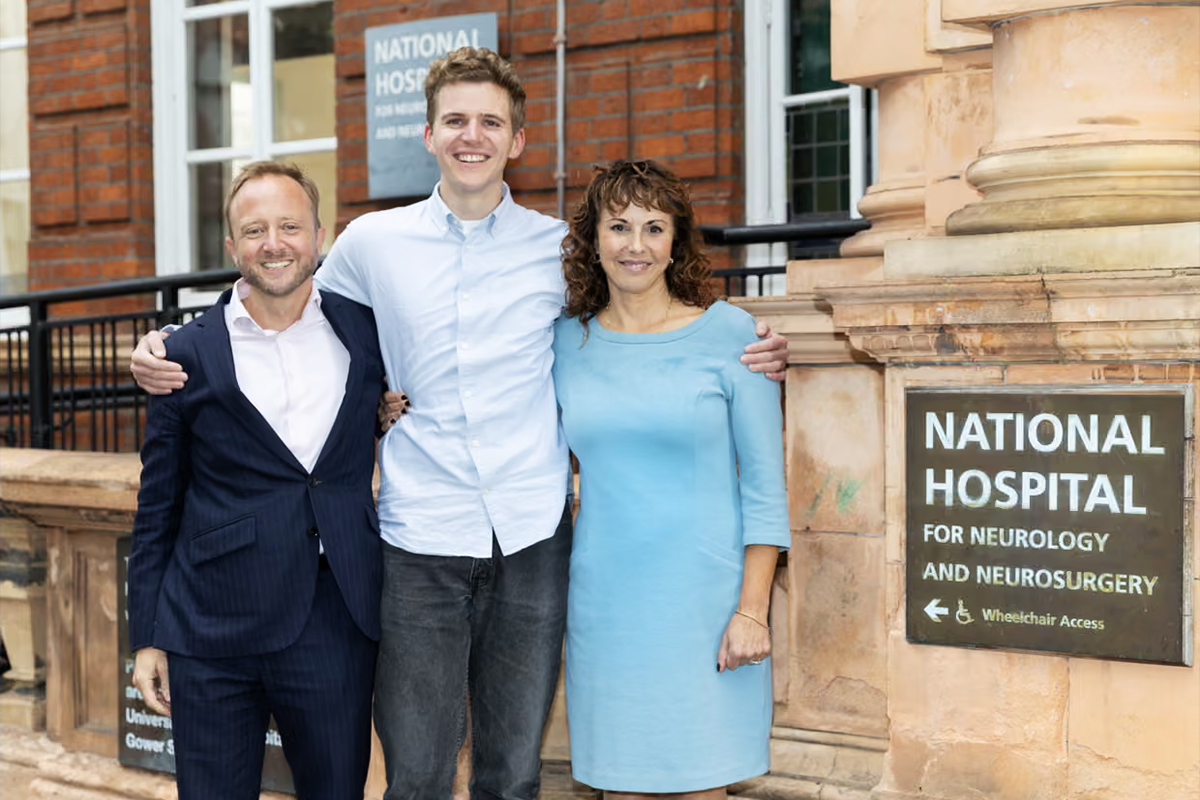
Professor Edward Wild, consultant neurologist at the National Hospital for Neurology and Neurosurgery, UCLH, added: “This result is the good news we’ve been working and waiting for: not just a treatment that slows progression of this terrible disease, but one that does so with truly stunning effectiveness. It is nothing less than the dawn of a new age for families impacted by Huntington’s disease. We must now work no less diligently to turn this breakthrough into something that benefits everyone who needs it.”
How the therapy performed
Patients who received the higher dose of AMT-130 declined far more slowly than those in matched control groups. On the main measure of disease progression, decline was reduced by three-quarters; on functional capacity, the slowing was around 60 percent. Tests of cognition showed striking preservation, with patients performing better on tasks of symbol recognition and word reading compared to the decline expected at this stage of disease. Motor function also trended in a favorable direction [1].
Crucially, levels of neurofilament light chain in cerebrospinal fluid – a biomarker that rises as neurons die – fell rather than rose, suggesting that the therapy is protecting brain cells as well as preserving outward function [1].
Safety and regulatory pathway
AMT-130 was generally well tolerated, with no new drug-related serious adverse events since late 2022. The most common side-effects were procedure-related, including transient headaches and inflammation, all of which resolved.
“We are incredibly excited about these topline results and what they may represent for individuals and families affected by Huntington’s disease,” said Walid Abi-Saab, MD, chief medical officer of uniQure. “These findings reinforce our conviction that AMT-130 has the potential to fundamentally transform the treatment landscape for Huntington’s disease, while also providing important evidence supporting one-time, precision-delivered gene therapies for the treatment of neurological disorders.”
uniQure plans to submit a Biologics License Application to the US Food and Drug Administration in the first quarter of 2026, aiming for a US launch later that year, pending approval; European and UK discussions are expected to follow. The therapy has Breakthrough Therapy and RMAT designations from the FDA, potentially smoothing regulatory review.
Financing future access
In parallel with the trial announcement, uniQure disclosed a $175 million non-dilutive loan facility with Hercules Capital, extending existing debt to 2030 and unlocking additional funds tied to regulatory and financial milestones. Management framed the financing as enhancing flexibility to fund the potential commercial launch of AMT-130 in 2026 [1].
A wider horizon
For clinicians, the immediate advance is a therapy that shifts the slope of decline; for patients, it offers more years of independence and preserved function. Yet the broader horizon is prevention: Tabrizi and colleagues are preparing to study mutation carriers who have not yet developed symptoms, raising the prospect of delaying or averting onset altogether.
Such strategies resonate with longevity science more broadly – intervening before damage accumulates rather than managing decline once established. Huntington’s may be a rare genetic disorder, but today’s data set a precedent: age-linked neurodegeneration can be slowed, neuronal death moderated, function preserved.
Beyond inevitability
Huntington’s disease has long epitomized inevitability, but AMT-130 shows that fate can be altered. The procedure is invasive, the cost will be high and global access uncertain, yet the principle has been established – neurons need not be left to die on schedule. For geroscience, the implications stretch beyond Huntington’s: accelerated aging processes are visible across many neurodegenerative conditions, and therapies that modify those processes could reshape not only rare genetic disorders but the wider landscape of age-related decline. That horizon remains ambitious and uncertain, yet it feels closer than it has ever been.
