

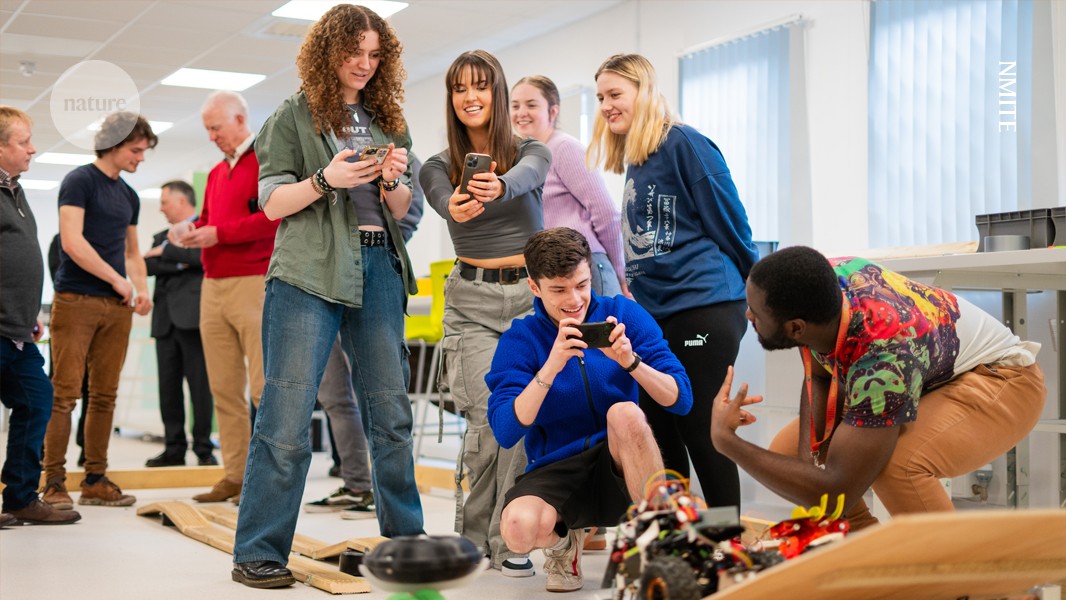
Teamwork and hands-on learning underpins NMITE’s pedagogy ethos.Credit: NMITE
Eight hundred years ago, a group of scholars walked out of the University of Oxford after a bitter and violent dispute with local townspeople. At a fork in the road, the scholars might have turned left and founded a university in Hereford, a cathedral city 106 kilometres away. Instead, they turned right and established the University of Cambridge, triggering an academic rivalry between the two institutions that endures to this day.

The future of universities
“It’s a fun ‘what if’,” said Jesse Norman of this apocryphal story about a university that might have been.
Norman, the Member of Parliament for Hereford, UK, recounted the tale in May at the inaugural graduation ceremony of the New Model Institute for Technology and Engineering (NMITE), which welcomed its first intake of 27 students to its Hereford campus four years earlier.
The institute is trying something rare in UK higher education. It is building a new kind of university from the ground up — one that promises to address the skills shortage in engineering, rebalance regional access to education and rethink how engineering is taught in a city with one of the lowest university participation rates in England.
“Broadly speaking, the approach to learning at NMITE is directly against the traditional wisdom in the higher-education system,” says Norman, who campaigned for the university to be set up and became its chair in January. “We don’t chase international students. We focus on raising the skills and intellectual achievement of kids in Britain.”
NMITE is not, and did not set out to be, a research-intensive institution; instead, it concentrates on undergraduate teaching, industry-led projects and preparing graduates for immediate employment.
It now has around 50 members of staff. Almost all live locally; most of the administrative staff members have long been based in the area, whereas most of the academic employees relocated to join the institute. NMITE offers a small number of specialist degrees — currently integrated bachelor’s and master’s in engineering. The latter is designed to meet the UK Engineering Council’s Chartered Engineer requirements and is delivered as an accelerated programme, taking three years instead of the usual four.
It’s about dealing with what James Newby, the chief executive, sees as a paradox at the heart of UK higher education: “There’s a national crisis, almost, in the UK in skills.”
Universities are — and must continue to be — a force for good
The problem has been documented for years: the Department for Education’s Employer Skills Survey 2022 found that UK skill shortages accounted for 36% of vacancies, up from 22% in 2017. At the same time, many graduates are in roles that do not require a degree. The expansion of higher education from 1997, under the government of then-prime minister Tony Blair, included a target of having 50% of young people at university, a milestone reached in 2017, ten years after Blair left office. But some critics argue that this placed too much emphasis on academic degrees as opposed to vocational training. In 2023, 20% of working-age UK graduates were in low-skilled employment.
“We didn’t want a university that’s the same as all the others,” Newby says. “There’s plenty of capacity in the sector for people who want to do a traditional degree in the traditional way. We wanted that regional impact, but we definitely wanted to be a national higher education disruptor.”
The tried-and-tested model isn’t necessarily working for UK institutions: more than 43% of higher-education providers in England expect to run a financial deficit for 2024–25 (see go.nature.com/4n3s8m9), according to the UK Office for Students (OfS).
There are worries that the declining financial performance of universities, because of poor international student recruitment coupled with rising staff and infrastructure costs, could lead to institutions going bust. Could a more innovative model be what the sector needs?

Elena Rodríguez-Falcón (far left) with staff and students on NMITE’s opening day in 2021.Credit: NMITE
This backdrop prompted Norman to join with two local entrepreneurs to create the organization that became NMITE — and secure £15 million (US$20.4 million) in start-up funding from the Department for Education, with £8 million coming from the Marches Local Enterprise Partnership, a regional development fund. NMITE launched in 2013 as a company limited by guarantee (a business structure typically used by non-profit organizations). In 2020, it became a regulated higher-education provider under the OfS. In 2021, after the pandemic paused its opening by a year, NMITE welcomed its first students. Two years later, it was granted its own degree-awarding powers and attracted 55 students that year.
Universities under fire must harness more of the financial value they create
NMITE’s first chief executive and president Elena Rodríguez-Falcón, who joined NMITE in 2018 from the University of Sheffield, UK, embodies what the institution aims to do. Originally from Monterrey, Mexico, she graduated in engineering and then became the only female employee in a factory of 200 blue-collar workers, where she recalls being teased for a couple of weeks. At the time, she described herself as an engineering graduate rather than an engineer. That distinction was reinforced during her time at Sheffield, where one of her roles was director of ‘enterprise education’ — an approach that encourages students to consider developing innovative products and services with economic and societal benefits. “Speaking to hundreds of companies, one thing they said to me was: you send us engineering graduates, and we have to train them again. They’ve done three years at university, and we still have to put them through a graduate scheme because they’re not engineers yet.” The realization shaped NMITE’s ethos: to produce work-ready graduates from day one.
The best way is to learn by doing, she says. “Authentic learning, experiential learning is the best pedagogy.”
The team looked for pedagogical inspiration globally, and a key influence was Olin College of Engineering in Needham, Massachusetts. The college welcomed its first faculty members in 2000 and was established to address a dearth of engineering students with exposure to enterprise education, in a country where, according to Rick Miller, Olin’s founding president, students “are taught about engineering, not to be engineers”. Those who flunk out of engineering don’t do so because the subject is too hard, but because they’re bored, argues Miller, who led Olin for 21 years. An early experiment, he says, was asking a team of 18-year-olds to design, build and demonstrate a pulse oximeter, a device that measures pulse rates and oxygen saturation levels in blood. “They didn’t even know what it was. Five weeks later, they had it working,” says Miller.
NMITE chose to focus on engineering because of its local relevance and national urgency. “The industrial ecosystem of the area is heavily based around engineering and technology,” says Newby, adding that many of the firms are small and medium-sized enterprises, including some in the defence and security sector.
What’s more, Newby says, engineering is “the sector nationally that’s been most vociferously complaining about the quality and work readiness of the graduates the traditional sector produces”.
NMITE’s model lends itself to people who think differently and want to be taught differently, says Rhys Morgan, director of education and skills at the Royal Academy of Engineering in London. The programme at NMITE is “not that kind of mathematically hardcore course” offered by the universities of Cambridge or Southampton or by Imperial College London, he adds. “It’s inherently more practical.”
That makes for more-flexible graduates, and a more-flexible workforce helps with pinch points across the system, he says.
A new teaching model
NMITE’s accelerated master’s programme is focused on learning by doing, with a curriculum co-designed with industry to prioritize real-world challenges.

The great university shake-up: four charts show how global higher education is changing
The approach means that there are no conventional lectures and no drifting between classes — students spend their days in a single studio space, working in small teams with educators moving between them. Morgan describes the academics’ role as that of a “guide on the side” rather than a “sage on the stage”. The year is broken into three intensive terms of eight-week ‘sprints’ with short breaks in between, meaning that it resembles a professional schedule more than it does a campus calendar. Attendance is closely monitored — the minimum requirement is 80% — and studying remotely is agreed on only in exceptional circumstances.
What’s more, the admissions process is designed to be inclusive. “We take the view that talent is evenly distributed around the country, but opportunity isn’t,” says Norman. “We select for drive, passion and resilience — not just grades.”
Unusually for undergraduate engineering programmes, students don’t need to have mathematics and physics A-levels (the qualifications typically taken at age 18 at most UK secondary schools). “We’ve found that people without that academic preparation can still make great engineers,” he says.

A graduation procession at NMITE earlier this year.Credit: NMITE
This policy could help to attract female candidates. In 2020–21, the proportion of female students enrolled in engineering and technology courses was just 18.5% at UK universities, and for other higher-education engineering and technology courses, such as diplomas, just 14.6%, according to research by the non-profit organization EngineeringUK in London (see go.nature.com/3jzr5yn). This under-representation is linked in part to subject choices at school — in England, Wales and Northern Ireland, female students make up only 23.1% of those taking A-level physics and 37.2% of those taking A-level maths.
At NMITE, women currently make up only 16% of its small student body, but that is “a work in progress” as the university gains momentum and reputation, Newby says. Enrolment of female students is expected to rise to more than 20% when the next cohort joins this month, following a substantial increase in applications from women.
Another of NMITE’s distinctive features is the use of block learning. Students focus intensively on one module at a time in eight-week sprints, rather than taking several modules at once, as in most institutions.
How universities came to be — and why they are in trouble now
“They’re not working for two hours in the morning on one topic and then moving to the next that afternoon,” says Newby. The NMITE approach “just drives much faster learning gain”, according to Newby, and the students can “fail in a safe place, they break things, and they learn things”.
David Helfand is an astrophysicist and block-learning pioneer who helped NMITE to adapt the model to engineering. “Some students who cannot operate in the ‘four or five courses at a time’ system just thrive in this system,” he says, adding that there are “precious few opportunities” at the moment to implement this approach in higher education.
From day one, NMITE students also work closely with employers in small teams on hands-on projects. Effectively, the industrial partner becomes a client and the students work to the client brief.
NMITE’s short teaching blocks allow educators to experiment and adapt quickly, creating space for innovation that conventional universities often struggle to accommodate. “It’s just very easy to slip into a routine,” says Helfand. “But the world, of course, changes around you and you can’t do that and remain relevant” and of value to students.
Assignments range from presentations and reports to creating prototypes. “We don’t assess by traditional exam,” says Newby. “But we obsess about academic quality — we are academically rigorous and vocationally relevant at the same time.”
The COVID-19 pandemic led Newby and others at NMITE to conclude that its teaching had to be in person and hands-on. “Across the rest of the sector, universities developed and invested in ways of teaching at a distance,” he says, but he questions whether this delivers the right level of quality and student experience.
Rodríguez-Falcón summarizes the approach as “9 to 5, 5 days a week, 46 weeks a year — like a job. No lectures. No exams. No A-level maths requirement. You learn by working through problems.”
Working with industry
The integration with industry is not “a bit of curriculum enrichment, but absolutely embedded in the curriculum”, Newby says. NMITE works with more than 80 industry partners across its degree programmes, ranging from small to medium-sized enterprises to major infrastructure companies. So far, partners have included the beer-maker Heineken, technology giant Microsoft and telecoms firm Virgin Media, as well as many more local businesses.
Projects span defence, energy, construction and agrotechnology. Students work directly with mentors, simulate client meetings and collaborate “with industrial partners from the first day of the programme to the last, and every day in between”, says Newby.
