

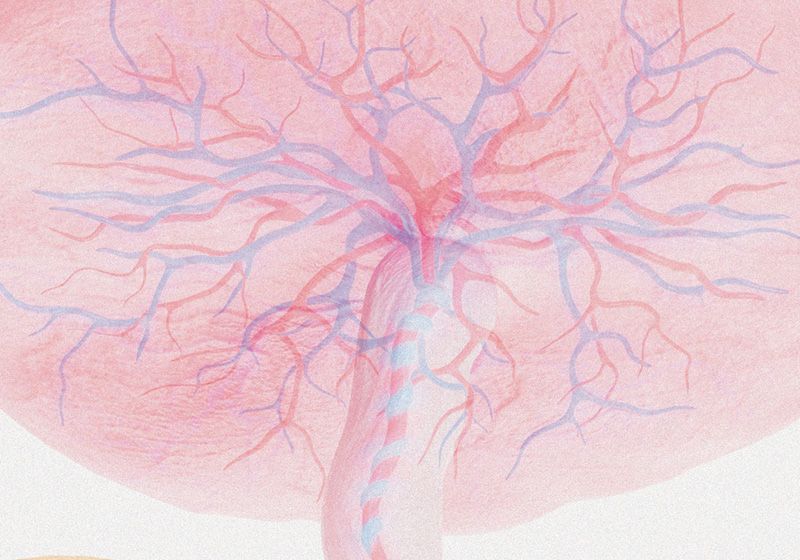
The placenta, with its branching blood vessels, is the interface where maternal and fetal cells meet to determine how far the placenta can implant into the uterine wall.
Pregnancy has long been framed as an evolutionary tug-of-war. The fetus presses for resources, while the mother mounts defenses to limit invasive placentation. A new study in PNAS challenges that view, reframing placental implantation as “coopetition,” a game-theory term for simultaneous competition and cooperation in the hope of mutually beneficial results.1 The shift could explain why some pregnancies succeed or fail, offering clues to disorders like preeclampsia.
“It started out as a random observation—when we grew maternal cells together with fetal cells, the maternal cells seemed to partially lose their pregnancy-prepared state,” said Yale University evolutionary biologist Günter Wagner, the co-corresponding author of the study. His collaborator Kshitiz at the University of Connecticut added, “The fetal trophoblasts had reversed the changes acquired by maternal cells in anticipation of pregnancy.”
From Placental Tug-of-War to Truce
For decades, scientists have explained pregnancy through the lens of maternal-fetal conflict. In this view, fetal cells invade to draw resources, while maternal tissues evolve countermeasures to limit invasion. Humans and great apes, with their unusually deep placental penetration, have been a focus of this debate.
A key part of the mother’s defense is decidualization—when uterine cells transform to stiffen tissue, thicken the matrix, and block trophoblast penetration. This evolved resistance explains why placentation ranges from invasive in humans and apes to noninvasive in many hoofed mammals. “Our previous work has shown that decidualized maternal cells resist invasion by fetal cells,” Kshitiz noted. It was therefore striking to find the maternal program could be undone.
When Maternal Defenses Switch Sides
The team investigated these interactions using decidualized stromal fibroblasts co-cultured with extravillous trophoblasts (EVTs), which are fetal cells that invade the maternal tissue to anchor the placenta. Whether the EVTs came from the primary placenta, stem cell-derived cultures, or a cell line, they reversed the resistant state of maternal cells. Instead of bolstering defenses, stromal cells produced enzymes to break down their own matrix.
To understand how fetal cells reprogrammed the maternal defenses, the team examined the signals driving this interaction. They found that interleukin-11 (IL-11), a signaling molecule secreted by EVTs, drove the process. In response, decidual cells boosted the expression of suppressor of cytokine signaling 3 (SOCS3), a protein that redirected IL-11 signaling to activate the transcription factor activator protein 1 (AP-1). This triggered the expression of genes for tissue-degrading enzymes. The researchers also found that a feedback loop exists: IL-11 boosts its own production in stromal cells via AP-1, sustaining the matrix-degrading state.
“Decidual cells were understood to protect the mother from deep placental invasion,” Wagner said. “But they can also promote invasion.” Kshitiz added, “Once prepared to resist, the maternal cells reverse their defenses when they meet the invaders. It is as if they become a betrayer to their own stated cause.”
The researchers called this the coopetition theory of implantation. Decidualization builds a defensive wall, yet fetal signals can persuade maternal cells to lower the drawbridge, creating a negotiated pathway for invasion rather than a unilateral assault.
Implications for Pregnancy Outcomes
The reframing carries both evolutionary and clinical weight. “The conflict perspective on human pregnancy is too limited,” Wagner said. He and colleagues argued that highly invasive placentation in great apes reflects not only fetal innovations but also maternal co-adaptations—a maternal switch in intracellular signaling that facilitates invasion when appropriate.
“The study adds another dimension to our understanding of the maternal-fetal relationship,” said Yoel Sadovsky, a placental biologist at the University of Pittsburgh who was not involved in the study. “The key advance is the identification of signals that allow fetal cells to cooperate with maternal decidual cells to optimize invasion. Optimized invasion benefits both the mother and the fetus, since inadequate invasion is a hallmark of preeclampsia and fetal growth restriction.”
Because the researchers pinpointed IL-11 and SOCS3 as the molecular levers of this switch, the work suggests that failures in the same pathway could underlie such disorders. The authors also noted parallels to other invasive processes. Like decidual cells, stromal cells in tumors can resist or aid cancer spread, and the EVT-decidual interaction mirrors how cancer cells coax their microenvironment to enable invasion.
Taken together, the new findings provide molecular detail for a middle ground between hostility and harmony at the maternal-fetal interface. The next challenge will be to explain what reins in this switch and how it is tuned in healthy pregnancies. Sadovsky added, “And can the process be pharmacologically regulated to optimize pregnancy outcome?”
