

You have full access to this article via your institution.
Hello Nature readers, would you like to get this Briefing in your inbox free every day? Sign up here.
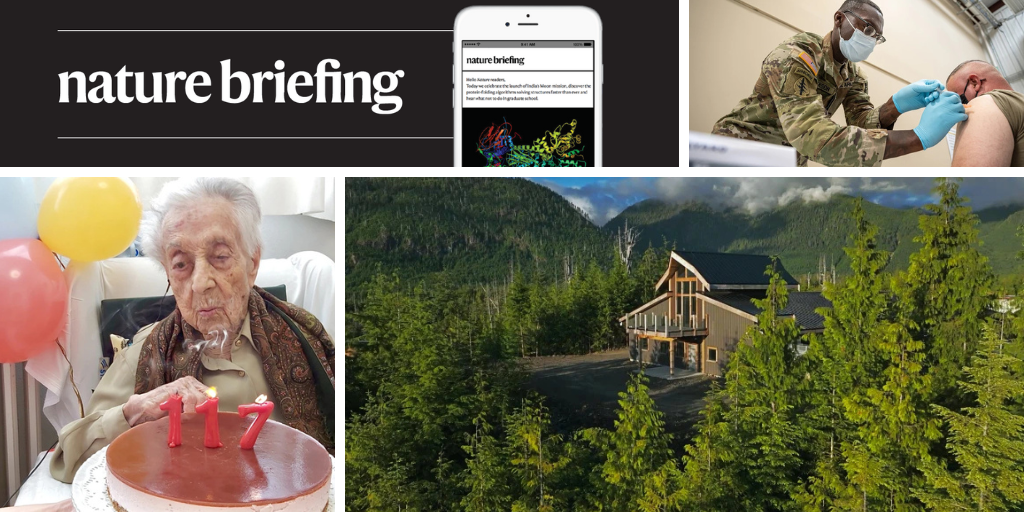
Maria Branyas Morera had been verified as the oldest living person when she died last year at age 117.Credit: Xavier Dengra (Public Domain)
A healthy diet and a bit of genetic luck helped Maria Branyas Morera live to the grand old age of 117. Before she died, researchers found that Branyas had genetic variants known to protect against cardiovascular disease, and none that increased risk of deleterious conditions such as Alzheimer’s. Blood tests also revealed she had few inflammation markers and a strong immune system. Lifestyle choices probably also contributed to Branyas’s longevity, says physician and study co-author Manel Esteller. “Our genes are the cards in a poker game,” Esteller says. “But how we play them is what really matters.”
Reference: Cell Reports Medicine paper
The US Department of Defense is still funding the development of mRNA vaccines, despite the Department of Health and Human Services (HHS) abruptly terminating funding for the same research last month. Among the beneficiaries are programmes developing vaccines against the virus that causes Crimean–Congo haemorrhagic fever, a deadly tick-borne illness. That such projects can still receive government funding is a relief, says infectious-disease researcher Amesh Adalja, but the HHS’s rejection of the technology still threatens national and global preparedness for emerging pathogens.
A species of Japanese dogbane (Vincetoxicum nakaianum) mimics the odour of injured ants to tempt the flies that feed on the insects to pollinate them. Botanist Ko Mochizuki noticed that flies were attracted to dogsbane, and found that the plant produces several scented chemicals that are also in ants’ pheromone SOS calls to their nestmates — the first evidence of plants copying ants.
Reference: Current Biology paper
A judge in New York has ruled that the use of cutting-edge DNA sequencing can be used as evidence in a case against an alleged serial killer. The technique, called whole-genome sequencing (WGS), was used to sequence tiny amounts of DNA in hairs found on the victims. The sequence was then analysed for single-letter variations in the genetic code, which can be used to pinpoint an individual person’s unique pattern. The judge’s ruling could allow the DNA samples previously considered too minuscule to be re-analysed with WGS to solve cold cases.
Features & opinion
Nature used machine-learning tools to attempt to reproduce the way in which the US National Institutes of Health cancelled grants under US President Donald Trump, and then applied it to past grants to reveal the broad-reaching consequences. Looking at around 48,000 NIH grants that were active in 2014, the algorithm found 1,287 grants that it considered likely to be cancelled — the science that might never have been born. The highly-cited studies that resulted from these grants included a seminal paper showcasing the results of the Human Microbiome Project.
In the 1970s, paediatric infections-disease researcher Carol Baker first suggested that group B streptococcus (GBS), or Streptococcus agalactiae, were causing stillbirths and killing newborn babies. Fifty years later, a phase III trial is investigating the efficacy of a vaccine for pregnant women to protect against GBS. If approved, the vaccine “could have a major, major public health impact”, says vaccinologist Shabir Madhi, particularly in sub-Saharan Africa. But the road has been bumpy — it took Baker and her colleagues 20 years to develop a workable vaccine, and for years after that pharmaceutical companies deemed the market too small for investment.
When physicist Maneesh Jain started his genomics company ParAllele — a clever combination of ‘parallel’ and ‘allele’ to reflect its work on mutations in the human genome — he learnt the hard way that interesting monikers don’t always get the message across. “Unfortunately, most often, people would call up and say, ‘Oh, hello, is that Paralegal?’,” he says. For her tech startup, materials scientist Julia Carpenter drew inspiration from the classics and her PhD research on metal foams to create a name: Apheros. “Even though it’s a made-up word, it’s short enough that people can remember it,” says Carpenter.
Nature | 2 min read & Nature | 4 min read
These articles are the first in a six-part series in which science-company chief executives describe how they landed on a name that resonates with customers, colleagues and investors.
Today I’m looking forward to the weekend, and not just because I’ll have two days off work. This Saturday is a mathematically special date.
Saturday 27 September is a ‘square date’ — written out in numerals, 27,092,025, the date is a square number (the square root is 5205, if you aren’t a human calculator).
For those of you across the pond thinking ‘but that isn’t how I write the date’, fear not, you’re also included. The alternative arrangement, 9,272,025, is also a square number, which makes it a rare example of a ‘global square date’. Mark your calendars!
While I plan for the next global square date (New Year’s Day 2036), why not send us your feedback on this newsletter? Your e-mails are always welcome at briefing@nature.com.
Thanks for reading,
Jacob Smith, associate editor, Nature Briefing
With contributions by Flora Graham
• Nature Briefing: Careers — insights, advice and award-winning journalism to help you optimize your working life
• Nature Briefing: Microbiology — the most abundant living entities on our planet — microorganisms — and the role they play in health, the environment and food systems
• Nature Briefing: Anthropocene — climate change, biodiversity, sustainability and geoengineering
• Nature Briefing: AI & Robotics — 100% written by humans, of course
• Nature Briefing: Cancer — a weekly newsletter written with cancer researchers in mind
• Nature Briefing: Translational Research — covers biotechnology, drug discovery and pharma
