

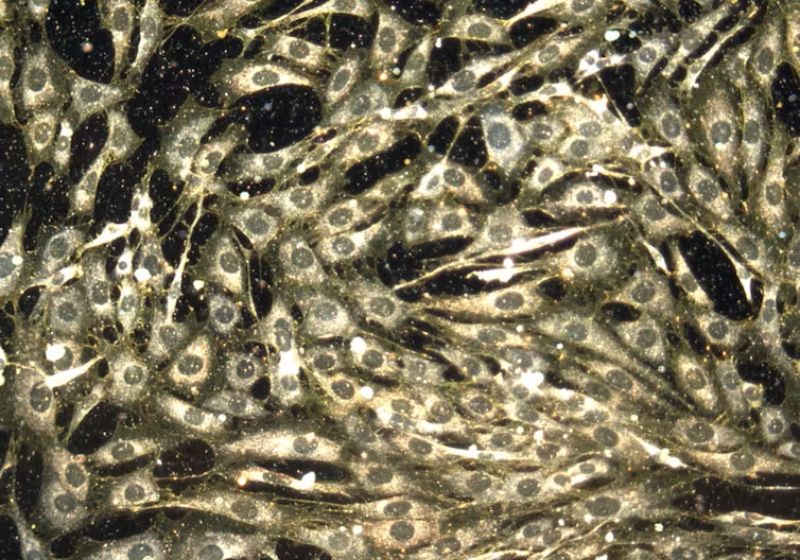
Researchers are studying the potential of gold nanoparticles (yellow dots) to deliver drugs into the body.
Image credit:Veronika Sapozhnikova, Konstantin Sokolov, Rebecca Richards-Kortum/M.D. Anderson Cancer Center and Rice University via NIH/Flickr
When the first cells appeared on Earth approximately 3.8 billion years ago, viruses were already here to greet them.1 Ever since, viruses have been devising ways to infect cells, and cells have been responding by evolving ways to stop these infections. This evolutionary dance eventually led to the development of your immune system.
A key aspect of your immune system is to distinguish “self” from “nonself” so it can destroy and remove foreign materials from your body.2 While this immune reaction protects you from viruses, it also has implications for how well foreign materials such as medications work.
I am a researcher studying ways to make drugs work better, including how to get them to the site of disease within the body before being removed or destroyed. One way to do this is to encapsulate drugs in nanoparticles – materials small enough to be taken up by cells. While these materials still trigger an immune response to get them out of the body, scientists like me have found that this reaction could actually be used to improve the effectiveness of cancer treatment.3
The Immune System and Drug Delivery
In addition to detecting pathogens, your immune system also responds to tissue damage. You might observe this reaction as inflammation – such as redness and swelling – when drugs are injected into your body with a needle.
Typically this inflammatory response is minimal. But the potential for a sustained reaction increases when drugs are administered slowly over a prolonged period of time, such as during chemotherapy infusions that can take an hour or more. For this reason, some patients are given anti-inflammatory medications before infusion to reduce the potential for an adverse immune response during treatment.4
The most recent breakthroughs in getting drugs into the body is using nanoparticles. These materials – which can be made from lipids, proteins, gold or other components – have the advantage of being very small: The diameter of a typical nanoparticle is about 10-thousandths of a millimeter. Their small size allows diseased cells to easily take them up. So when nanoparticles contain drugs, they can act as a drug delivery system.
Despite being so small, nanoparticles can hold a large number of drug molecules, allowing them to deliver a potent cargo of treatment directly into a cell. They can also deliver drugs made of DNA and RNA.5 The most well-known example of this technology is the COVID-19 vaccine, which uses nanoparticles made of modified fat molecules to deliver mRNA that teaches the immune system to protect itself against COVID-19 infection.
Your innate immune system also identifies nanoparticles as foreign invaders when they are injected into your body. As a result, some patients experience an initial inflammatory reaction when the body tries to attack the nanoparticle.
But what if this reaction could actually be used to improve treatment?
Exploiting the Innate Immune Response
For the past 30 years, my laboratory at the University of Colorado has been studying how nanoparticles deliver drugs. More recently, we have focused on understanding how the innate immune system responds to an injection of nanoparticles. While this immune reaction is typically considered a drawback, we wanted to explore whether it could enhance therapy.
In a 2022 study on how nanoparticles affect the immune response in mice, we found that the innate immune response triggered by an initial dose of nanoparticles carrying a drug will also reduce the effects of a second dose if it is injected shortly afterward – typically within days.6 It does this by clearing the drug out from the body more quickly. This reaction is similar to how an initial viral infection would trigger a short-term protective response against a subsequent infection from another virus.
One critical aspect of this protective effect involves the production of a protein called interferon lambda.7 This molecule “interferes” with the infection process by restricting viruses from gaining access to different tissues in the body. Researchers have previously tested this protein as a potential antiviral drug to treat COVID-19.8
Similarly, the interferon lambda made in response to the first dose of nanoparticles limits the ability of the second dose to deliver the drug to healthy tissues in the body.9 However, it did not affect the nanoparticle’s ability to access tumors, possibly because tumors can impair the immune response.10
In conventional cancer treatment, chemotherapy drugs are used to kill the tumor. Because these drugs are also toxic to healthy cells, patients often experience side effects such as hair loss, gastrointestinal problems and skin rashes. Using nanoparticles to deliver cancer treatment could help reduce these side effects, and combining them with interferon lambda could allow the nanoparticle-encapsulated drug to stay in the body long enough to have its full effects.
Our team is studying whether directly injecting interferon lambda before chemotherapy with nanoparticles could help limit the amount of drug that ends up in healthy tissues while increasing their concentration in tumors.3 In an initial test of this strategy in mice with colon cancer, all mice that received interferon lambda saw increased survival time and reduced weight loss. A better understanding of how this effect happens could help researchers eventually test this approach to cancer treatment in human patients.
Scientists have a long way to go in developing nanoparticles that are as efficient as viruses at getting into cells. But our hope is that exploiting an immune response that evolved approximately a billion years ago to prevent viral infections could help reduce the toxic side effects from treatment while improving its effectiveness.
Tom Anchordoquy, Professor of Pharmaceutical Sciences, University of Colorado Anschutz Medical Campus
This article is republished from The Conversation under a Creative Commons license. Read the original article.
