

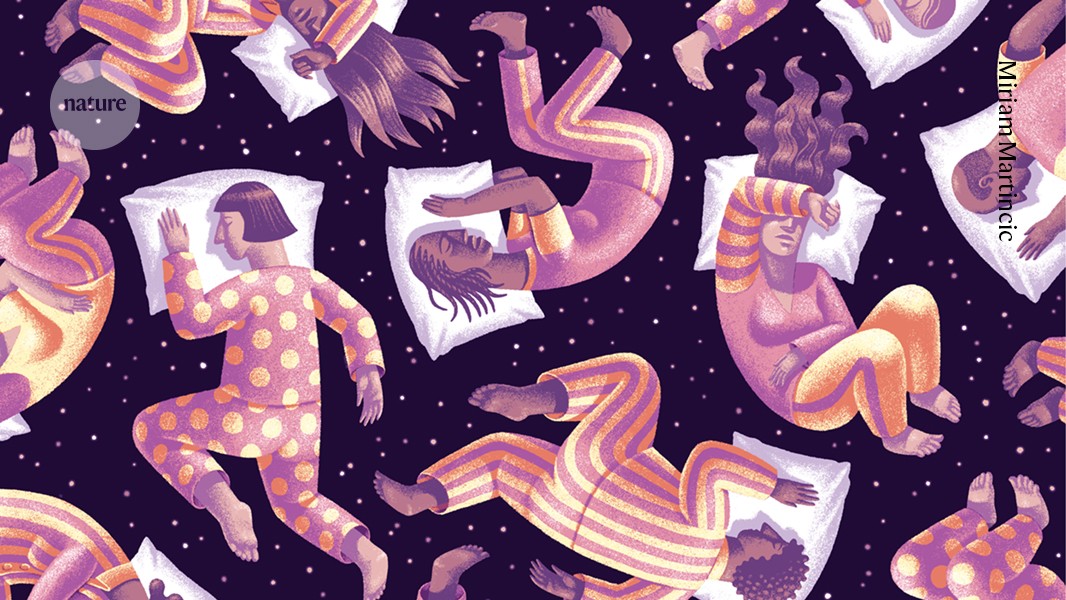
From TikTok videos touting mouth tape and weighted blankets, to magazines ranking insomnia-curbing pillows, sleep advice is everywhere. And it’s no wonder. People all over the world complain of insomnia and not getting enough sleep, driving a market for sleep aids worth more than US$100 billion annually.
But scientists warn that online hacks and pricey tools aren’t always effective. And failed attempts to remedy the situation could have negative effects, says Andrew McHill, a circadian scientist at Oregon Health & Science University in Portland. “It could discourage people from finding help, and things could get worse,” he says.
How the brain wakes up from sleep — and produces that morning feeling
Instead, researchers point to the lessons coming from circadian science, which over the past five decades has exposed a network of biological clocks throughout the body. This timekeeping machinery ensures that physiological systems are primed to do the right things at the right times — such as defend against pathogens, digest food and sleep. But circadian clocks don’t cycle precisely on their own. To stay in sync and function optimally, they need regular calibration from sunlight, daily routines and other cues.
Modern life doesn’t often cooperate. People spend much of their time indoors. They eat late into the night. They shift sleep schedules between workdays and weekends, effectively jet-lagging themselves. The toll is steep. In the short term, circadian disruption and insufficient sleep can reduce cognition, mood and reaction time. In the long term, they can increase risks of infections, diabetes, depression, dementia, cancer, heart disease and premature death.
For better sleep and overall health, McHill and other scientists emphasize three basics: contrasting light and dark, consolidating mealtimes and keeping sleep times consistent. “Simply taking a walk outside during the day and reducing our light exposure in the evening could have great effect,” says McHill.
Seek contrasts
Light provides the most powerful signal to the circadian system. Blue wavelengths are especially potent. That is not a coincidence. Humans evolved outdoors, under the sky. And the midday sky is rich in blue light. Still, common advice about avoiding blue light at night captures only part of the story.
In the 1990s and 2000s, a string of discoveries proved the existence of light-sensitive cells in the eye that are not directly involved in seeing1. Rather, these cells synchronize body clocks. They detect both intensity and wavelength, with input from rods and cones, and relay those data to a circadian pacemaker in the brain.
The circadian system requires bright light to operate properly. “But we’re pretty bad at determining how much light we’re getting,” says Jamie Zeitzer, a sleep and circadian scientist at Stanford University in California. Typical home lighting of 100–250 lux might feel like a lot to the eye. But the blue-rich daylight that the circadian system is primed to detect shines orders of magnitude brighter — upwards of 10,000 lux even on an overcast day.
Timing matters, too. Bright blue light during the daytime synchronizes circadian rhythms and supports the nightly surge of melatonin — the hormone signal that tells the body it’s time to sleep. It can also directly boost alertness and cognitive performance. The same illumination at night, from artificial lights and glowing screens, confuses the circadian system.
Unlocking the secrets of sleep
Blue light is the strongest disruptor, but enough photons of any colour at night can shift rhythms, suppress melatonin levels and hinder sleep. Exposure in the middle of the night, such as with a flip of a toilet light switch, is most disruptive, says Zeitzer. The circadian system’s sensitivity peaks near the midpoint of sleep, when it least expects light. Studies show that even dim light, such as a hallway bulb, can raise overnight heart rate and impair sleep2.
Ultimately, scientists say, what matters most is contrast: bright days and dark nights. In fact, light during the day can buffer against the potential harms of light at night, says Mariana Figueiro, director of the Light and Health Research Center at the Icahn School of Medicine at Mount Sinai in New York City. Mounting research links greater daytime light exposure with stronger circadian rhythms and higher sleep quality. One study of college students found that their total hours of light exposure during the day better predicted their bedtimes and wake times than did light exposure after dusk3. “The more light you get during the day, the better you’ll sleep at night,” says Figueiro.
Too little daylight and too much night light could even shorten life expectancy. A UK study of nearly 90,000 people found that the 20% with the poorest light-exposure patterns were predicted to die around five years earlier than were the 20% with the healthiest habits, even after accounting for factors such as income and physical activity4.
Andrew Phillips, a sleep health scientist at Flinders University in Adelaide, Australia, and an author of the study, pins the explanation on circadian rhythms: “They regulate every aspect of your physiology.”
Unfortunately, achieving this daily contrast is difficult in the modern world. Indoor lighting leans on green wavelengths that serve vision but not circadian signalling. Energy-usage codes limit how bright those fixtures shine. Daylight entering through windows gets quickly diluted. And energy-efficient window glass and blue-light-blocking spectacle-lens coatings further reduce how many circadian-stimulating photons reach the eyes. Ageing compounds the problem; people’s lenses become more yellow over time and filter out more blue light.
Circadian science’s prescription: spend more time outdoors, sit near windows and use daylight-mimicking light-emitting-diode lamps during the day. In the evening, lower the brightness of lamps and power down screens — or use apps that dim or shift screens to a warmer spectrum. And consider a low-intensity amber night light for the toilet.
Scientists note that the precise prescription is personal. Even people of the same age can vary considerably in how they respond to the same light, possibly because of characteristics such as sex or eye colour. And when light comes from screens, the content can matter as much as the light itself. “If you’re on an iPad at 11 at night, then the light exposure might have some effect,” says Zeitzer. “But if you are doing something relaxing, that might outweigh the effect.”
Consolidate calories
Calorie intake is also intricately linked with circadian rhythms and sleep. The human liver at 10 a.m. and the human liver at 10 p.m. are very different organs. The same can be said for other parts of the body that process food. Hunger hormones, digestive enzymes and glucose-regulating insulin have rhythms, too.
Humans are simply not equipped to deal with food at all hours, says Emily Manoogian, a circadian scientist at the Salk Institute for Biological Studies in San Diego, California. Late morning to early afternoon is when the body is usually most prepared for incoming calories. Eating late in the evening disrupts clocks and leaves key steps of digestion incomplete. It can also disrupt the gut microbiome, which could contribute to insomnia5. What’s more, late meals send blood to the gut and raise core body temperature, countering the natural night-time dip that promotes sleep. And they elevate glucose levels and uncouple liver and kidney clocks from the core clock in the brain, raising the chance of midnight toilet trips.
Manoogian and others suggest reviving the old adage: eat like a king in the morning, a prince at noon and a peasant at dinner. That last meal, they say, should fall at least three hours before bedtime, ideally with no subsequent snacks or caloric drinks.
Revealed: how the brain turns stress into a bad night’s sleep
Food quality matters, too. Diets high in sugar and saturated fat lighten and fragment sleep. Caffeine lingers for hours. And alcohol is deceptively disruptive: “You might fall asleep, but the quality of your sleep will be quite poor,” says Manoogian. On the flip side, eating some plant-based foods during the day could improve sleep. Research shows that walnuts boost melatonin levels and sleep quality6. Marie-Pierre St Onge, a nutrition, sleep and circadian scientist at Columbia University in New York City, co-authored a study that links greater daytime intake of fruits and vegetables with less-fragmented sleep7.
