

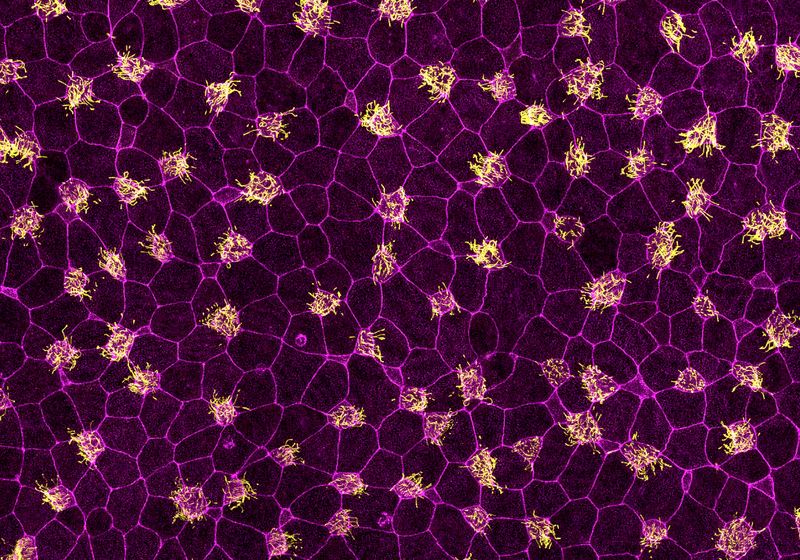
To gain a complete picture of cell development, scientists recently filmed cells in the live skin tissue of frog embryos. They quantified changes in cell shape and movement and analyzed how these changes defined cell fate.
Image credit:Raghavan Thiagarajan
What do cells want to be when they grow up, and how do they get there? Intrigued by these questions, many developmental biologists try to follow the journeys of cells from when they can virtually become any kind of cell to when they have reached their final fate. Scientists can take snapshots of this journey at specific timepoints, but what happens between these captured moments eludes them.
Jakub Sedzinski is a cell biologist at the University of Copenhagen and a coauthor of the study. His research focuses on stem cell development in the airways, for which frog embryo skin tissue is commonly used as a model.
Jakub Sedzinski
Jakub Sedzinski, a cell biologist at the University of Copenhagen, and his collaborator Bianca Dumitrascu, a computational biologist at Columbia University, wondered if they could follow developing cells as they change without losing a single moment.
In a recent preprint publication, the researchers live-imaged frog embryo cells as they developed and measured how the cells’ shape and movement changed as time elapsed.1 They discovered that cells’ progress towards their final fate was not linear and certain features, such as the nuclei’s position within cells, could predict the cells’ fate better than others. The team’s findings highlight the value of following the dynamics of developing cells versus relying on static representations of cell states alone.
“They’ve done a really nice, thorough job of quantifying the different transitions that happen in individual cells in a real, developing tissue,” said Chris Bakal, a cancer biologist at the Institute of Cancer Research who was not involved in the study. “No one has done this before to this scale and extent, especially in the context of development.”
John Rinn, a biochemist at the University of Colorado Boulder who was not associated with the study, added, “It’s taking the age-old question, ‘Can you predict what’s going on in cells from an image?’ and applying modern technology to it.”
To learn how cell identities change during development, scientists typically use single-cell RNA sequencing, inferring shifts in cell states based on gene expression changes between different timepoints. But by focusing on specific timepoints, they likely miss the true dynamics of this process. Single-cell RNA sequencing is also very expensive. This often limits how many timepoints researchers can sample, which in turn worsens the incomplete picture issue.
So, Sedzinski and his colleagues tracked cell shape and movement, two features that, like gene expression, change as cells develop and assume new identities. The team filmed cells in the skin of frog embryos under a microscope for 24 hours, the time in which the cells reach their differentiation end point, taking pictures every three minutes. They used computational tools to quantify over 30 features pertaining to the cells’ shape and position, such as their surface area, volume, and how deeply they’re located within the tissue.

John Rinn, a biochemist at the University of Colorado Boulder, combines computational and experimental approaches to study how long noncoding RNAs regulate biological processes. He was not involved in the study.
John Rinn
“It’s like watching a movie rather than reading a flip book,” Rinn said.
Bakal added, “This is a much more direct readout of cell function. From a technological point of view, live-cell imaging is also easier to implement.”
For each cell, the researchers mapped a combination of these features, which they called the cell’s morphodynamic state, over time. They found that cells progressed through different states continuously, indicating that cell fate determination likely occurs on a spectrum. The researchers also observed that most features—except cell’s position within the tissue—did not show any significant or consistent trend over time, suggesting that the development process is not as linear as once expected.
“We learned that cell fate determination is not a simple transition from point A to point B,” Sedzinski said. “The cells are, in fact, exploring all the different possibilities. Then at some point, they settle into a final state, and this is a gradual decision.”
Next, the researchers wanted to know if any feature was particularly telling of the cell’s final fate. Using machine learning, they discovered that the most predictive features were time, the cell’s depth within the tissue, and unexpectedly, the location of the nucleus relative to the center of the cell, also known as nucleus-membrane offset.
“[The last] was completely new,” said Sedzinski. “I think that hasn’t really been studied in the context of cell fate decisions.”
Rinn added, “The nuclear offset thing—that’s pretty cool and really surprising. I would have never thought of that.”
In the future, Sedzinski hopes to integrate morphodynamic state changes and transcriptomics data to better understand how cells reach their final fate. Rinn looks forward to this, as he believes that the ability to detect cell states from images may someday revolutionize medicine.
“In the 2000s, we used to joke about the Star Trek scanner—it scans the body and takes pictures, then it’d be able to tell what’s wrong with you—this paper is the closest to such a thing!”
