
Close Menu
My Blog

    Subscribe to Updates

    Get the latest creative news from FooBar about art, design and business.

    What's Hot

    Nautilus debuts Voyager platform in push toward next-gen proteomics

    March 1, 2026

    First-in-Human Success for Prenatal Stem Cell Therapy in Spina Bifida

    February 28, 2026

    Pressure-Driven Pathway Links Liver Congestion to Fibrosis and Cancer

    February 28, 2026
    Facebook X (Twitter) Instagram
    X (Twitter) YouTube
    My BlogMy Blog
    Sunday, March 1
    • Home
    • About Us
    • Healthy Living
    • DNA & Genetics
    • Podcast
    • Shop
    My Blog
    Home»Probiotics»What Are the Signs and Symptoms of Skin Cancer?
    Probiotics

    What Are the Signs and Symptoms of Skin Cancer?

    adminBy adminOctober 1, 2025No Comments3 Mins Read
    Facebook Twitter Pinterest LinkedIn Tumblr WhatsApp VKontakte Email
    What Are the Signs and Symptoms of Skin Cancer?
    Share
    Facebook Twitter LinkedIn Pinterest Email

    Signs and Symptoms of Skin Cancer

    The different types of skin cancer can look different and may be more likely to appear in certain areas of your body. Some may share similar characteristics, however.

    Basal Cell Carcinoma Symptoms

    Basal cell cancer can appear anywhere but tends to develop on parts of the body that get a lot of sun exposure, such as the face, head, and neck.

    Although it can be flat and look like normal skin, it also can have more distinctive characteristics, including:

    • Small pink, red, pearly translucent, or shiny bumps, possibly with areas of blue, brown, or black
    • Pink growths with slightly raised edges and an indentation in the center; tiny blood vessels might run through it like the spokes of a wheel
    • Open sores, possibly with oozing or crusted areas, that don’t heal or that go through cycles of healing and bleeding
    • Flat, firm, pale, or yellow areas that resemble a scar
    • Raised, reddish patches of skin that might be itchy or irritated
    • Delicate areas that bleed easily, such as a sore or cut that lingers longer than one week

    These slow-growing skin cancers can be easy to ignore unless they become big and begin to itch, bleed, or even hurt.

    Squamous Cell Carcinoma Symptoms

    Like basal cell cancer, squamous cell cancer tends to develop on parts of the body that get a lot of sun, such as the face, neck, ear, lips, and back of the hands. It might also appear in scars or skin sores anywhere on the body.

    While squamous cell carcinoma can look like a flat area resembling healthy skin, there may be clearer signs of malignancy, including:

    • Rough or scaly red patches that may bleed or crust
    • Raised growths or lumps, sometimes with a depression in the center
    • Open sores, possibly with oozing or crusted areas, that don’t heal or that go through cycles of healing and bleeding
    • Growths that resemble warts
    A history of genital warts can be a risk factor of squamous cell carcinoma in the genital area. This skin cancer also can develop from a noncancerous lesion called actinic keratosis, which are small, crusty, or scaly and can be tiny or as wide as 1 inch.

    Melanoma Symptoms

    Melanoma can develop anywhere on the skin but is more likely to start on the chest and back in men and on the legs in women.

    People with darker skin pigment are significantly less likely to get skin cancer in these areas than those with lighter skin. Melanoma may develop, however, on the palms of the hands, the soles of the feet, in the eyes, or underneath the nails.

    Most melanoma cells still produce the pigment melanin, so they are often tan, black, or brown, but they can also contain colors of red, white, and blue.

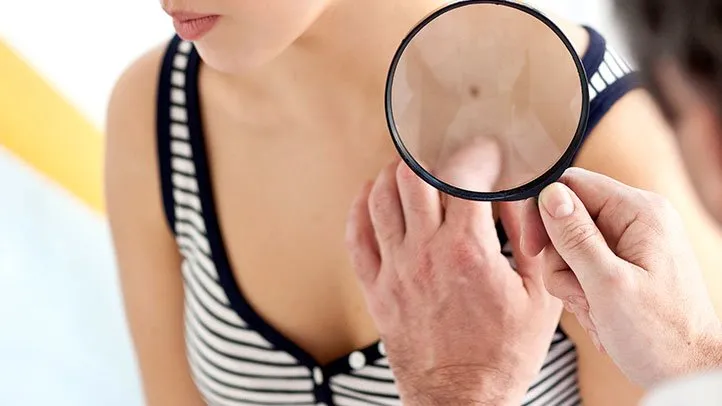
    About 30 percent of melanoma cases begin as existing moles, but they also may appear on otherwise normal skin. One way to assess if a spot is melanoma is to use the ABCDE system, examining if it has the following characteristics.

    • A is for asymmetry. One half of the spot does not match the other.
    • B is for border. Edges are irregular, scalloped, or notched.
    • C is for color. Parts of the spot may be different colors, from shades of tan, brown, and black, to red and blue.
    • D is for diameter. The spot is bigger than the eraser on a pencil, about ¼ inch.
    • E is for evolving. The spot changes in size, color, shape, and elevation.

    Not all moles will develop into melanoma. And some melanomas don’t neatly fit into the ABCDE categories, as well. If you notice changes in a spot on your skin, or if it does not heal or appears unusual, talk to your doctor.

    Cancer Signs Skin Symptoms
    Share. Facebook Twitter Pinterest LinkedIn Tumblr WhatsApp Email
    Previous ArticleResident doctors shouldn’t depend on exception reporting
    Next Article Jane Goodall, Renowned Primatologist and Conservationist, Dies at 91
    admin
    • Website

    Related Posts

    Pressure-Driven Pathway Links Liver Congestion to Fibrosis and Cancer

    February 28, 2026

    Advanced Brain Cancer Survival Rates Double with LITT

    February 27, 2026

    Internal Structure of Biomolecular Condensates Linked to Cancer and Neurodegeneration

    February 26, 2026

    Astellas, Vir Biotechnology Launch Up-to-$1.7B Prostate Cancer Collaboration

    February 26, 2026
    Leave A Reply Cancel Reply

    Our Picks

    9 Time-Saving Kitchen Gadgets for Fall at Amazon

    September 5, 2025

    Why Exercise Is So Important For Heart Health, From An MD

    September 5, 2025

    An Engineered Protein Helps Phagocytes Gobble Up Diseased Cells

    September 5, 2025

    How To Get Rid Of Hangnails + Causes From Experts

    September 5, 2025
    • Facebook
    • Twitter
    • Pinterest
    • Instagram
    • YouTube
    • Vimeo
    Don't Miss
    Longevity

    Nautilus debuts Voyager platform in push toward next-gen proteomics

    By adminMarch 1, 20260

    Company’s new benchtop system promises a clearer view of proteins following validation at a leading…

    First-in-Human Success for Prenatal Stem Cell Therapy in Spina Bifida

    February 28, 2026

    Pressure-Driven Pathway Links Liver Congestion to Fibrosis and Cancer

    February 28, 2026

    A cellular atlas of aging comes into focus

    February 28, 2026

    Subscribe to Updates

    Get the latest creative news from SmartMag about art & design.

    About Us

    At FineGut, our mission is simple: to enhance your self-awareness when it comes to your gut health. We believe that a healthy gut is the foundation of overall well-being, and understanding the brain–gut connection can truly transform the way you live.

    Our Picks

    9 Time-Saving Kitchen Gadgets for Fall at Amazon

    September 5, 2025

    Why Exercise Is So Important For Heart Health, From An MD

    September 5, 2025

    An Engineered Protein Helps Phagocytes Gobble Up Diseased Cells

    September 5, 2025
    Gut Health

    Nautilus debuts Voyager platform in push toward next-gen proteomics

    March 1, 2026

    First-in-Human Success for Prenatal Stem Cell Therapy in Spina Bifida

    February 28, 2026

    Pressure-Driven Pathway Links Liver Congestion to Fibrosis and Cancer

    February 28, 2026
    X (Twitter) YouTube
    • Contact us
    • Privacy Policy
    • Disclaimer
    • Terms and Conditions
    © 2026 finegut.com. Designed by Pro.

    Type above and press Enter to search. Press Esc to cancel.