

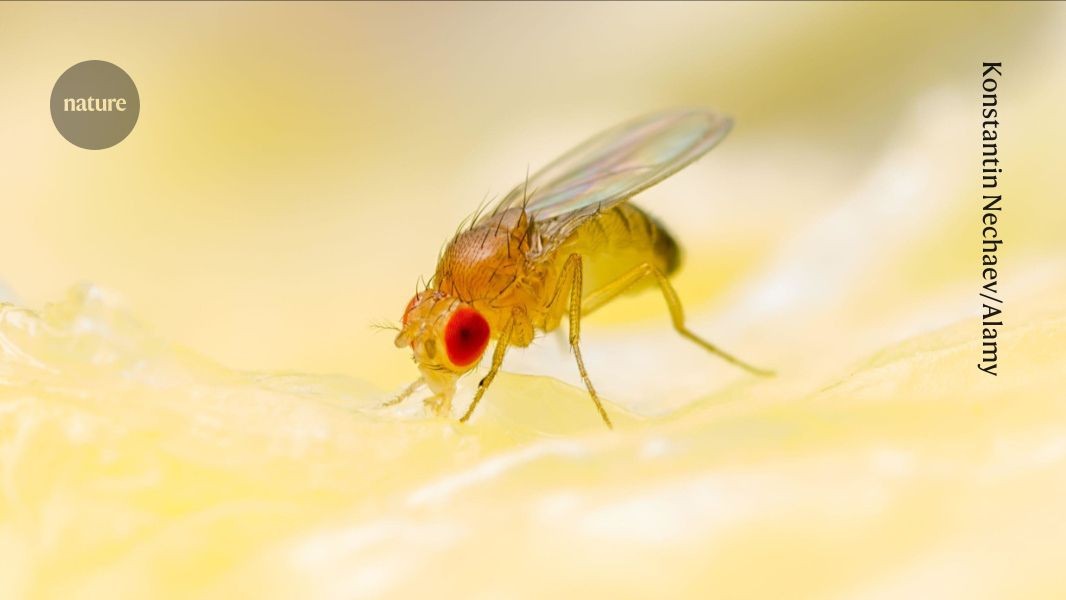
FlyBase, a database for the model organism Drosophila, has lost government funding. Credit: Konstantin Nechaev/Alamy
A key repository for the world’s fruit-fly research community became an unexpected casualty of Harvard University’s continuing conflict with the administration of US President Donald Trump. In May, the administration froze more than US$2.2 billion in federal funds that were awarded to the university, including the National Institutes of Health (NIH) grant that supported the repository, called FlyBase. Harvard University, which is based in Cambridge, Massachusetts, filed a lawsuit to end the funding freeze, and the case has been making its way through the courts.
But the damage to FlyBase was immediate and extensive. Its eight staff members were laid off — including database curators Sian Gramates and Victoria Jenkins, both at Harvard — and subawards that funded collaborators at three other universities also disappeared. Gramates has been at FlyBase for more than 20 years, and was looking forward to retiring. Jenkins says she is now seeking opportunities outside science. When they depart, they will take with them decades of institutional knowledge about one of the best-studied model organisms in biology, the fruit fly, Drosophila melanogaster.

US Supreme Court allows NIH to cut $2 billion in research grant
FlyBase’s situation is unique, but it’s not the only resource that’s struggling. Similar model organism databases (MODs) exist for mice, rats, zebrafish, yeast, frogs, the nematode worm Caenorhabditis elegans and the plant Arabidopsis thaliana. Collectively, these repositories — which support hundreds of thousands of researchers between them — have underpinned decades of scientific discoveries and served as hubs for their research communities. All of them have been heavily supported by the NIH, and now, they face losing that funding owing to broad cuts to federal research support, prompting lay-offs and disruptions that risk setting back basic science.
“It’s hard to overstate the value of these resources and the teams overseeing their curation, which is truly what makes them such valuable tools,” says Jenkins. “Without them, it’s hard to imagine research continuing at anything near the pace and quality we’ve seen in the past.”
The MOD squad
Since the early 1990s, as advances in sequencing technology created gluts of new information in need of curating, MODs have emerged as authorities over the genomes of their individual species. These websites typically contain curated, annotated data on gene function and expression, phenotypic alleles and variants, human-disease associations and protein interactions — as well as community resources such as researcher directories and forums. Despite their importance, a study published last month noted that such centralized repositories might be vulnerable, partly owing to shifting political or funding priorities1.
In 2016, the NIH launched an effort to consolidate eight of these repositories into a single flagship organization, the Alliance of Genome Resources, reasoning that housing these MODs together would unify their information and infrastructure and make them easier to use. Each member group was given until 2029 to migrate their data and was told that their funding would diminish over time. Now, with less than five years to go and amid a period of scientific upheaval in the United States, MOD leadership is facing a daunting challenge.
Many MODs have integrated only a small portion of their data into the Alliance — in some cases, less than 10%, sources say. Part of the issue, says Stacia Engel, the project manager at the Saccharomyces Genome Database (SGD), who is based at Stanford University in Palo Alto, California, is that harmonizing so many data isn’t trivial. Each group has different needs, data types and protocols, and researchers have failed to reach a consensus for a single, unified vision for the Alliance.
Harvard researchers devastated as Trump team cuts nearly 1,000 grants
As funding has been siphoned away, the problem has compounded: MODs cannot retain their staff, and with fewer staff, data integration becomes harder. Meanwhile, the total amount from individual grants that each MOD currently receives is not being allocated in full to the Alliance, which faces its own cuts. “We simply don’t have enough time or resources to make things happen as effectively as we would like,” says Carol Bult, a geneticist at the Jackson Laboratory in Bar Harbor, Maine, and a co-principal investigator of the Alliance and principal investigator of the Mouse Genome Informatics database.
In the interim, some MODs have put out calls for donations, considered enforcing what were previously voluntary fees for using the platforms or ceased operations. The nematode database WormBase, launched in 2000, announced that October would mark its last major update so that it could dedicate itself fully to integrating into the Alliance, whereas the SGD noted in a newsletter in April that cuts from the NIH were continuing to “strain” its finances. (Representatives at both the SGD and WormBase say they have also lost staff or had to cut ties with collaborators owing to budget cuts.)
“You can see that everyone is scrambling to make ends meet,” Engel says. “In some ways it feels like we’ve been handed an impossible task.”
