

Non-ionic surfactants such as polysorbates and poloxamers play a crucial role in biopharmaceutical formulations, improving protein stability and reducing aggregation. Polysorbates, such as Polysorbate 80 (PS80 or Tween-80), are among the most widely used surfactants in the pharmaceutical industry and are present in most commercial monoclonal antibody formulations.1
Regulatory agencies, including the U.S. Food and Drug Administration (FDA) and the European Medicines Agency (EMA), expect excipients such as surfactants to be appropriately selected, justified, and characterized, with their stability and potential degradation monitored throughout the product lifecycle. This expectation is reflected in ICH Q8(R2), various FDA guidance, and regulatory assessments of licensed biologics.2
Why surfactant quantification matters
Accurate quantitation of PS80 is essential for:
- Formulation optimization: Determining the right concentration to stabilize proteins without introducing adverse effects
- Aggregation prevention: Ensuring adequate protection against particle formation
- Product quality and safety: Preserving formulation integrity and detecting degradation
- Regulatory compliance: Meeting documentation and control requirements for licensed products
PS80 is typically used at low concentrations between 0.1 and 1 mg/mL. The low concentration and non-ionic nature of PS80 complicates detection and quantification using conventional analytical techniques. Current standard methods rely on solid-phase extraction (SPE) followed by high-performance liquid chromatography (HPLC). This method requires extensive development time and technical expertise.3,4 HPLC is also time-consuming itself, requiring weeks for results and costing hundreds of dollars per sample.
The power of NIR spectroscopy
High-Precision Tunable Laser Spectroscopy (HPTLS) is the next generation of near-infrared (NIR) spectroscopy. It provides a faster, more accessible alternative to HPLC by harnessing the quantitative capabilities of NIR spectroscopy. Using this approach, surfactant concentrations in protein-containing formulations can be quantified rapidly, without complex sample prep or extraction steps.
Traditional broadband NIR spectroscopy interrogates samples using light in the 780–2500 nm range of the electromagnetic spectrum, where vibrational overtones and combination bands occur (Figure 1). While many applications focus on first and second overtones (typically 1000–2000 nm), HPTLS focuses on the combination band region (2100–2400 nm), where molecular interactions among C–H, O–H, and C–O bonds produce distinct, chemically rich features.
This region offers greater spectral specificity in complex biopharmaceutical matrices, allowing accurate differentiation between chemically similar excipients such as surfactants, buffers, and stabilizers, even in the presence of high-concentration proteins. The result is enhanced resolution and quantitative performance without compromising sample integrity. By taking full advantage of the high spectral selectivity, as well as the stronger absorption in this region, HPTLS achieves superior quantitative accuracy.
Unlike UV-Vis or Raman techniques, NIR combination band spectroscopy is particularly well-suited for aqueous, protein-rich environments. It is non-destructive, requires only microliter volumes, and integrates seamlessly into formulation workflows.
Accelerating surfactant quantification

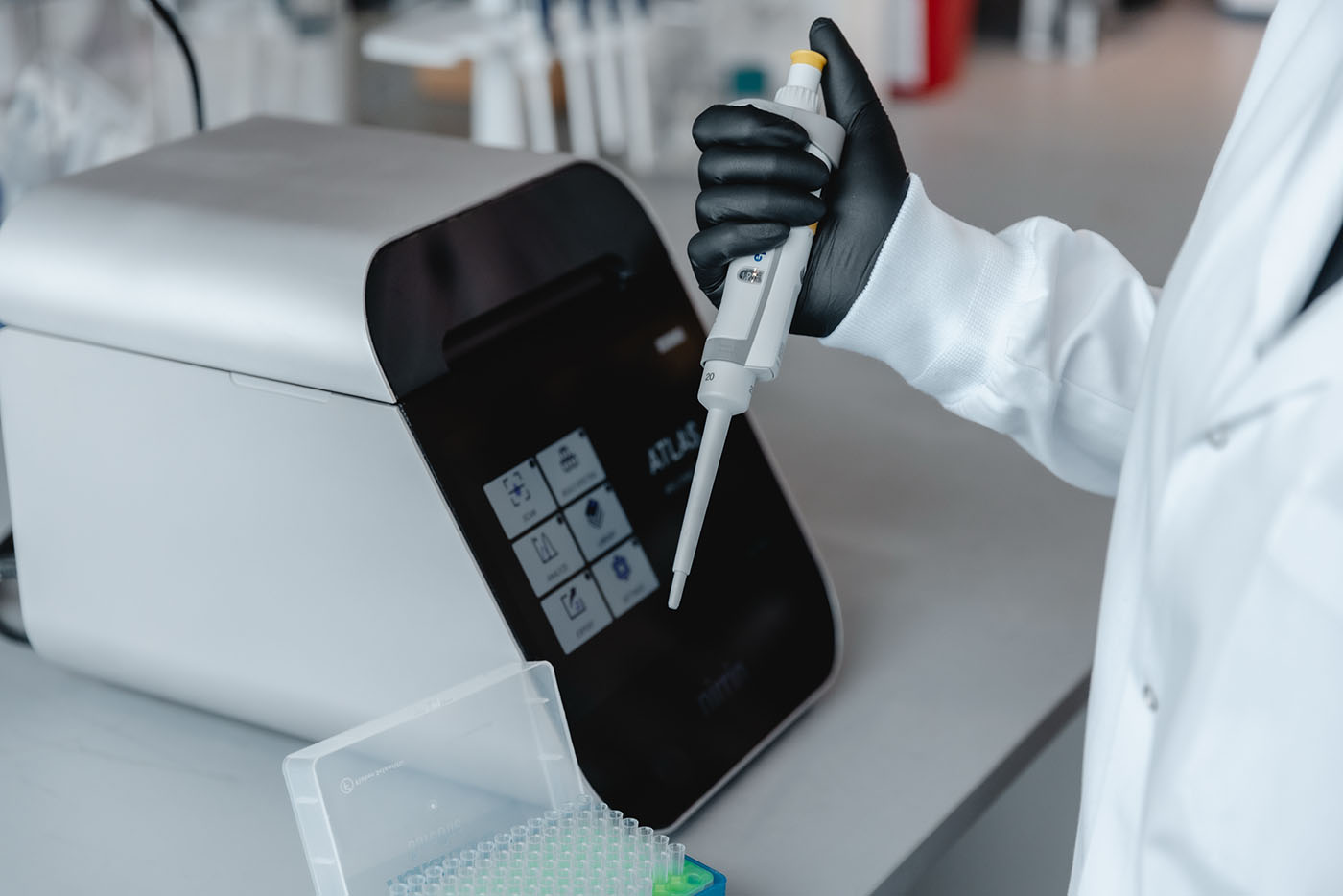
HPTLS delivers rapid NIR analysis through a compact, automated platform (Figure 2). A 15 µL sample is pipetted between sapphire windows, forming a 1 mm fixed pathlength. Upon closing the lid, a tunable laser scans the combination band region. The system uses a pre-calibrated spectral library to deconvolve the absorbance signal and determines analyte concentrations with HPLC-like accuracy, in under three minutes. No extraction steps, external calibrations, or specialized operators are required.
Table 1 summarizes the quantitative accuracy of HPTLS across high- and low-concentration Polysorbate 80 stocks. Even in low concentration (0.1%) stocks, the system delivered a %RSD <1.

Performance data demonstrate the system’s robust capability for measuring PS80 in different formulation conditions, including the presence of sugars, buffers, and protein (Figure 3). Notably, the method reliably distinguishes surfactant concentrations even in highly complex matrices, without matrix-specific calibration. While HPLC recovery of PS80 declined in protein-containing samples, HPTLS maintained consistent results, highlighting the value of an orthogonal method for cross-validation and robustness.

Conclusion
Legacy surfactant quantitation methods such as SPE-HPLC are slow, complex, and expensive, creating bottlenecks in formulation development and QA/QC workflows. HPTLS in the combination band region offers a compelling alternative: rapid, label-free quantitation from a single microliter-scale sample, with no method development or cleanup steps.
This transformative approach empowers scientists to monitor excipient levels more frequently, confidently, and cost-effectively, accelerating formulation optimization and supporting regulatory compliance without sacrificing accuracy or reproducibility.
References
1. Brovč EV, Mravljak J, Šink R, Pajk S. Rational design to biologics development: The polysorbates point of view. Int J Pharm. 2020;581:119285. doi:10.1016/j.ijpharm.2020.119285
2. International Council for Harmonisation. Q8(R2) Pharmaceutical development. US Food and Drug Administration. Updated August 2022. Accessed August 13, 2025.
3. Guo K, Song J, Bennington P, Pavon AJ, Bothe JR, Xi H, Gunawan RC. Identification of surfactant impact on a monoclonal antibody characterization via HPLC-separation based and biophysical methods. Pharm Res. 2024;41(4):779-793. doi:10.1007/s11095-024-03684-4
4. Webster GK, Chang JC, Heflin JL. Stability indicating method for polysorbate 80 in protein formulations. J Chromatogr Sci. 2021;59(8):706-713. doi:10.1093/chromsci/bmaa116
Hannah Furelle is an analytical scientist at Nirrin Technologies.
