
Close Menu
My Blog

    Subscribe to Updates

    Get the latest creative news from FooBar about art, design and business.

    What's Hot

    Nautilus debuts Voyager platform in push toward next-gen proteomics

    March 1, 2026

    First-in-Human Success for Prenatal Stem Cell Therapy in Spina Bifida

    February 28, 2026

    Pressure-Driven Pathway Links Liver Congestion to Fibrosis and Cancer

    February 28, 2026
    Facebook X (Twitter) Instagram
    X (Twitter) YouTube
    My BlogMy Blog
    Sunday, March 1
    • Home
    • About Us
    • Healthy Living
    • DNA & Genetics
    • Podcast
    • Shop
    My Blog
    Home»Gut Health»Chemistry Nobel for scientists who developed massively porous ‘super sponge’ materials
    Gut Health

    Chemistry Nobel for scientists who developed massively porous ‘super sponge’ materials

    adminBy adminOctober 8, 2025No Comments2 Mins Read
    Facebook Twitter Pinterest LinkedIn Tumblr WhatsApp VKontakte Email
    Chemistry Nobel for scientists who developed massively porous ‘super sponge’ materials
    Share
    Facebook Twitter LinkedIn Pinterest Email

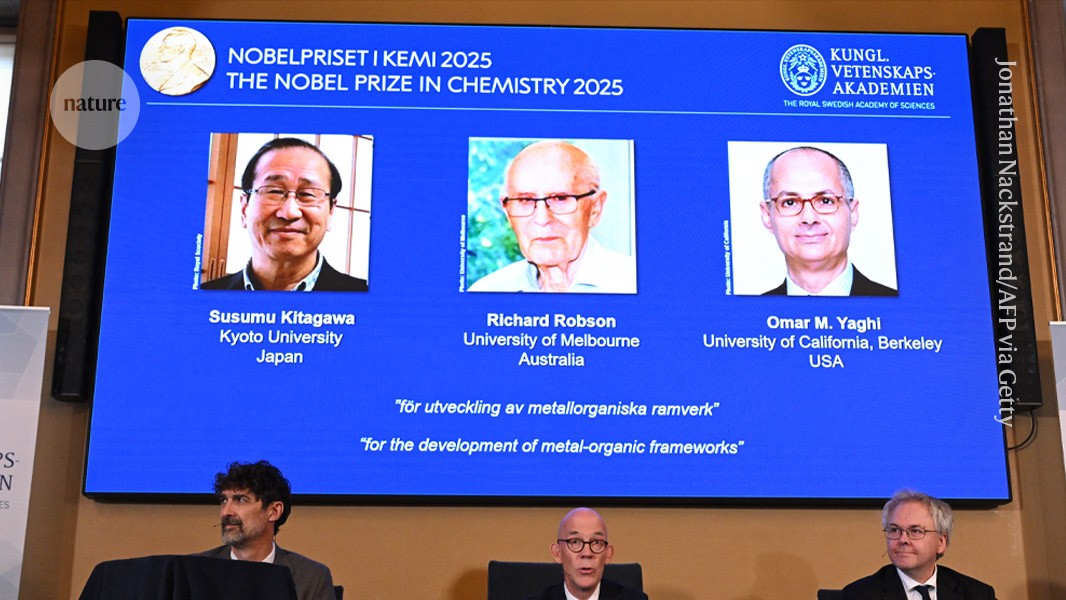
    Susumu Kitagawa, Richard Robson and Omar Yaghi share the 2025 chemistry Nobel.Credit: Jonathan Nackstrand/AFP via Getty

    Three scientists who developed a class of extremely porous materials known as metal-organic frameworks (MOFs) have won this year’s Nobel Prize in Chemistry.

    Susumu Kitagawa at Kyoto University in Japan, Richard Robson at the University of Melbourne, Australia, and Omar Yaghi at the University of California, Berkeley, will share the prize of 11-million Swedish kronor (US$1.2 million), for inventing a new form of molecular architecture. Because they have such a vast internal surface area, MOFs can store gases, act as catalysts and deliver drugs, among many other potential uses.
    World’s most porous sponges: intricate carbon-trapping powders hit the market

    “This year’s laureates…have found ways to create materials, entirely novel materials, with large cavities on their insides, which can be seen almost like rooms in a hotel so guest molecules can enter and also exit again,” said Nobel committee chair Heiner Linke, a nanophysicist at Lund University in Sweden, at a press conference announcing the prize. “A small amount of such material can almost be like Hermione’s handbag in Harry Potter – it can store huge amounts of gas in a tiny volume”.

    The MOF concept was first developed by Robson in the 1980s. Inspired by the structure of diamond crystals — in which each carbon atom binds to four other carbon atoms — he and his collaborator Bernard Hoskins designed a material made of pyramidal-shaped modules, with metal atoms linked by organic molecules1,2.

    In the early 1990s, Kitagawa developed MOFs that could be filled with water, and were stable enough to not be disrupted if they were subsequently dried up. He also realized that the frameworks could change shapes depending on whether they were filled or not.

    Chemistry developed massively materials Nobel porous Scientists sponge Super
    Share. Facebook Twitter Pinterest LinkedIn Tumblr WhatsApp Email
    Previous ArticleVitamin D2 supplements may impact bone and immune health by lowering D3 levels, study warns
    Next Article Takara Bio USA Launches Expanded Spatial Biology Portfolio
    admin
    • Website

    Related Posts

    The ins and outs of the new Dietary Guidelines for Americans in light of the gut microbiome

    February 25, 2026

    Manchester Calling: The Families and Scientists Refusing to Let Hunter Syndrome Go Unfunded

    February 19, 2026

    Patrick Veiga – Gut Microbiota for Health

    February 17, 2026

    The gut microbiome puzzle and probiotics in primary care patients with IBS

    February 16, 2026
    Leave A Reply Cancel Reply

    Our Picks

    9 Time-Saving Kitchen Gadgets for Fall at Amazon

    September 5, 2025

    Why Exercise Is So Important For Heart Health, From An MD

    September 5, 2025

    An Engineered Protein Helps Phagocytes Gobble Up Diseased Cells

    September 5, 2025

    How To Get Rid Of Hangnails + Causes From Experts

    September 5, 2025
    • Facebook
    • Twitter
    • Pinterest
    • Instagram
    • YouTube
    • Vimeo
    Don't Miss
    Longevity

    Nautilus debuts Voyager platform in push toward next-gen proteomics

    By adminMarch 1, 20260

    Company’s new benchtop system promises a clearer view of proteins following validation at a leading…

    First-in-Human Success for Prenatal Stem Cell Therapy in Spina Bifida

    February 28, 2026

    Pressure-Driven Pathway Links Liver Congestion to Fibrosis and Cancer

    February 28, 2026

    A cellular atlas of aging comes into focus

    February 28, 2026

    Subscribe to Updates

    Get the latest creative news from SmartMag about art & design.

    About Us

    At FineGut, our mission is simple: to enhance your self-awareness when it comes to your gut health. We believe that a healthy gut is the foundation of overall well-being, and understanding the brain–gut connection can truly transform the way you live.

    Our Picks

    9 Time-Saving Kitchen Gadgets for Fall at Amazon

    September 5, 2025

    Why Exercise Is So Important For Heart Health, From An MD

    September 5, 2025

    An Engineered Protein Helps Phagocytes Gobble Up Diseased Cells

    September 5, 2025
    Gut Health

    Nautilus debuts Voyager platform in push toward next-gen proteomics

    March 1, 2026

    First-in-Human Success for Prenatal Stem Cell Therapy in Spina Bifida

    February 28, 2026

    Pressure-Driven Pathway Links Liver Congestion to Fibrosis and Cancer

    February 28, 2026
    X (Twitter) YouTube
    • Contact us
    • Privacy Policy
    • Disclaimer
    • Terms and Conditions
    © 2026 finegut.com. Designed by Pro.

    Type above and press Enter to search. Press Esc to cancel.