

Généthon’s goal is to make cell and gene therapies (CGTs) not only safe and effective, but affordable. CGTs often are so expensive that payers are unwilling to foot the bill, even for relatively common conditions. For rare and ultra-rare diseases, which have far less commercial demand, the chances that a drug will be developed are slight at best.
“We know CGTs can save lives and be highly efficient, but transforming them into medicines and taking them through clinical trials is very costly,” Frédéric Revah, PhD, CEO of Généthon, tells GEN. “Approximately 85% of rare diseases are too rare to be profitable for classical players.”
“We work on rare and ultra-rare diseases,” Revah says. “If we (as an industry) don’t decrease the costs, it will be hard getting these drugs to the patients affected by rare diseases. The cost of manufacturing some of the drugs can be in the million-of-dollars range. We want them to be in the tens-of-thousands-of-dollars range.”
Patient organizations like the French Muscular Dystrophy Association (AFM-Téléthon), which founded Généthon, are working to address that challenge, but not even they have infinite resources. A large part of the solution, therefore, is to make CGT production more cost-effective, and to make the therapeutics themselves more efficacious.
Make manufacturing affordable
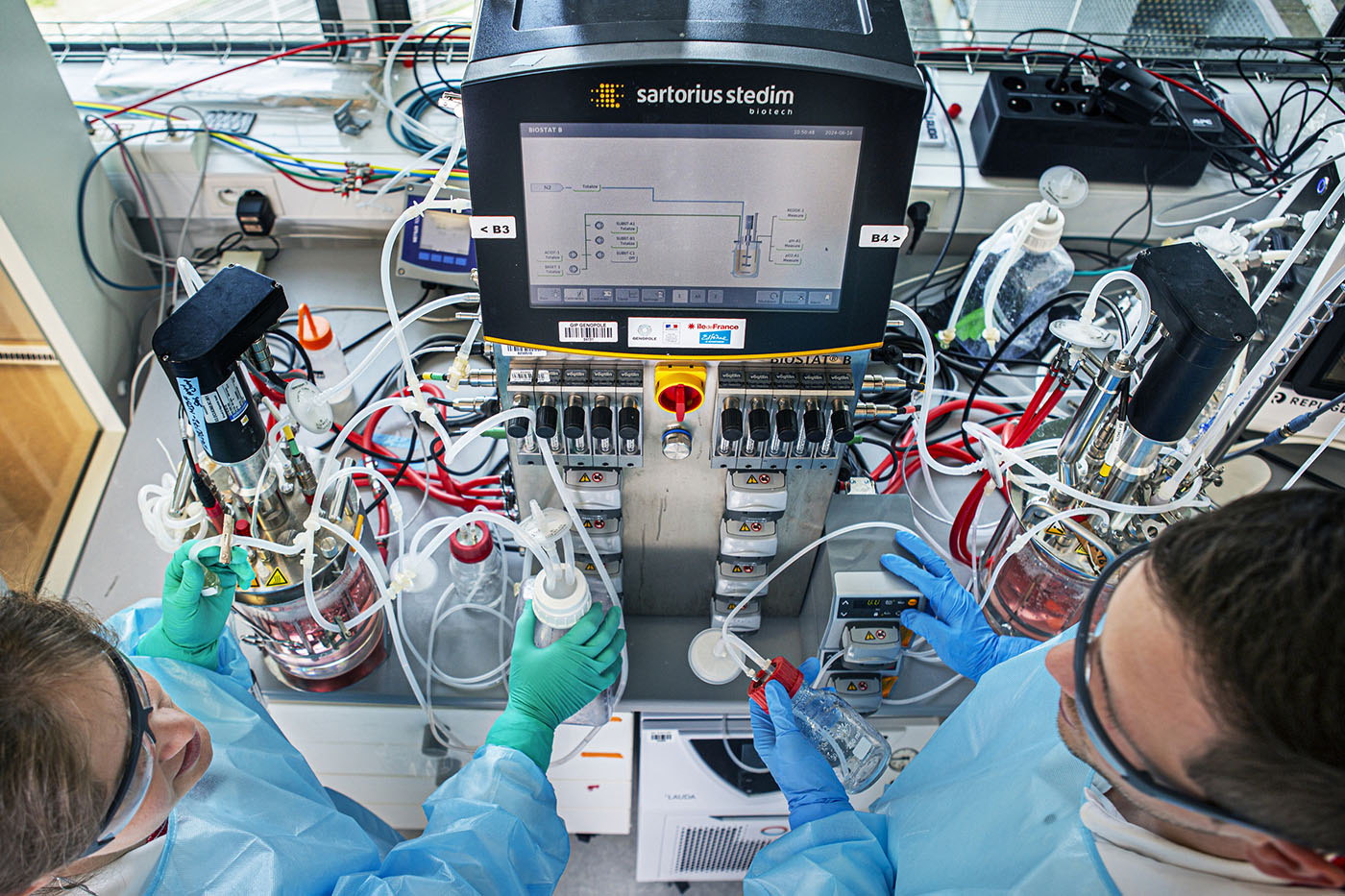
To that end, within Généthon, a staff of 40 is working to developing innovative biomanufacturing methods that are assessed in terms of both clinical and manufacturing efficiency. This research-oriented clinical-stage company boasts labs for product design, preclinical development, and clinical development, as well as a chemistry, manufacturing, and controls laboratory for biomanufacturing. Of its 240 employees, 170 are scientists, Revah points out.
That team is working with innovators in industry and academia “to bring in technologies that you might not have thought of as useful in the gene therapy setting, but that we think can be useful,” he says.
The collaboration with Eukarÿs is one example. “It has an enzyme that boosts internal protein production from a recombinant cell line. The results for some proteins have been very spectacular,” Revah reports.
The company also is working with Thales, an AI leader in the European defense industry, to develop AI-supported bioprocessing models to improve bioproduction yields. “We are trying to see whether we can generate a virtual twin of our bioreactors to model the manufacturing of our AAVs and processing parameters without having to conduct experiments,” Revah explains. The goal, he says, is a 100-fold decrease in costs.
DMD entering Phase III
Généthon concentrates on developing gene therapies, with an immediate focus on neuromuscular diseases. “Muscles constitute 30 to 40% of the body mass. To get efficiency, we must be able to transduce a large part of the muscles and muscle cells. That’s very demanding,” Revah says.
Généthon recently received approval to launch a Phase III trial for its low-dose microdystrophin gene therapy for Duchenne muscular dystrophy (DMD). It comes on the heels of news from Sarepta Therapeutics, in which a death occurred during a clinical trial for a DMD gene therapy. That trial has since resumed.
“The European Medicines Agency and the (United Kingdom’s) Medicines and Healthcare products Regulatory Agency, fully knowledgeable of the Sarepta situation, have granted us approval for (a) pivotal phase in the EU,” Revah says. “We are focused on developing a gene therapy that is effective at a lower dose than the other gene therapies under development for DMD, with a unique protocol to be able to analyze
safety and efficacy vs. placebo in a reduced number of patients.”
Based on data from Phase I/II trials, “GNT-004 has the potential to be best in class,” Revah says. Its low doses offer a broad safety margin and sustained clinical results that—as of this interview—exceed two years, he says.
The product uses AAVs to deliver the transgene that codes for a micro-dystrophin that, unlike the full-sized dystrophin gene, is small enough to be inserted into the DNA by an AAV. The therapeutic is designed to treat DMD regardless of the specific genetic abnormality that caused it.
Other pivotal trials include Crigler-Najjar syndrome, myotubular myopathy, and Fanconi’s anemia.
So far, 13 products stemming from Généthon’s research are in clinical trials either in collaboration with other corporations or led by its internal team. They include therapies for diseases of the liver, blood, immune system, muscles, and eyes. Zolgensma®, commercialized by Novartis, is one of those products. Within the next five years, seven more products may begin clinical trials.
Building better vectors
Last autumn, Généthon used artificial intelligence to design and engineer a muscle-specific capsid, LICA1, that matched the efficiency of the gold standard, minimized liver targeting, and was efficient at lower doses. Revah cited an up to 800-fold increase in specificity.
The company also is developing solutions for patients who are seropositive for AAVs and, therefore, are not eligible for gene therapy. That program uses an immune regulator—imlifidase—recently approved in the EU for organ transplantation. Early studies suggest that, for a time, it digests anti-IgG antibodies enough that even those with pre-existing antibodies can be treated.
It is testing that approach in humans with a Phase I/II trial involving patients with Crigler-Najjar syndrome. Those patients have “very high bilirubin levels (which become neurotoxic). We are testing the approach in patients who have antibodies against AAV. They normally are not eligible for gene therapy,” Revah says. Because imlifidase is already approved and its safety is established, “we’re looking for efficacy upfront.”
Généthon has teamed with Samabriva-AAV to manufacture adeno-associated viral vectors (AAVs) from turnip roots. “This is very exploratory,” he cautions, but has interesting possibilities. Beyond enhancing AAVs, the company also is working with lentiviral vectors and is beginning a program involving lipid-like nanoparticles.
For each of its vector programs, the goal is to reduce the quantity of the vector needed to deliver an effective dose. “That’s a safety issue, and also a cost of goods issue,” Revah says. Therefore, the company is engineering intelligent vectors with improved specificity. That includes stealth vectors that can go unnoticed by the immune system.
Begat by Téléthon
Généthon is the direct result of France’s first telethon. In 1990 AFM-Téléthon formed Généthon as a not-for-profit organization. Its purpose was to decode and map the human genome, and then to correlate genes to diseases. It published the first human genome maps between 1992 and 1996.
By 1997, the company’s goal had evolved to developing gene therapies and the vectors to deliver them. A first commercialized product—approved in 2019 in the U.S. and soon afterward in Europe and Japan—treated spinal muscular atrophy. AFM-Téléthon still provides more than 70% of the company’s funding.
During Généthon’s early years, the challenges were mainly scientific. In those heady times, researchers throughout the world were working to identify genes and correlate them to genetic diseases. The Human Genome Organization was in its infancy and scientists were still trying to agree on a common ontology to use for their databases.
Today’s challenges are related to therapeutic design and delivery, and the ever-present global issue of reimbursement for therapies that are extremely effective and, typically, extremely expensive.
“Everyone understands the question, and there have been some attempts to answer it,” with compassionate use exceptions and other mechanisms. Eventually, he suggests, funding should be provided from public money.
