

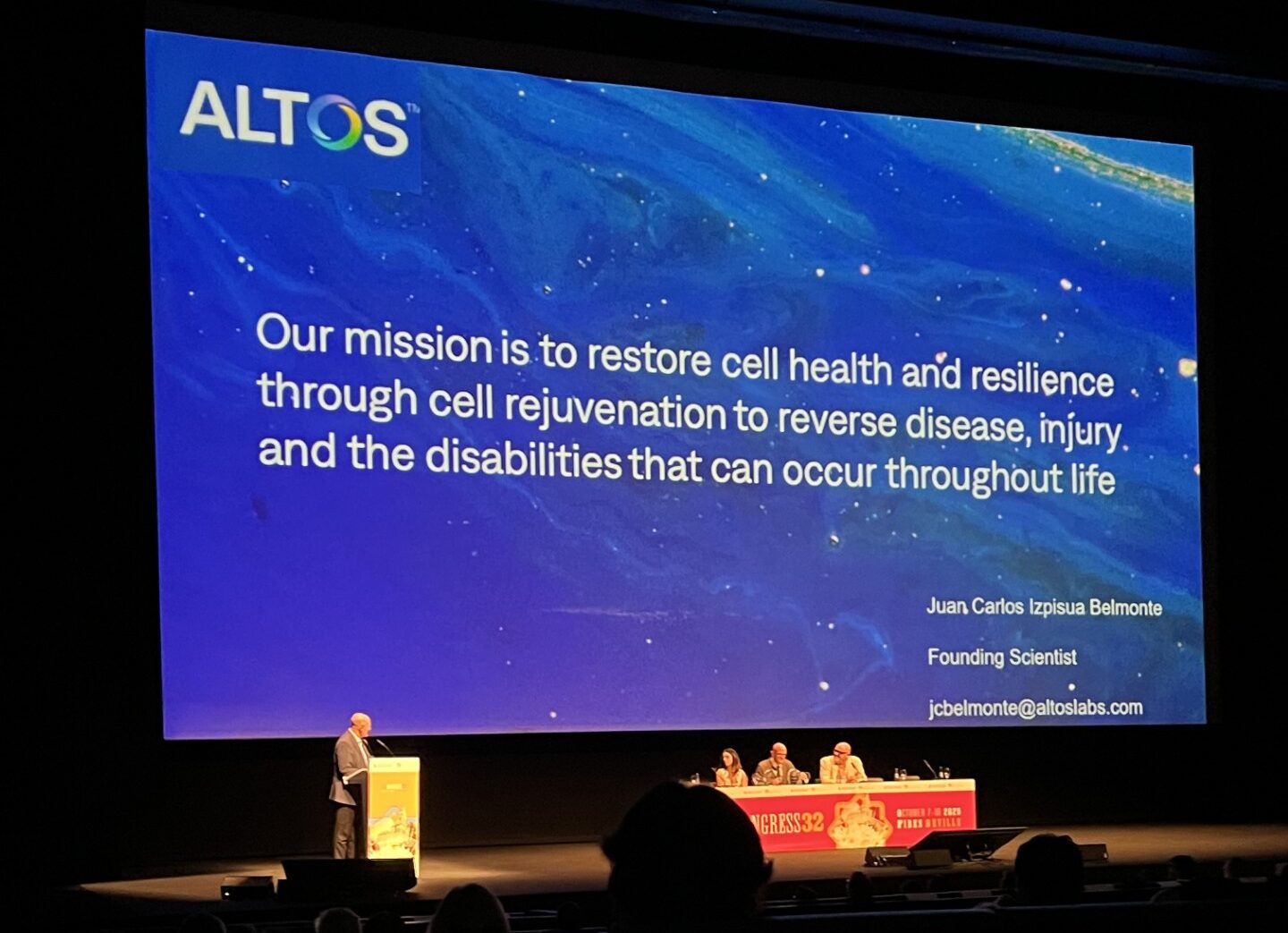
SEVILLE – It was fitting that the European Society of Gene and Cell Therapy (ESGCT) invited the noted Spanish stem cell biologist Juan Carlos Izpisúa Belmonte, PhD, to deliver the keynote address at this year’s conference in Seville. Thankfully, the police did not need to intervene in crowd control, as happened during his presentation at a conference in Boston two years ago.
The interest in Izpisúa Belmonte’s research on aging and longevity is understandable. He is a founding scientist of Altos Labs, the for-profit biotech company based in the San Francisco Bay Area, which launched in January 2022 with $3 billion funding—much of it from billionaire investor Yuri Milner. Izpisúa Belmonte joined almost two dozen leading scientists in such fields as stem cell biology, epigenetics, and biological clocks to launch the company. Little has been heard of them since.
Izpisúa Belmonte opened his ESGCT talk by presenting his “conflict of interest” slide, which featured Altos Labs’ mission statement:
Our mission is to restore health and resilience through cell rejuvenation to reverse disease, injury and the disabilities that can occur throughout life.
Buffer capacity
The “buffer capacity”—the ability of a cell or organism to respond to stress and maintain resilience—is high in young, robust cells, but declines as cells age and become frail. This contrasts with the risk of disease onset, which increases over time. Where these two paths cross “is where disease starts to appear and aging materializes,” Izpisúa Belmonte said.
Izpisúa Belmonte pointed to examples from the work of David Liu, PhD, and Francis Collins, MD, PhD, in using base editing to treat a mouse model of Hutchinson-Gifford progeria. (Patients with this rare Mendelian disorder usually die of premature atherosclerosis around age 10-15.) “Fixing a mutation that causes aging is not just removing damage but strengthening the buffer capacity of the organism,” he said.
Aging is the strongest risk factor for any disease, but Izpisúa Belmonte bemoaned the fact that “we don’t have a gene for age that we can fix.” Instead, he espoused the idea of increasing buffer capacity, “so disease will take longer, and aging may slow down.” He even offered the possibility of reversing this “deleterious process.”
One of the dozen hallmarks of aging in humans is epigenetic alterations. Izpisúa Belmonte focused on changes in chromatin conformation from ‘closed’ to ‘open’. In human aging, “you see an opening of chromatin,” he said. Well-known markers of chromatin modification (histone marker methylation) decrease in progeria.
Almost two decades ago, Japanese Nobel laureate Shinya Yamanaka, PhD (now an advisor to Altos Labs) performed a seminal experiment in chromatin remodeling, identifying a group of four so-called Yamanaka factors to return a specialized adult cell into an induced pluripotent stem cell.
Years ago, Izpisúa Belmonte and colleagues showed that histone markers switch on after treatment with these transcription factors. Izpisúa Belmonte’s lab went on to adapt Yamanaka’s protocol: instead of continuous expression, his lab tested short pulses of the factors in different mouse strains, resulting in an increased lifespan. This “epigenome buffering” produced mice that were indistinguishable to the treated progeria mouse model and he said has been extended to many other disease models and tissues.
Mesenchymal drift
Izpisúa Belmonte advocates a disease-agnostic approach, but first, he said, “we must understand the mechanism, something that is core to the cell.” His lab, including senior scientists William Tu, PhD, and Jinlong Lu, PhD, recently published in Cell their work on the role of “mesenchymal drift” in aging—one of the first major peer-reviewed reports published by Altos Labs investigators.
Izpisúa Belmonte’s group reported a “pervasive upregulation of mesenchymal genes” in dozens of human tissues, along with an altered composition of stromal cell populations. After pulsing with Yamanaka reprogramming factors, “we see closure of chromatin,” Izpisúa Belmonte said. He argued that the epithelial-mesenchymal transition (EMT) promotes cell delamination and migration during embryonic development in various tissues. When maladapted, this leads to disease.
EMT is the leading upregulated pathway during aging and many other diseases. This mesenchymal drift “seems to be a hallmark of aging tissues and diseases,” Izpisúa Belmonte said.
In idiopathic fibrosis, mesenchymal gene expression is upregulated in various cells including fibroblasts and endothelial cells. Patients with lower mesenchymal gene expression exhibit much longer survival times than those with higher gene expression levels, providing a marker for “survival expectation.”
In colon disease, mesenchymal drift may occur prior to full disease manifestation, Izpisúa Belmonte said, potentially contributing to disease progression and serving as a useful diagnostic marker. In kidney disease, “we see mesenchymal drift in cells that have not undergone disease process,” he said, noting that injured tubular cells secrete elevated stress-related proteins. Shifts in the state of a single cell type can thus alter the plasma secretome, influencing multiple tissues via endocrine cell signaling.
“Mesenchymal drift is not a symptom or noise, but a maladaptive program that expands across the organism,” Izpisúa Belmonte stated.
Clinical applications
Experimental evidence has been growing for decades that, in kidney transplantation, hosts typically survive longer when they receive a kidney from a younger donor. In experiments performed in collaboration with clinical colleagues in Barcelona led by nephrologist Josep Campistol, MD, the researchers perfused aged donor kidneys in mice with a pulse of Yamanaka factors before transplantation, observing a significant increase in survival.
This could lead to initial clinical applications in ex vivo organ reprogramming; Spain is a world leader in organ donation and transplantation. Izpisúa Belmonte also suggested that there was a possibility of rejuvenating human organs in vivo.
Increasing these promising findings regarding buffer capacity, chromatin reprogramming, and mesenchymal drift offers hope for the efforts of Altos and others to slow down aging and improve the outcome of many diseases.
