

To accelerate the discovery of new antibiotics, microbiologist Cesar de la Fuente develops computational tools to look for (“encrypted”) antimicrobial peptides hiding in the genomes of a wide range of organisms.
In the summer of 1928, Alexander Fleming, an English biologist, accidentally discovered that the mold Penicillium notatum inhibits bacterial growth. Fleming’s serendipitous finding brought penicillin—one of the first antibiotics—into the world.
Now, nearly 100 years later, scientists still look to nature to find new antibiotics. They dig up soil and collect water, trying to purify active compounds from these highly complex samples. This process takes many years—often longer than the average PhD program—and costs billions of dollars, but it still heavily relies on trial and error.
In hopes of accelerating antibiotic discovery, Cesar de la Fuente, a microbiologist at the University of Pennsylvania, develops computational tools to seek out new antibiotic candidates in the form of short protein fragments, or peptides. In his ambitious quest, de la Fuente scours the genomes of a wide range of organisms, from modern humans to the microbes that colonize their bodies and even mammoths, which went extinct thousands of years ago.
“Now, on the computer, in a few hours, we can discover hundreds of thousands of [antibiotic candidates],” de la Fuente said at the 2025 American Society for Microbiology annual meeting. “If we really push our resources, we can go from discovery to synthesis to testing in about one or two weeks—it’s really an amazing playground for scientists.”
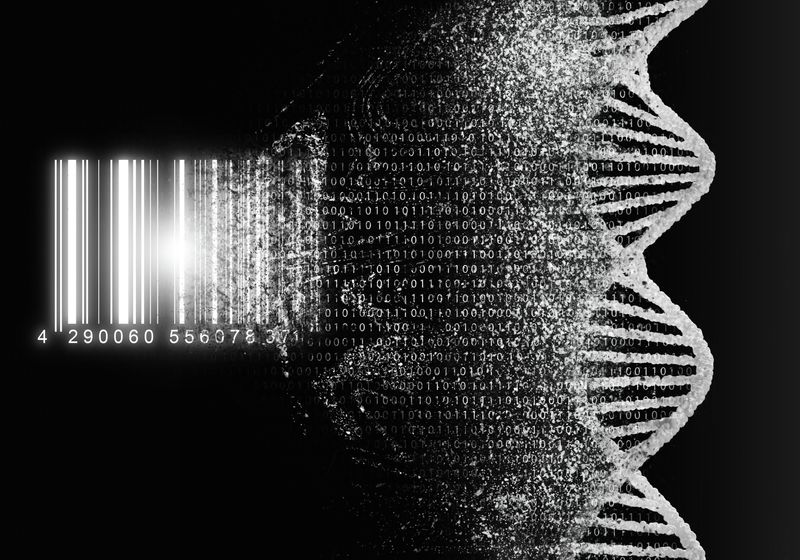
In 2022, de la Fuente developed a computational platform to mine the human proteome for peptides that may be promising antibiotic candidates.1 The tool’s algorithm operates like a barcode reader, de la Fuente explained. It scans protein sequences to look for regions that may have antimicrobial properties based on their physical and chemical characteristics. De la Fuente called these antibiotic candidates “encrypted peptides” because their sequences are hidden within those of proteins whose main functions may have nothing to do with antimicrobial activity.
In the study, de la Fuente’s team identified about 2,600 encrypted peptides from over 40,000 protein-encoding sequences (including isoforms). The researchers synthesized 56 of these peptides and discovered that approximately 60 percent indeed had potent antimicrobial activity. Comparing the encrypted peptides to known antimicrobial peptides in existing databases, the team found substantial differences, including that the encrypted peptides’ sequences were more hydrophobic and contained more arginine residues. These differences suggest that encrypted peptides likely represent a novel class of antibiotic compounds.
De la Fuente wondered if encrypted peptides also existed in the ancestors of modern humans, such as the Neanderthals and Denisovans, and how these peptides compared to the ones found in their present-day counterparts. To explore these questions, de la Fuente’s team came up with an approach to study how encrypted peptides evolve, which involved the resurrection of molecules from extinct organisms—they called this molecular de-extinction.2,3 This led to the discovery of neanderthalin-1 and mammuthusin-2, which are encrypted peptide antibiotics derived from Neanderthals and mammoths, respectively.
There is a lot of overlap between living and ancient biology, de la Fuente said, but the researchers are also uncovering a lot of new ground. “It’s expanding how we think about molecular diversity,” de la Fuente said. “By looking at ancient biology, we can bring back molecules that present-day pathogens have never seen.” But is it okay to resurrect molecules that don’t naturally exist in today’s world? To ensure that his team innovates responsibly, de la Fuente consults with bioethicists and science philosophers. For example, he said, “if we find amino acid sequences that look like a biotoxin or something like that, we just stop working on those.”
In addition to exploring past lives, de la Fuente also investigates the microscopic world. “We thought that [the human microbiome] is a great place to look for [new peptide antibiotics],” he said. “Microbes are using small peptides to fight each other off in a way of out-competing each other and colonizing specific niches in the body.”
De la Fuente recently collaborated with Luis Pedro Coelho, a computational biologist at Queensland University of Technology, to build an open-access catalog of antibiotic candidates from all microbes on Earth.4 The researchers uncovered nearly one million new antibiotic candidates by sampling microbes from water, soil, and humans. Of the 100 molecules that they synthesized, about 80 showed antimicrobial activity. De la Fuente hopes that other researchers will join their endeavor.
“We realize that it’s impossible for just my lab or Luis’s lab to do this,” de la Fuente said. “Everybody has access to all these molecules, and hopefully amongst the whole community of scientists around the world, we can take some of these molecules to the next stages.”
