
Close Menu
My Blog

    Subscribe to Updates

    Get the latest creative news from FooBar about art, design and business.

    What's Hot

    Nautilus debuts Voyager platform in push toward next-gen proteomics

    March 1, 2026

    First-in-Human Success for Prenatal Stem Cell Therapy in Spina Bifida

    February 28, 2026

    Pressure-Driven Pathway Links Liver Congestion to Fibrosis and Cancer

    February 28, 2026
    Facebook X (Twitter) Instagram
    X (Twitter) YouTube
    My BlogMy Blog
    Sunday, March 1
    • Home
    • About Us
    • Healthy Living
    • DNA & Genetics
    • Podcast
    • Shop
    My Blog
    Home»DNA & Genetics»Machine Learning Designs Intrinsically Disordered Proteins
    DNA & Genetics

    Machine Learning Designs Intrinsically Disordered Proteins

    adminBy adminOctober 9, 2025No Comments3 Mins Read
    Facebook Twitter Pinterest LinkedIn Tumblr WhatsApp VKontakte Email
    protein
    Share
    Facebook Twitter LinkedIn Pinterest Email

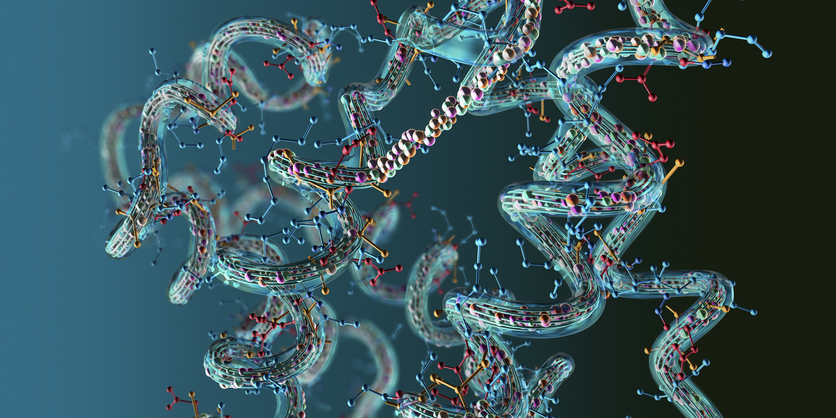
    For decades, scientists have relied on structure to understand protein function. Tools like AlphaFold have revolutionized how researchers predict and design folded proteins, allowing for new therapeutics and enzymes to be modeled in silico. But what happens when proteins don’t fold at all? Nearly 30% of the human proteome consists of shapeshifting, intrinsically disordered proteins (IDPs) that refuse to settle into a stable structure—and have remained beyond the reach of AI-based prediction tools.

    Now, researchers at the Harvard John A. Paulson School of Engineering and Applied Sciences (SEAS) and Northwestern University have developed a new way to bring order to this biological chaos. Their physics-based machine learning framework can design IDPs with custom properties, paving the way for deeper understanding of their biological roles and potential therapeutic use. The study, titled “Generalized design of sequence–ensemble–function relationships for intrinsically disordered proteins,” was published in Nature Computational Science.

    Unlike traditional protein design methods that depend on 3D structural templates, this new approach embraces disorder. “We needed to either come up with better AI models, or, we needed to come up with a way to actually take those physics models where you not only get good predictions, but you also get the physics for free,” said Krishna Shrinivas, PhD, senior author and assistant professor of chemical and biological engineering at Northwestern.

    At the heart of the method is automatic differentiation, a mathematical technique borrowed from deep learning that allows computers to compute derivatives automatically. Applied here, the algorithm performs gradient-based optimization on molecular dynamics simulations to identify amino acid sequences that exhibit desired ensemble behaviors.

    The researchers compare the process to a powerful search engine for amino acid sequences. By iteratively simulating and adjusting sequences, the framework learns how even single amino acid changes affect a protein’s overall behavior without relying on vast experimental datasets. “We didn’t want to have to take a bunch of data and train a machine learning model to design proteins,” said Ryan Krueger, a SEAS graduate student and co-lead author. “We wanted to leverage existing, sufficiently accurate simulations to be able to design proteins at the level of those simulations.”

    Using this framework, the team successfully designed disordered proteins that act as molecular loops, linkers, and environmental sensors, capable of responding to salt, temperature, or phosphorylation changes. These behaviors mirror how IDPs function in cells—serving as flexible connectors or switches that regulate signaling and assembly.

    By fusing machine learning with physical simulations, the method sidesteps the limitations of purely data-driven models, offering a generalizable framework for designing proteins that defy structural conventions. As Shrinivas and colleagues noted, future work may extend this approach to other complex biomolecules, including RNA and DNA, where flexibility drives biological function.

    Designs Disordered Intrinsically learning Machine Proteins
    Share. Facebook Twitter Pinterest LinkedIn Tumblr WhatsApp Email
    Previous ArticleThe girl who used to be my sister
    Next Article Montego Pet Nutrition brings African Innovation to the Netherlands with Karoo Wild and Bags o’ Wags treats
    admin
    • Website

    Related Posts

    A Video Report from AGBT

    February 27, 2026

    Novo Nordisk, Vivtex Ink Up to $2.1B Deal to Develop Oral Biologics for Metabolic Conditions

    February 27, 2026

    Increasing Rice Yields with Gene-Informed Selective Breeding

    February 27, 2026

    Mutant p53 Selective Reactivation Demonstrated in Advanced Solid Tumors

    February 27, 2026
    Leave A Reply Cancel Reply

    Our Picks

    9 Time-Saving Kitchen Gadgets for Fall at Amazon

    September 5, 2025

    Why Exercise Is So Important For Heart Health, From An MD

    September 5, 2025

    An Engineered Protein Helps Phagocytes Gobble Up Diseased Cells

    September 5, 2025

    How To Get Rid Of Hangnails + Causes From Experts

    September 5, 2025
    • Facebook
    • Twitter
    • Pinterest
    • Instagram
    • YouTube
    • Vimeo
    Don't Miss
    Longevity

    Nautilus debuts Voyager platform in push toward next-gen proteomics

    By adminMarch 1, 20260

    Company’s new benchtop system promises a clearer view of proteins following validation at a leading…

    First-in-Human Success for Prenatal Stem Cell Therapy in Spina Bifida

    February 28, 2026

    Pressure-Driven Pathway Links Liver Congestion to Fibrosis and Cancer

    February 28, 2026

    A cellular atlas of aging comes into focus

    February 28, 2026

    Subscribe to Updates

    Get the latest creative news from SmartMag about art & design.

    About Us

    At FineGut, our mission is simple: to enhance your self-awareness when it comes to your gut health. We believe that a healthy gut is the foundation of overall well-being, and understanding the brain–gut connection can truly transform the way you live.

    Our Picks

    9 Time-Saving Kitchen Gadgets for Fall at Amazon

    September 5, 2025

    Why Exercise Is So Important For Heart Health, From An MD

    September 5, 2025

    An Engineered Protein Helps Phagocytes Gobble Up Diseased Cells

    September 5, 2025
    Gut Health

    Nautilus debuts Voyager platform in push toward next-gen proteomics

    March 1, 2026

    First-in-Human Success for Prenatal Stem Cell Therapy in Spina Bifida

    February 28, 2026

    Pressure-Driven Pathway Links Liver Congestion to Fibrosis and Cancer

    February 28, 2026
    X (Twitter) YouTube
    • Contact us
    • Privacy Policy
    • Disclaimer
    • Terms and Conditions
    © 2026 finegut.com. Designed by Pro.

    Type above and press Enter to search. Press Esc to cancel.