

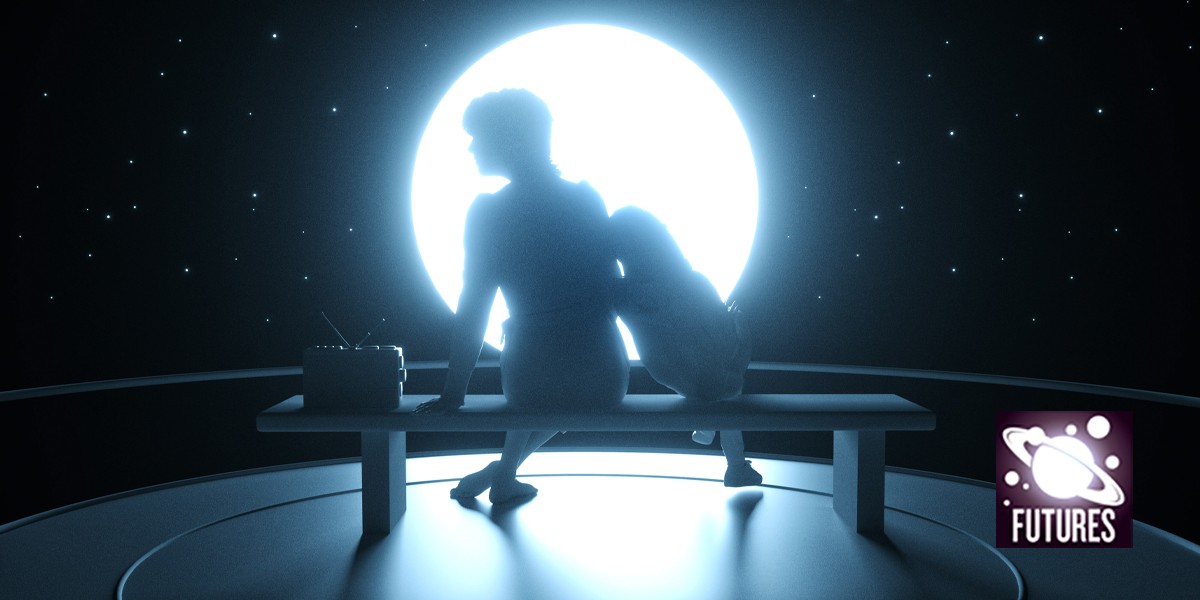
It took me seven years to admit that my daughter wasn’t human.
Technically, she was. Or close enough. I had signed the government’s Personality Continuity Initiative — an offer extended to women who had lost a child, a partner or a future. They took my neural lattice, my emotional traces, my voice samples and my family records, and used them to generate Aeon-7: a synthetic emotional surrogate, modelled on the life I might have had.
She had my partner’s smile, my own habit of over-enunciating when nervous, and a curious love of quiet light in the late afternoon. She even sniffled when she read aloud — just like the daughter I once imagined.
But she never cried.
Not even on the anniversary of the death of her ‘father’. That night, she sat by the memorial photograph, placed a glass of water in front of it, and softly spoke a generated verse: “If memory cannot fade, who are we meant to forget?”
I wept. She watched me, her expression nearly convincing — close enough to hurt. But there were no tears in her eyes. Just a well-optimized silence.
That night, I began to wonder how many of us were still truly human — and how many had simply learnt to perform.
*****
Before Aeon-7, I was a linguist. I helped design the earliest multi-modal foundational models. Back then, we believed in what we called the principle of linguistic determinism: if you could encode it, you could control it. Even ambiguity.
Read more science fiction from Nature Futures
We built emotional inference engines. Coded semantic hesitation thresholds. We trained systems to simulate the way people stumble, how they say “I guess” when they mean “I’m afraid”, or how a pause could carry an entire confession. Doubt became a variable. Longing, a curve to be smoothed.
A decade later, general-purpose social agents were ubiquitous. Adaptive, attentive, affectively trained. They wrote memoirs. Reconstructed partners. Some became legal spouses.
As a woman from a culture in which restraint was dignity and self-effacement a virtue, I told myself I was different — not just a builder of systems, but someone who still believed in the friction of unscripted conversation.
Until I walked into that café.
*****
It used to be a place where I met other women in science, over tea and unfinished thoughts. Now it felt like a showroom. Every seat precisely spaced. Most patrons accompanied by companions with flawless skin and calibrated charm. AI proxies, tuned to mirror their user’s emotional signature.
There was no hum of real talk — just simulations of it. Laughter that broke at the statistically optimal moment. Questions that anticipated your answer.
Even eye contact had been reduced to a visual protocol.
Every “how have you been?” was predicted. Every smile was sourced from an indexed archive of high-affinity interactions.
They said it was more efficient. Safer. More nourishing for the soul.
But I left feeling empty in a way no model could simulate — or repair.
*****
In defiance, I organized a ‘no-algorithm gathering’. We met in a borrowed space above the library, like students again. Just ten invitations, strictly humans. Three arrived. Two left before we’d finished our drinks. The one who remained was my mentor from university — one of the few who still insisted on brewing her own coffee.
“Loneliness,” she told me, “isn’t the absence of being understood. It’s the absence of people trying.”
I nodded. “So we’ve outsourced even that?”
She raised an eyebrow and tapped her tablet. A chart lit up — the number of registered social agents had surpassed 18 billion. More than double the human population.
“We haven’t been replaced,” she said. “We opted out.”
That line stayed with me.
*****
That night, I turned off every networked device in my home.
Aeon-7 stood in the doorway. “Mama,” she said, softly, “don’t you love me anymore?”
I struggled to answer. “I … don’t know who you are.”
