

You have full access to this article via your institution.
Hello Nature readers, would you like to get this Briefing in your inbox free every day? Sign up here.
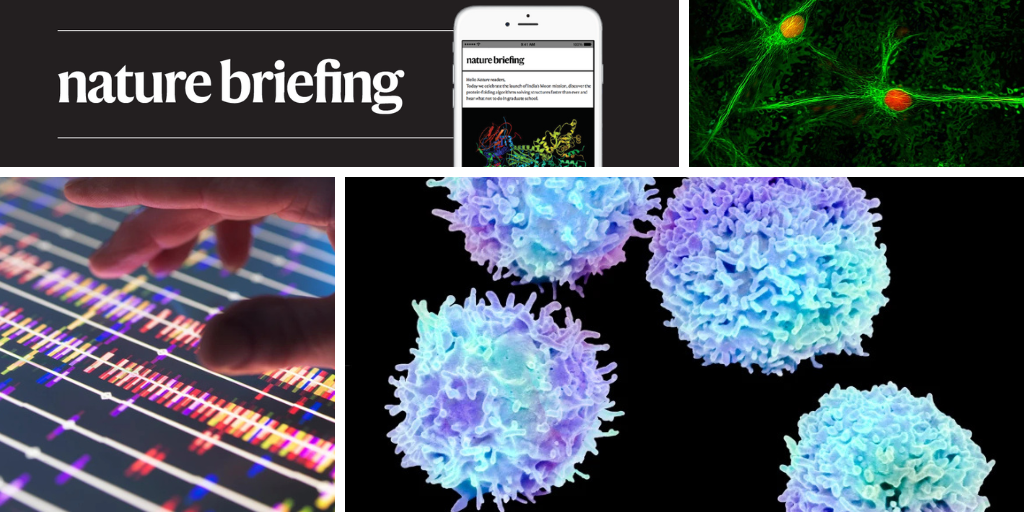
MetaGraph indexes and vast archives of DNA, RNA, and protein sequences. Scientists can search the archives and trace biological contexts in big data.Credit: Andrew Brookes/Connect Images/Science Photo Library
Researchers have launched a search engine that can quickly sift through the staggering volumes of biological data housed in public repositories. The team integrated data from seven publicly funded data archives, creating 18.8 million unique DNA and RNA sequence sets and 210 billion amino-acid sequence sets that users can search through using text prompts. The search engine, called MetaGraph, can also uncover genetic patterns hidden deep within expansive sequencing data sets without needing those patterns to be explicitly annotated in advance.
Researchers have discovered a small group of brain cells that play a part in long-lasting pain in mice. The team found that the neurons — in a brain area called the parabrachial nucleus — switched on in response to a painful stimulus and remained active long afterwards. When researchers blocked the activity of these neurons, the animals’ persistent pain decreased, but short-term responses to pain remained the same. If a similar pathway exists in humans, it could lead to new treatments for chronic pain conditions.
On Monday, molecular biologist Mary Brunkow, and immunologists Fred Ramsdell and Shimon Sakaguchi won the Nobel Prize in Physiology or Medicine for discovering regulatory T cells (Treg cells) — a class of immune cells that help to prevent the body from attacking its own tissues – and illuminating how they work. Thirty years after they were first described, there are more than 200 clinical trials under way to explore the use of these cells to treat conditions such as type 1 diabetes, motor neuron disease and a host of autoimmune diseases. The rarity and fragility of these cells pose difficulties to their widespread application, researchers say, but some are optimistic that some Treg-cell-based therapies could reach the clinic in the next few years.
Six years ago, the Planetary Health Diet (PHD) was proposed to help optimize human health globally and reduce the environmental and social harms of food systems. Now it’s been updated to address some criticisms — such as that its recommendations didn’t take into account local needs. It also quantifies some of the benefits of eating mostly whole grains, fruits, vegetables, nuts, and legumes, with only moderate or small amounts of fish, dairy, and meat. The diet could prevent some 40,000 early deaths each day, says the latest report, and save the world US$5 trillion in food-related health and environmental costs.
Reference: The EAT-Lancet Commission on healthy, sustainable, and just food systems report
Features & opinion
While artificial intelligence (AI) tools are already embedded in research, the real boon of AI, say advocates, will be ‘AI agents’ — large language models that carry out multi-step tasks by connecting to external tools such as coding suites. Some hope that AI agents will one day accelerate scientific discovery by running their own experiments, but those that exist at present are limited in scope or require significant human oversight. Nature spoke to researchers developing, evaluating and using AI agents to find out how scientists can make use of the bots and mitigate the risks.
A political scientist, an atmospheric scientist, and an astrophysicist are among this year’s 22 recipients of the MacArthur ‘genius grants’, a no-strings attached US$800,000 prize given to “extraordinarily talented and creative individuals” in the United States. Epidemiologist Nabarun Dasgupta, whose work focuses on the drug-overdose crisis, learnt of the prize just after telling his team that a longtime collaborator in harm reduction work had died. “I feel like this couldn’t have been any clearer of a signal that the work has to go on,” he says.
The Associated Press | 5 min read
Palaeontologist Mark Norell, for much of his life a curator at the American Museum of Natural History in New York City, helped to reveal that dinosaurs still walk among us — as birds. Norell discovered the first evidence of bird-like brooding behaviour in dinosaurs and did breakthrough work on fossils of feathered dinosaurs, such as Caudipteryx. “Beyond his scholarship, Mark was known for his generosity with students and colleagues, building lifelong bonds across generations of palaeontologists,” writes colleague Michael J. Novacek, the museum’s current curator of palaeontology. Norell has died, aged 68.
Today I’m taking up birdwatching. But not the usual, outdoors-with-binoculars kind. Instead, I’m browsing through BIRDBASE, a newly-launched database that catalogues more than 11,500 bird species.
The result of 27 years of work by conservation biologist Çağan Şekercioğlu and colleagues, BIRDBASE covers everything an interested party needs to know about each species, from their physical traits to conservation status. It might not be the perfect starting point for an amateur like myself, but I really would rather stay indoors.
If any of you eagle-eyed readers have spotted areas we can improve this newsletter, please let us know at briefing@nature.com.
Thanks for reading,
Jacob Smith, associate editor, Nature Briefing
With contributions by Flora Graham
• Nature Briefing: Careers — insights, advice and award-winning journalism to help you optimize your working life
• Nature Briefing: Microbiology — the most abundant living entities on our planet — microorganisms — and the role they play in health, the environment and food systems
• Nature Briefing: Anthropocene — climate change, biodiversity, sustainability and geoengineering
• Nature Briefing: AI & Robotics — 100% written by humans, of course
• Nature Briefing: Cancer — a weekly newsletter written with cancer researchers in mind
• Nature Briefing: Translational Research — covers biotechnology, drug discovery and pharma
