

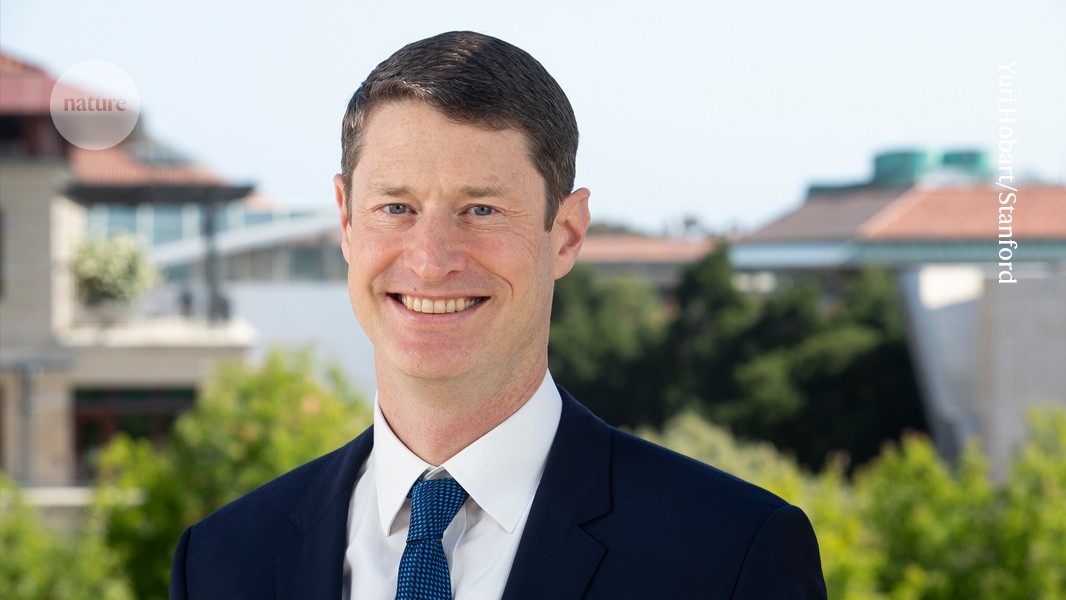
Jack W. Baker had to unexpectedly combat an accusation of plagiarism. It taught him something about keeping science transparent.Credit: Yuri Hobart/Stanford
More than ten years ago, my student and I were accused of misconduct. The issue was our just-published paper in a journal. Our accuser pointed to his own recent publication, which had a nearly identical scope to ours. He claimed we were aware of his previous work and had intentionally not cited it because of a lack of “scientific ethics”. He also alleged that we had abused our privilege, characterizing us as a well-known research group that deliberately ignored work from what he described as a smaller and less affluent country.
The accuser made his claim to the journal editor, and submitted a Comment article with this accusation, which he requested the journal publish as an addendum to our paper. The editor contacted us to review the accusation and offer a response, before she decided whether to publish it. She was dispassionate and didn’t indicate what outcomes she was considering. This was professionally appropriate while she was gathering information. But my student and I were in shock. As an assistant professor still building confidence in my work, I had no experience navigating an accusation of this kind.
Building our defence
We took some time to study the accuser’s original paper, and the similarities to ours were alarming. It tackled a problem similar to ours and proposed the same set of equations to develop a solution. These equations were identical, even down to minor notational choices. This was more than a case of needing to add citations to previous related work — plagiarism seemed to be involved. No wonder the journal editor took the claim seriously.
Should I tell anyone that I suspect misconduct in a paper I’m reviewing?
The two papers had been submitted to different journals a year earlier. We had submitted ours a few weeks earlier, although our accuser’s got through the review process faster. But our journal paper wasn’t our first public contribution of these ideas: we dug up two preliminary project documents from the previous few years that we’d published on our group’s website. They contained the same notation and equations, as well as similar results.
The documents were the sort of things we’d now add to a public repository or preprint server, but at the time, these were not yet in vogue in our field. Our accuser had cited other materials from our website in his original paper, but not these two documents.
We surmised that the commenter had used the work published on our website to form the basis of his own paper and then submitted it to a journal, presenting our preliminary results as his own.
Crafting a response
With the evidence in hand, we replied to the journal editor to explain what we thought had happened (edited for anonymity):
We have been researching this topic for several years, culminating in the publication being discussed here. Our preliminary work has been publicly available for several years, including a project report and a conference presentation. The commenter is clearly aware of our work, as they cite seven other documents available on our website but not the specific ones described above. The above documents were announced on our website at the time of their release and have been continually available. Some of the complex notation in our early documents is identical to the commenter’s paper and our eventual paper: [details and examples listed]. It thus seems clear to us that the commenter copied the terminology, equations and figures from our preliminary work (publicly available for several years), submitted his paper, and is now trying to claim to be the original creator of ideas he copied from us. We believe that the submitted claims are not supported by facts, would only serve to confuse readers and offer no intellectual contribution. We thus suggest that the comment be rejected.
The resolution
The journal editor understood and accepted our perspective and rejected the Comment article. Our accuser never contacted us directly. I’m still unsure what he hoped would happen, and uncertain whether he anticipated that we could rebut and stop his Comment from being published. At the time, I was just happy to avoid a public accusation, and I never seriously thought about alleging misconduct to the journal that published his paper. Both papers remain available today, and I’ve never had a reader enquire about duplication of the two documents.
