

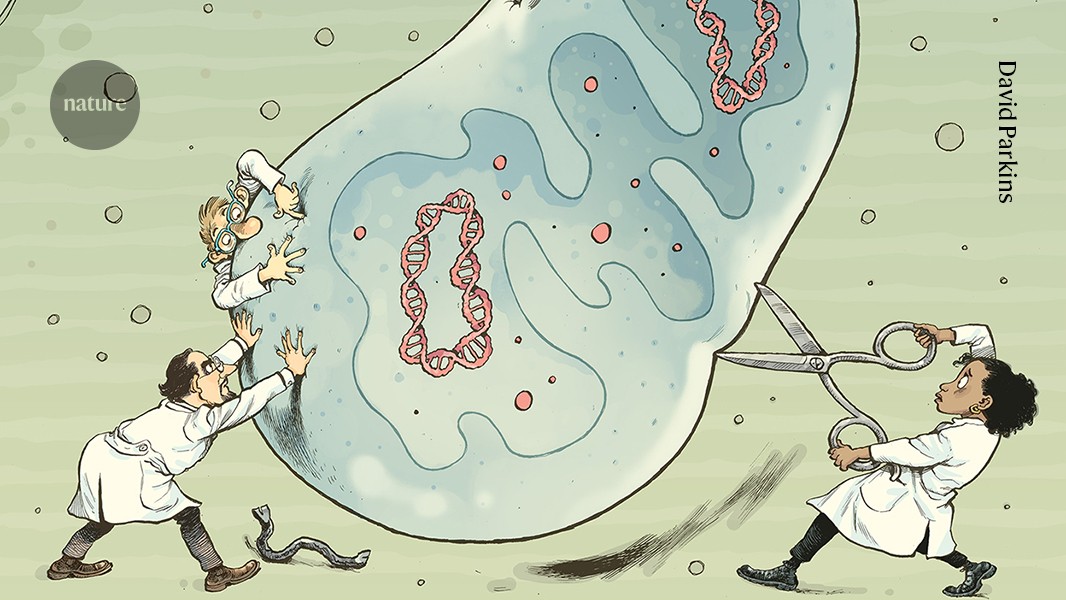
CRISPR gene editing has made its way into every corner of modern biology, but not into every corner of the cell. Although researchers have used these systems to develop treatments for sickle-cell anaemia and blood cancers, to unlock the secrets of multicellularity and to discover the role of thousands of overlooked proteins, there’s one place CRISPR can’t easily reach: mitochondria.
Cancer cells get power boost by stealing mitochondria from nerves
The rings of DNA inside mitochondria are inaccessible to these techniques, which means that precise edits to mitochondrial DNA (mtDNA) remain frustratingly out of reach. “Mitochondria missed the CRISPR–Cas9 revolution that exploded 12 years ago,” says Michal Minczuk, a geneticist at the University of Cambridge, UK.
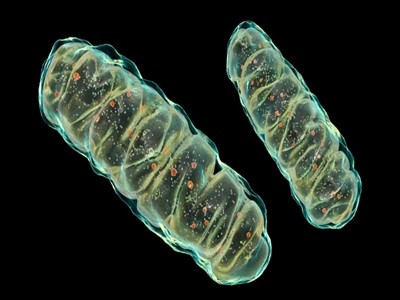
But researchers are eager to access this DNA, says Minczuk. Mitochondria are bean-shaped organelles that power cells and have myriad other cellular tasks. Exploring their DNA is essential for understanding the energy production and exchange that underlies metabolic health. And more than 300 mutations in this DNA cause mitochondrial diseases — incurable genetic disorders with a wide range of symptoms that can rob people of their sight and hearing, trigger muscle problems and spark seizures1. These disorders affect roughly 1 in 5,000 people.
Because CRISPR can’t help with these problems, researchers have been looking for other ways to precisely edit the mitochrondrial genome. And the past few years have brought some success: the tools are already proving to be a boon for creating accurate animal models of mitochondrial diseases. “The progress has been remarkable,” says Jin-Soo Kim, a chemical biologist who develops mtDNA editing tools at the Korea Advanced Institute of Science and Technology in Daejeon, South Korea.
If researchers can make mtDNA editing safe and accurate enough, it could eventually be used to treat, and even cure, these genetic conditions. “It would be a medical breakthrough,” says Kim.
A bacterial origin
The exact origins of mitochondria are murky, but the leading theory holds that the organelle’s story started around 1.5 billion years ago when a single-celled microorganism called an archaeon gobbled up a roaming bacterium that survived inside its host. This event marked the beginning of the eukaryotes — the large group of organisms, including plants, animals and fungi, in which cells contain organelles that are enclosed inside membranes. The swallowed bacterium retained its characteristic circular DNA as it settled into its new home, but over time it sacrificed most of its genes to the nuclear genome of its host.
In the evolutionary lineage that gave rise to humans and other animals, this genetic transfer whittled the resident bacterium’s genome down to just 37 genes that code for 13 proteins involved in energy production, turning it into a specialized organelle.
Mitochondria expel tainted DNA — spurring age-related inflammation
The small amount of mitochondrial DNA that stuck around in animals differs in key ways from nuclear DNA, which in humans encodes around 20,000 genes. For a start, mtDNA is typically inherited solely from the mother. There can be several copies of mtDNA in each mitochondrion, and the organelle has its own built-in machinery for making RNA and proteins from that DNA.
Mitochondrial DNA is also much more error-prone, with a mutation rate estimated to be 10–20 times greater than that of nuclear DNA. This is in part because it has to contend with a barrage of damaging reactive oxygen species — unstable molecules that are generated in mitochondria during normal energy production. But it’s also because it doesn’t have histones: the proteins that protect and package nuclear DNA.
Compared with its counterpart in the nucleus, mtDNA’s toolkit for repairing itself is rudimentary. The nucleus is quick to fix a snapped DNA strand using an arsenal of repair mechanisms, but mitochondria can mend only some defects. They often simply throw away their broken DNA. This difference limits the options for gene-editing tools, because nearly all such tools for nuclear DNA use its inherent repair pathways.
It has been notoriously challenging to develop approaches for modifying mitochondrial DNA, says Stephen Ekker, a molecular biologist at the University of Texas at Austin. “Its bacterial origins are revealed when you start trying to edit it,” he says.
The most crucial hurdle for scientists trying to tinker with the mitochondrial genome is that it is locked behind a wall of membranes that doesn’t allow external nucleic acids to pass into the organelle. Although there have been hints that CRISPR-based gene-editing tools — which rely on RNA to guide them to the correct sequence — might be able to overcome these barriers, many researchers remain unconvinced.
Snip and trash
Still, there are other ways in. More than a decade before CRISPR became a research tool, mitochondria researchers began experimenting with other editing tools that could cross mitochondrial membranes and coax the organelles into ditching their problematic DNA2.
Every cell contains a vast number of mitochondrial genomes, because cells contain thousands of mitochondria and each one can carry several copies of mtDNA. Healthy and mutated mtDNA often coexist: a state known as heteroplasmy. It’s when the proportion of mutated mtDNA reaches 60–80% in a particular tissue or cell type that mitochondrial diseases manifest3.
Cells are swapping their mitochondria. What does this mean for our health?
If researchers could reduce the faulty copies of mtDNA in cells, they could eliminate the resulting disease. So, they turned to enzymes called zinc finger nucleases (ZFNs) and transcription activator-like effector nucleases (TALENs) to snip the double-stranded mtDNA. Whereas targeted snipping of nuclear DNA cajoles the cut DNA strands to glue themselves back together without the harmful mutation, the cut DNA in mitochondria is simply cast out. This elimination triggers the remaining intact copies to replicate themselves so that the correct level of mtDNA is maintained.
In most cases, the mutated copies will be reduced to an acceptable level as the normal copies are replicated. “That’s going to make up for what you’re destroying,” says Carlos Moraes, a geneticist at the University of Miami in Florida.
Although there has been progress with this approach, it hasn’t made its way out of the laboratory. And even if it did reach the clinic, the technique would be powerless against diseases caused by mutations that are often present in all copies of a person’s mtDNA, such as Leber’s hereditary optic neuropathy (LHON), a rare condition that causes rapid vision loss.
What researchers need are tools that do more than cut DNA but that don’t rely on guide RNA.
CRISPR-free base editing
When CRISPR–Cas9 emerged as a tool in 2012, it became the go-to gene editor for all kinds of application. A guide RNA directs the Cas9 enzyme to a specific DNA sequence, where the enzyme does the cutting. Genetic changes are introduced as the DNA repairs itself.
The approach became even more useful in 2016, when David Liu, a chemical biologist at the Broad Institute of MIT and Harvard in Cambridge, Massachusetts, and his colleagues introduced a more precise technique called base editing4. In this case, researchers modify the Cas9 enzyme and rely on another enzyme, called a deaminase, to convert one DNA base letter to another — such as cytosine (C) to thymine (T) or adenine (A) to guanine (G).
Hope, despair and CRISPR — the race to save one woman’s life
Although base editing and other CRISPR techniques took off for nuclear DNA, Liu and other research teams couldn’t get it working on mtDNA. Because CRISPR’s guide RNA doesn’t readily pass through a mitochondrion’s double membrane, using precise tools on mtDNA remained a pipe dream. “We did not have much success,” says Liu.
A solution materialized in 2018 when Joseph Mougous, a microbiologist then at the University of Washington in Seattle, and his colleagues stumbled across a toxin made by the bacterium Burkholderia cenocepacia. This enzyme, a deadly weapon against other bacteria, wreaks havoc by ultimately converting base C to T across the bacterial genome5.
Mougous, now based at Yale University in New Haven, Connecticut, e-mailed Liu asking whether the enzyme, called DddA, would be of any use to him. “I knew exactly what it might be used for — base editing mtDNA!” says Liu.
But switching every C to a T would be lethal to cells. Liu and his colleagues set out to “tame the beast”. They split DddA into two inactive pieces so that the enzyme would do its handiwork on mtDNA only when the pieces were brought together in a particular orientation. And instead of using guide RNA, Liu and his colleagues modified proteins found in TALENs to direct the DddA segments to their target sequences (see ‘Making the edit’).

