

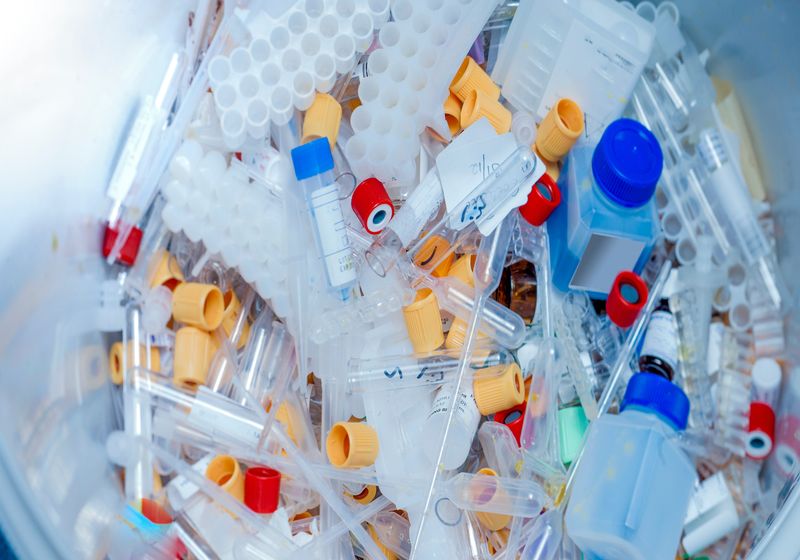
Every experiment produces results—and byproducts. Plastics, solvents, and energy use add up quickly in research settings, but a growing number of laboratories are showing that waste doesn’t have to be an unavoidable cost of discovery. New approaches are turning what was once seen as inevitable into a space for innovation.
At the Rethinking Waste session of the My Green Lab Summit 2025, experts from academia, biotech, and healthcare argued that the future of laboratory sustainability lies not just in new technologies but in new ways of thinking. By reframing waste as a resource challenge—one that can be addressed through smarter procurement, cultural change, and recycling innovation—labs are beginning to prove that meaningful reductions are possible without compromising scientific progress.
Starting with Procurement and Communication
In January, Catherine Fleming, research associate at the University of Birmingham, was tasked with investigating sustainability practices across the College of Life and Environmental Sciences. The timing coincided with preparations for Green Impact Lab accreditation, providing her with the opportunity to examine procurement, waste management, energy use, data storage, and plastics management.
“From the investigation, what I found as a good place to start [was] for the labs to log everything that they’re buying, who they’re buying it from, and who the procurement people are,” Fleming said. She explained that this kind of tracking would help bring transparency and reduce confusion.
She added that stronger purchasing decisions could be made by prioritizing energy-efficient equipment, integrating life cycle cost analysis into major investments, and collaborating with suppliers offering greener chemical options that are already price-matched.
Fleming also pointed to persistent gaps in communication. “There were quite a few take-back schemes available to the labs in the universities, but they just didn’t know about them,” said Fleming. For example, contracts allowing vendors to collect and reuse glass bottles—but many labs were unaware such options existed.
Waste Streams, Step by Step
For Magnus Bergner, senior project manager at RG Discovery, reducing waste was as much about culture as it was about technical targets. When the company committed to pursuing My Green Lab certification across its facilities, the scope of the work initially discouraged staff. “What they saw was the mountain of work before them, not the path,” Bergner recalled.
To shift that mindset, the team broke large goals into smaller, manageable steps. One simple change was keeping fume hood sashes closed. “A normal fume hood pulls the same kind of power as four to five normal-sized houses in a year if it stands fully open. By … moving the sash down a little bit, that saves us quite a lot of energy,” Bergner said. Adding smiley-face reminders to the hoods reduced ventilation energy by 20 percent in just two weeks.
Other adjustments focused on transport and water use. Consolidating supplier deliveries across multiple companies into a single weekly shipment cut transport emissions by up to 95 percent, while switching to central vacuum systems and recirculating cooling for evaporators eliminated the waste of six liters of clean water per minute.
These incremental changes, Bergner noted, encouraged colleagues to contribute their own ideas. “Now it’s always there—if we do this, we also get a sustainability thing from that. And that’s a major shift in the mindset of people.”
Tackling Plastics and Hazardous Waste
Sean Fitzgerald, director of research and academic safety at Hackensack Meridian Health, highlighted both the scale of the issue and the opportunity for progress. “Accounting for only .1 percent of the population, scientists create approximately 5.5 million tons of plastic waste annually in life sciences alone, which accounts for two percent of plastic waste produced worldwide,” he said.
“You know [the saying], ‘You can eat an elephant one bite at a time,’” Fitzgerald continued. “[Sustainability] isn’t a problem you can tackle holistically and say, ‘We’re going to reduce all waste.’ That’s a great idea, and that sounds wonderful, but that’s not practical. You have to come up with practical solutions to tackle each of these different waste streams, and they also all come under very heavy regulatory burdens.”
He pointed to tangible examples already making a difference: replacing radiolabeling with CRISPR labeling to reduce radioactive waste, partnering with vendors on chemical buyback programs, and tightening reproducibility standards to avoid unnecessary experiments.
Fitzgerald noted that shifting long-standing practices takes persistence, especially when established researchers are cautious about change. Yet, step by step, practical solutions are showing that progress is possible.
Technology and Recycling Innovation
Closing out the session, Paul Woodstock, president of Envetec, highlighted how technology can transform contaminated lab plastics into reusable material. He described the company’s Generations system, designed for use directly in laboratories, where it shreds, disinfects, and pelletizes items such as petri dishes and pipette tips into clean polymer feedstock. Treating waste on-site avoids the need to ship contaminated plastics off for incineration or landfill, reducing both safety risks and transport emissions.
In one case study, a microbiology lab ran 600 petri dishes through the system. The material was shredded, disinfected, and then extruded into pellets—clean plastic that began as single-use labware. Woodstock said the process can recover 75 percent of material from biopharma waste, 82 percent from clinical waste, and even higher percentages from general laboratory plastics like pipette tips and microplates.
Envetec frames the output as part of a circular economy: the pellets can re-enter manufacturing supply chains as raw material, rather than being treated as sterilized waste. The company also claims that the process cuts emissions from waste treatment by up to 90 percent and reduces transport-related emissions by more than 90 percent compared to traditional disposal methods. Its approach has earned ACT label certification in the US, UK, and Europe.
“Everybody’s goal is to reduce, reuse, and recycle—but most importantly, to keep it out of landfill,” Woodstock said.
From Incremental Fixes to Systemic Change
Laboratory waste is not an inevitable cost of science, but rather a challenge that can be addressed from multiple angles. Whether through procurement, culture, or technology, progress comes from embedding sustainability into daily decisions rather than treating it as an afterthought. Small interventions build momentum, and over time, they reshape how research environments operate.
Rethinking waste, then, is less about a single breakthrough and more about shifting perspective—seeing byproducts not as burdens, but as opportunities to innovate and reduce impact.
This article was republished from Lab Manager. Read the original article.
