

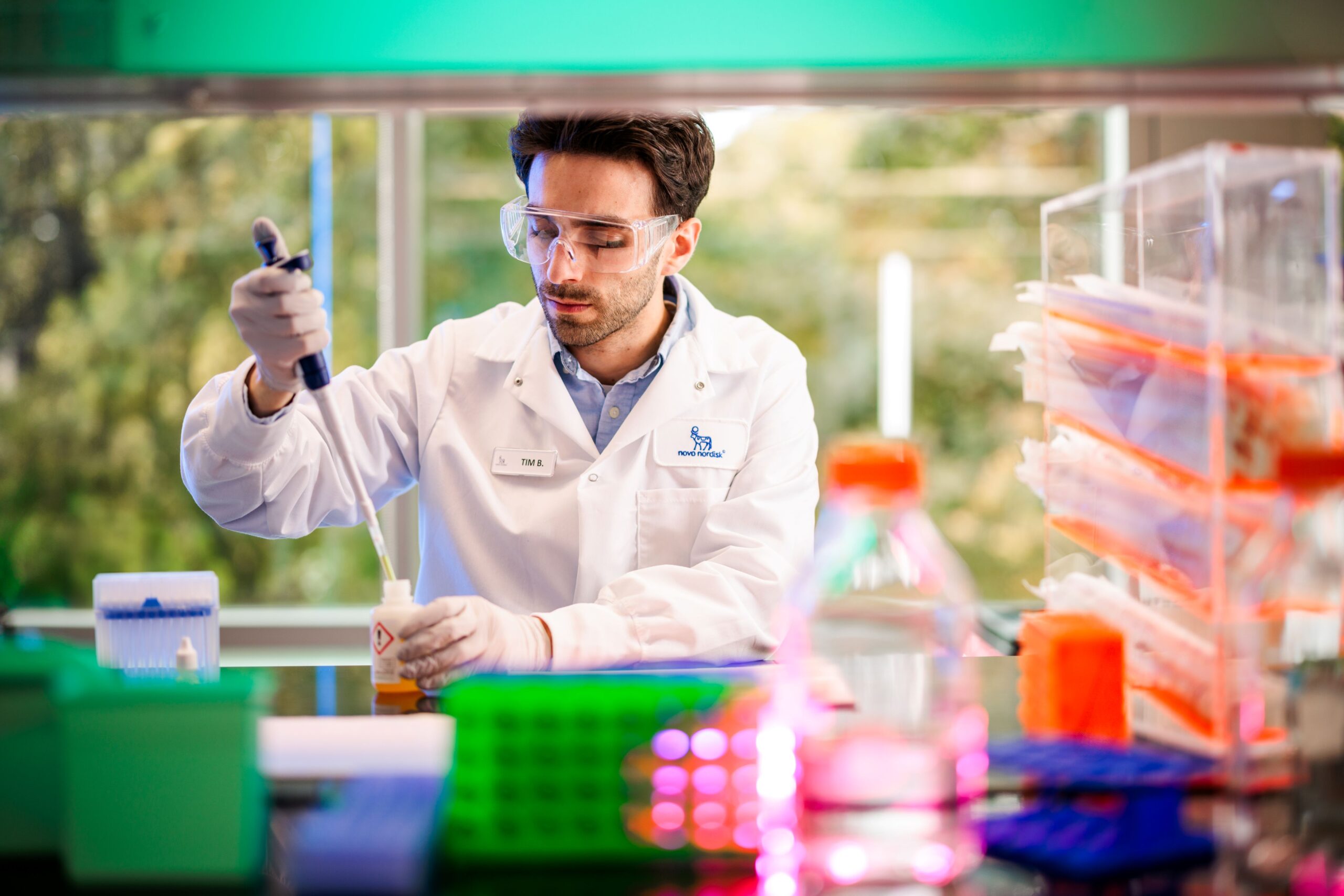
If developing drugs for metabolic dysfunction-associated steatohepatitis (MASH) were a poker game, you could say Novo Nordisk (NASDAQ Copenhagen: NOVO-B) saw a competitor’s bet and raised the stakes with its planned up-to-$5.2 billion acquisition of Akero Therapeutics (NASDAQ: AKRO).
Akero, based in South San Francisco, CA, brings to Novo Nordisk a Phase III fibroblast growth factor 21 (FGF21) analogue efruxifermin (EFX) that the Danish-based buyer has trumpeted as a potentially best-in-class treatment for MASH. EFX is now in Phase III studies for the treatment of moderate to advanced liver fibrosis (F2-F3) as well as for the treatment of cirrhosis (F4).
And Novo Nordisk showed how eager it was to get its hands on EFX, since it agreed to pay upfront 90% of the potential deal value, or approximately $4.7 billion.
Why pay so much? One key reason is EFX’s strong clinical data. In January, Akero released positive preliminary topline 96-week data from the Phase IIb SYMMETRY trial (NCT05039450) assessing EFX in patients with biopsy-confirmed compensated cirrhosis (F4), Child-Pugh Class A, due to MASH.
Data from SYMMETRY showed that among 134 patients with baseline and week 96 biopsies, 39% of the 46 patients treated with 50 mg EFX had their cirrhosis reversed with no worsening of MASH vs. 15% of the 47-patient placebo group. In the trial’s 181-patient Intent to Treat (ITT) population, with all missing week 96 biopsies treated as failures, 29% of patients in the 63-patient 50 mg EFX group saw reversal of cirrhosis with no worsening of MASH, compared to approximately 12% in the 61-patient placebo group.
“Leading treatment” potential
“It is the only FGF21 analogue that has demonstrated fibrosis regression in the late-stage F4 segment in a long Phase II trial,” Novo Nordisk president and CEO Maziar (Mike) Doustdar explained, addressing analysts on a conference call announcing the Akero acquisition. “We therefore believe that efruxifermin has the potential to become a leading treatment option within the treatment intensification segment of MASH, with efficacy anticipated to outstrip that of incretins as monotherapy in late-stage fibrosis cases.”
Among those incretins is Novo Nordisk’s blockbuster obesity/weight maintenance drug Wegovy® (semaglutide), a glucagon-like peptide 1 (GLP-1) agonist, which in August won additional FDA approval to treat MASH in adults with moderate-to-advanced liver fibrosis (F2-F3). The company held off commenting on the success of its launch during the call until after it released third-quarter results.
Wegovy’s approval for MASH was based in part on 72-week data from the Phase III ESSENCE trial (NCT04822181) showing 62.9% of people treated with semaglutide 2.4 mg achieved resolution of steatohepatitis with no worsening of liver fibrosis (vs. 34.3% of placebo patients), while 36.8% of semaglutide patients saw improvement in liver fibrosis with no worsening of steatohepatitis (vs. 22.4% on placebo).
In MASH, Wegovy treats the same adults that were successfully treated by Akero with EFX in another Phase IIb trial, HARMONY (NCT04767529). According to data published August 14 in The Lancet, in HARMONY’s 126-patient modified intent-to-treat population, 21 of 43 patients (49%) treated with 50 mg of EFX showed a ≥1-stage fibrosis improvement without MASH worsening vs. 8 of 43 patients (19%) in the placebo group.
“Efruxifermin resulted in greater improvements in fibrosis than placebo after 96 weeks, warranting further investigation in Phase III trials,” researchers concluded.
“Overall, the MASH market is in its early stages, and we aim to develop a portfolio spanning across the disease stages of MASH,” Doustdar added.
Among its competitors in MASH is Madrigal Pharmaceuticals (NASDAQ: MDGL), which last year won an historic accelerated approval for its MASH therapy Rezdiffra™ (resmetirom), the first drug ever approved to treat the disease. Rezdiffra was approved for the treatment of adults with noncirrhotic MASH with moderate to advanced liver fibrosis (consistent with stages F2 to F3 fibrosis), in conjunction with diet and exercise.
It’s too early to tell if analyst predictions of Rezdiffra becoming a blockbuster as early as 2026 will come true. The drug generated $180.1 million in sales last year and $350.052 million in the first six months of this year—short of the billion-dollar-a-year “blockbuster” benchmark.
One-upping a competitor
Beyond positive data and pipeline building, another key reason for Novo Nordisk’s interest in EFX and Akero was an apparent desire to one-up a competitor.
Novo Nordisk’s deal comes a month after Roche (SIX Swiss Exchange: ROG) expanded its MASH pipeline beyond a single Phase I candidate, the anti-TL1A monoclonal antibody RG6631 (afimkibart). Roche agreed to shell out up to approximately $3.5 billion to buy out 89bio (NASDAQ: ETNB), a deal expected to close this quarter. At the time, one analyst said that the driver of the deal—89bio’s lead candidate pegozafermin—was one of two Phase III FGF21 analogs for MASH that Roche could have acquired, the other being Akero’s EFX.
“With basically two acquisition targets available to Roche in the FGF21 space, we believe Roche got a relative bargain for a late-stage Phase III asset,” the analyst, Edward Nash of Canaccord Genuity, wrote in a research note.
Nash followed up by saying Novo was likely to end up with the best FGF21 analog at the best price compared to Roche and another biopharma giant GlaxoSmithKline (GSK), which in July acquired the lead asset of Boston Pharmaceuticals, the Phase IIb candidate efimosfermin, for up to $2 billion ($1.2 billion in upfront cash, $800 million in milestones).
“Good fit? Definitely!”
“A good fit? In our view, definitely!” Nash wrote. He noted that GSK and Roche have never been known as MASH drug developers.
“That is not to say they cannot run successful trials for a metabolic indication, but MASH is not one of their core indications from a business standpoint,” Nash explained. “Novo, on the other hand, is by far historically and currently one of the most active Pharma players in the space across multiple mechanisms. We feel that they are the perfect fit for a drug like efruxifermin and definitely know the space well.”
Investors didn’t seem quite as enthused. Akero shares only jumped 16% on Thursday on news of the Novo Nordisk deal, from $46.49 to $54.08—instead of the one-third or higher surge that companies typically see when niche drug developers are acquired by a big-name biopharma. The stock barely budged Friday, dipping 0.4% to $53.88, then down another 0.4% to $53.66.
At $54 a share upfront, the Akero-Novo Nordisk offers investors only a 16% premium from Wednesday’s close. Investors will also receive a non-transferable contingent value right (CVR) entitling them to another $6 per share if Novo Nordisk wins U.S. regulatory approval of EFX for compensated cirrhosis due to MASH by June 30, 2031.
Novo Nordisk shares on NASDAQ Copenhagen slipped 1.25% Thursday, from DKK 384.40 ($59.50) to DKK 379.60 ($58.76), dipped another 0.7% to DKK 376.95 ($58.34) on Friday, and slid a further 0.9% to DKK 373.55 ($57.82). That result suggests that investors were not as wowed as Novo Nordisk and Doustdar, who inked the company’s largest-ever merger-and-acquisition deal by purchasing Akero.
Since Doustdar succeeded Lars Fruergaard Jørgensen as CEO on August 7, Novo Nordisk shares have risen 22% from DKK 308.85 ($477.97). However, the stock is still down year-over-year, having nosedived 53% in the year since it closed at DKK 802.50 ($124.64) on October 10, 2024, as investors remain concerned over the competitive challenge posed by growing competition from rival obesity and diabetes drug developers.
Novo Nordisk aimed to address those concerns last month when it laid off about 9,000 of its 78,400 employees, 11.5% of its global workforce.
Akero’s key role in Roche deal
Akero’s positive EFX data played a key role in Roche’s planned buyout of 89bio.
About two weeks after the deal was announced on September 18, 89bio disclosed in a regulatory filing that it had been in talks with Roche stretching back to March 2023, when 89bio entered into a nondisclosure agreement with Roche’s Genentech subsidiary to discuss “a potential business combination, collaboration, or partnership.”
Genentech was the only company named among the 14 “global and regional biopharmaceutical companies” that had engaged 89bio, according to the October 1 filing. If Novo Nordisk was among those companies, 89bio did not say so.
The filing also revealed that Roche stepped up its due diligence into 89bio after seeing Akero’s positive MASH data from the SYMMETRY trial.
“Shortly thereafter, representatives of Parent [Roche] conveyed that Akero Therapeutics, Inc.’s data were a positive indicator for the class and that Parent [Roche] wished to assemble a cross-functional team to engage in diligence with the intent of exploring a potential collaboration with 89bio,” according to 89bio.
What followed were talks between Roche and 89bio that initially focused on a manufacturing deal for pegozafermin, then expanded at 89bio’s suggestion into acquisition talks. Both companies negotiated on a share price before agreeing ultimately to up to $20.50 ($14.50 upfront, $6 in CVs tied to achieving three milestones).
Roche, like GSK and now Novo Nordisk, is eager to carve out places in what is shaping up to be a rapidly growing market for MASH treatments. That market stood at $2.47 billion last year and is expected to expand at a compound annual growth rate of 16.8% to $8.38 billion by 2033, according to Growth Market Reports.
Intellia data lifts gene editing shares
The past month has been a bullish one for the stocks of gene editing therapy developers led by Intellia Therapeutics (NASDAQ: NTLA) as its investors embraced its announcement of positive clinical data in hereditary angioedema (HAE) and transthyretin amyloidosis (ATTR)—while the good vibes extended to the shares of other companies in the space.
Intellia shares climbed 19% last week, from $20.54 on October 6 to $24.52 on Friday. Much of the surge consisted of a one-day 20% jump from $20.44 to $24.47 on Wednesday after Birgit Schultes, PhD, Intellia’s executive vice president and CSO, presented updates on three of the company’s ongoing clinical programs at a plenary session during the European Society of Gene and Cell Therapy (ESGCT)’s Annual Congress, held in Seville, Spain.
Schultes shared data from the Phase I/II trial (NCT05120830) showing that lonvoguran ziclumeran (lonvo-z), the gene editing candidate previously called NTLA-2002, successfully treated HAE by reducing kallikrein levels to less than 60% up to and beyond two years after treatment at all doses. The 50 mg dose offered the best results among the 27 patients studied in Phase II, with 70% of those patients showing a complete response.
Lonvo-z for HAE is now under study in the Phase III HAELO trial (NCT06634420), which completed patient enrollment last month. Intellia said it expects to release topline data in the first half of 2026, then submit a biologics license application (BLA) in the second half of 2026, and launch lonvo-z in the first half of 2027.
As for ATTR, Schultes presented results from a two-part Phase I study (NCT04601051) of nexiguran ziclumeran (nex-z; formerly NTLA-2001) in patients with hereditary ATTR amyloidosis with polyneuropathy (ATTRv-PN). The results showed that 24 months following treatment, most patients experienced improvements in their modified neuropathy impairment score—something not seen in any other treatments, Schultes emphasized.
Among the 33 patients who received a one-time dose of 0.3 mg/kg or higher, the mean serum TTR reduction at 24 months was 92% (corresponding mean absolute serum TTR level of 17.3 g/mL). Among the 12 patients evaluated 36 months following treatment, the mean serum TTR reduction was 90% (corresponding mean absolute serum TTR level of 20 g/mL).
Researchers published the results in The New England Journal of Medicine and plan to finish the trial in 2027.
Schultes characterized the TTR reductions seen in Phase I as “rapid, deep, consistent, and durable,” adding: “Patients are getting better.”
So too are Intellia shares, which over the past month have more than doubled, zooming 108% from $11.42 on September 12, despite a 3% drop that sent shares down to $23.76 on Monday.
Also showing significant one-month gains among gene editing stocks:
- Prime Medicine (NASDAQ: PRME)—Up 39% from $4.07 to $5.65
- Editas Medicine (NASDAQ: EDIT)—Up 32% from $2.69 to $3.56
- CRISPR Therapeutics (NASDAQ: CRSP)—Up 21% from $56.26 to $68.29
Leaders and laggards
- BeOne Medicines (OTC Pink: BEIGF) shares rocketed 70% from $15.95 to $27.05 on Monday after the company said that the FDA granted its Breakthrough Therapy Designation for its next-generation BCL2 inhibitor candidate sonrotoclax for the treatment of adults with relapsed or refractory (R/R) mantle cell lymphoma (MCL). The FDA also accepted BeOne’s request for participation in Project Orbis, an initiative that provides a framework for concurrent submission and review of oncology products among participating global health authorities. The FDA based its decision on data from the Phase I/II BGB-11417-201 trial (NCT05471843), evaluating sonrotoclax (formerly BGB-11417) in adults with R/R MCL, following treatment with a Bruton’s tyrosine kinase inhibitor (BTKi) and anti-CD20 therapy. BeOne said it plans to present full data from the trial at an upcoming medical meeting. Sonrotoclax is now under study in the Phase III confirmatory CELESTIAL-RRMCL trial (NCT06742996). BeOne was formerly called BeiGene until its relaunch in May.
- Tvardi Therapeutics (TVRD) shares cratered 84% from $41.60 to $6.69 on Monday after the company reported preliminary data from its Phase II REVERT trial (NCT05671835) assessing TTI-101 in idiopathic pulmonary fibrosis (IPF). Tivardi acknowledged that a preliminary analysis of exploratory efficacy showed no statistically significant differences between placebo and treatment arms. From baseline to last visit on treatment, the proportion of patients who demonstrated forced vital capacity (FVC) improvement from baseline was 41% for the study’s 24 evaluable placebo patients, 39% for the eight evaluable patients dosed with 400 mg of TTI-101, and 44% for the 13 evaluable patients dosed with 800mg. “In the aggregate, we did not observe a benefit of TTI-101 treatment in this IPF study. The limited data set, high variability within treatment arms, and unexpected performance of the placebo arm make it difficult to provide more definitive conclusions at this time,” Tvardi CEO Imran Alibhai, PhD, stated.
