

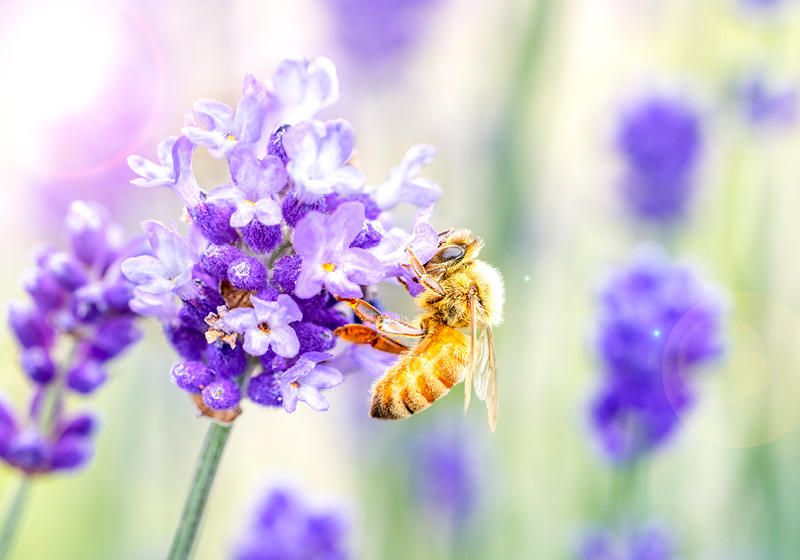
Climate change makes pollen scarce, starving honeybees. A new supplement made from engineered yeast that contains specific beneficial fats may help young honeybees thrive.
Honeybees keep the agricultural industry abuzz by pollinating crops in farms. But extreme weather and shifts in plants’ flowering periods have made pollen scarce, causing them to starve.
Elynor Moore is a synthetic biologist at Delft University of Technology. At the time of the study, she was a graduate student in the laboratory of Geraldine Wright, a bee researcher at the University of Oxford.
Elynor Moore
Recently, researchers formulated a recipe for a pollen substitute, which when fed to honeybees, helped them raise their young, or brood, more successfully.1 The team, led by then graduate student Elynor Moore at the University of Oxford, genetically engineered yeast to make the key ingredients in pollen in large quantities, a feat that no one else had managed to achieve. Their work, published in Nature, may have a direct impact on helping beekeepers and their honeybees thrive.
“I think it will be a really big advancement in the world of bee nutrition,” said Adam Dolezal, a bee researcher at the University of Illinois Urbana-Champaign who was not involved in the study.
In the absence of pollen, beekeepers feed their honeybees with artificial substitutes that contain a mix of nutrients, including proteins, fats, and vitamins. “But we know they don’t work as good as real pollen,” Dolezal said.
Bees need sterol, a type of fat that they use to produce specific hormones. Bees cannot make sterols themselves, so they must get them from their food. Moore explained that a typical pollen contains about 30 different sterols, and each may have a specific biological function.2 So, she said, “You can’t just dump a load of cholesterol in the diet.”
Researchers previously identified sterols that are likely important for honeybee health, but they did not have a way to synthesize them at scale.3 Past studies also focused on adult bees, and according to Moore, this type of analysis likely missed the most important sterols for brood development, which represents the future of the colony.
Within a colony, “nurse” bees eat “bee bread” that foragers make from floral pollen. Then, they feed a processed form of this bread, also known as larval jelly, to the larvae. Before they become adult bees, healthy bee larvae enter a pupal stage, in which they are inactive and do not feed.
Moore said, “If we just look at the pupae, then we’ll know which sterols the bees have selectively given to the brood—these are most likely to be the really important ones.”
Through their analysis of pupal tissues, Moore’s team discovered 24-methylenecholesterol, which constituted most of the sterol content at 60 to 70 percent. They also identified five other sterols that altogether made up another 15 to 20 percent.

Adam Dolezal is a bee researcher at the University of Illinois Urbana-Champaign. He was not involved in the study.
Adam Dolezal
“I love these kinds of studies, where it’s like, ‘How do we not know this already?’” said Dolezal.
To produce these sterols, the researchers sequentially introduced enzyme-coding genes from algae and plants, such as tomatoes and potatoes, to a yeast strain that could accumulate large amounts of fat. The researchers cultivated the engineered yeast in five-liter bioreactors and ground the yeast biomass into a fine powder. They supplemented the powder to a base bee diet containing other essential nutrients.
Honeybees that consumed this recipe reared about 15 times more larvae to the pupal stage than their counterparts that ate a base diet with no supplement or a base diet supplemented with biomass from non-engineered yeast. This indicated the formulation’s promise in supporting honeybee growth and development.
Moore shared that the team, led by her PhD advisor and bee researcher Geraldine Wright, plans to commercialize the powder in the near future, although Moore, who is now a postdoctoral fellow at Delft University of Technology, is no longer involved in the work.

Dave Goulson is a bee researcher at the University of Sussex. He was not involved in the study.
Dave Goulson
Dave Goulson, a bee researcher at the University of Sussex who was not involved in the study, said, “Current pollen substitutes are basically rubbish, so this is a positive step in that respect.” But Goulson worries about what this advance could mean for the environment outside of bee farms. “If beekeepers can keep their honeybees alive without flowers, then there’s no incentive for them to have anything flowering other than their crop. There will not be wildflowers, no wild bees, no butterflies—that doesn’t sound like a world I particularly would want to live in,” he said.
Moore and Dolezal disagree. Moore said, “The [honeybees and the wild bees] are two separate systems, and actually, we even hope that if we could feed the managed honeybees with a complete diet such that they actually don’t need to go foraging for floral pollen, then it would free up much of the available wild floral pollen for the wild bees.”
Dolezal echoed this, adding that honeybees and wild bees rarely coexist, and when they do, it’s often because the honeybees need food. “If anything, I think that this alleviates the issue more than exacerbates it.”
