


Amid a growing consumer awareness of gut health and the microbiome, Danone recently opened its OneBiome Lab to expand research for future innovations. We explore scientific advances, research gaps, and biotic product development with Danone’s chief research and innovation officer.
Isabelle Esser tells Nutrition Insight that the microbiome has become a “hidden health capital.”
“The science of the microbiome is evolving all the time, and we see more and more correlation between health outcomes and the microbiome. Think about diabetes, immunity, Crohn’s disease, inflammation, and even mental health. They are related, but we still don’t know how much.”
“Lots of products will come to market as microbiome science advances, and our understanding of the gut microbiome as a health marker is becoming more important.”
Research opportunities
To understand how the gut works, Esser underscores going beyond the metabolism to examine the “billions of interactions between microorganisms and between microbes and the gut itself.”
“If we can truly understand the mechanisms — beyond the triangle of microbiome, health, and diet — the possibilities are infinite. Think of growth, cognitive impairment, immunity, diabetes, improved resistance to microbes, and more.”
Sometimes discoveries are serendipitous, she says. For example, Akkermansia research started accidentally but has now led to a beneficial probiotic for reducing inflammation.
More and more, consumers want to have good health, which includes a healthy and resilient microbiome. “Today, there are already many products claiming that,” says Esser. “What we need to define is the difference between claims and actual efficacy.”
 Antoine de Saint-Affrique, CEO at Danone, and Esser discussing microbiome research at the OneBiome Lab launch (Image credit: Danone).“There is still low consumer awareness on how to take care of your gut health, because there is a lot of information,” she cautions. “The difficulty is that when things become popular, they get confusing because you hear so many different things.”
“Part of our role as scientists is to make concepts simple without making them simplistic and to demystify some things but to be honest about what we know and don’t know.”
Microbiome-centric health benefits
Esser points to longevity and healthy aging as an underexplored research area that could significantly influence product development and broader health strategies.
“If interventions in the microbiome could help reverse diseases or enable people to age healthily, that would be wonderful,” she comments.
“Life expectancy is getting longer, but we’re not necessarily in very good health. Longevity and understanding the markers of a healthy, diverse microbiome are key.”
She adds that microbiome diversity is also becoming more prominent. “It’s not only about the species in your microbiome but also about diversity — it changes with age and disease.” For example, the prevalence of bacteria like Akkermansia and Bifidus longum decreases considerably as people age.
From a scientific perspective, Esser notes that people’s microbiomes are unique, so the solution should be more personalized. Therefore, Danone explores different microbiome differences among specific population groups, such as teenagers or 65+ people living in US retirement homes.
“We use ‘engines’ — bundles of nutrients or biotics that we put together to deliver a health outcome. These can deliver benefits to large populations but can also be targeted, for example, for GLP-1 users or type 2 diabetics,” she explains.
“Some ingredients, like Lactobacillus casei for immunity, are good for everyday, for people with reduced immunity, but also for healthy people who want to increase their resilience.”
Product development
Danone’s two main commercial focuses are fast-moving consumer goods, such as dairy and everyday products, and medical nutrition. Esser explains that both product groups may benefit from gut microbiome research and product development.
“Many of these products are based on biotics anyway, so they can all benefit from the advances of science on the gut microbiome.”
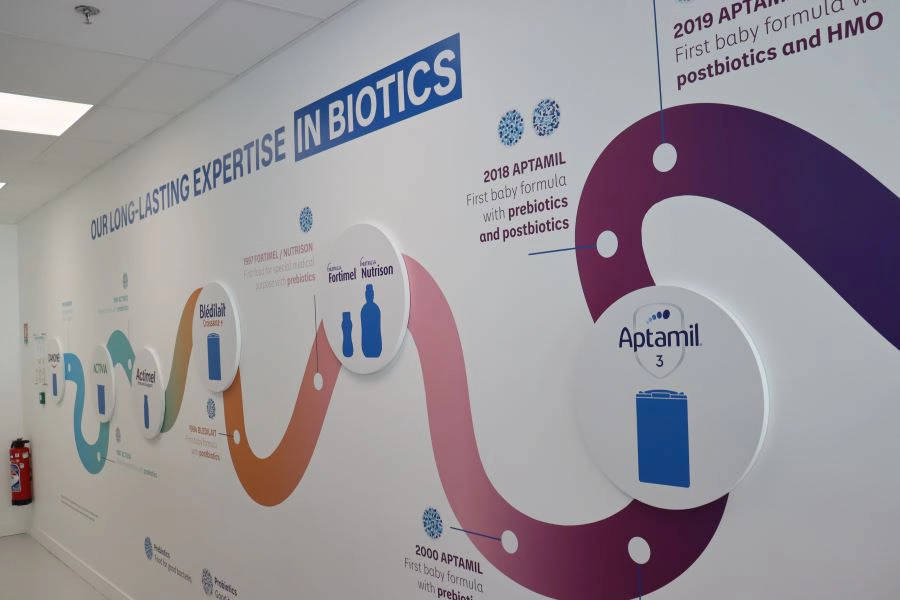 Danone’s product launches in biotics include Actimel, fermented milk with probiotics, and Fortimel medical nutrition with prebiotics.She says medical nutrition products already benefit from research advances as they help patients through their treatment. For example, she highlights Danone’s Fortimel Compact Protein, offering a high-protein and energy solution for hospital patients. Several flavors were co-built with cancer patients experiencing taste alteration.
“We know that some biotics enhance the microbiome barrier and improve immune resistance, allowing patients to continue treatments they might otherwise stop.”
Esser adds that developments in medical nutrition can also be used in fast-moving consumer goods, depending on whether they can be formulated as palatable, delicious, and affordable products for everyday use.
“Activia, for example, today uses three biotics, which we know have an effect on the microbiome and digestive health. Tomorrow, you can imagine that with the advances in digestive health, you could add other formats for Activia.”
However, product development will depend on whether ingredients can be formulated into consumer products or require regulatory approval. For example, products used in hospitals need to undergo clinical testing. Foods for specialized medical use are highly regulated, requiring dossiers, evidence, and approvals.
“But both areas overlap. What we’re doing at Danone’s OneBiome Lab applies to patients and consumers, in disease and health, across all life stages,” says Esser. “Where it can have the most impact will depend on research and what it can find.”
Weight management support
Weight loss is one health area where Danone has developed new products. The company launched yogurt as a companion product for GLP-1 medication users in the US.
“The issue with weight loss is that people often lose muscle as well as fat, and that’s not healthy,” explains Esser. “So we’ve developed products to help enhance muscle production.”
 Esser explains that elderly consumers require more protein than the average adult, around 1.2–1.8 g per kg of body weight.“GLP-1 users also have a specific microbiome. They are taking a drug that affects the microbiome, but they also probably have dysbiosis because they often have diabetes or other diseases.”
In addition, she notes that these consumers will change their dietary patterns, which is one of the key factors influencing the microbiome. They need a nutrient-rich diet with more probiotics.
As GLP-1 users often have digestive issues, Esser says it’s essential to understand their microbiome before, during, and after treatment to help develop products to alleviate symptoms or rebalance the microbiome.
“GLP-1 is one we talk about most, but cancer patients undergoing chemotherapy suffer from the same issues,” she adds. “These nutrition solutions help patients or consumers undergo treatment and maintain the best possible microbiome.”
Protein and fiber gaps
Research on healthy diets started with a focus on good food and reducing sugar, fat, and salt, says Esser. Next came food fortification to address micronutrient deficiencies and the protein gap, where some population groups do not consume sufficient protein.
“You need a lot of protein when you’re young,” she explains. “In your teenage years, you need a little more, and then it reduces. In your older age, you need a lot more protein. Protein needs can go from 0.8 g per kg of body weight to 1.2–1.8 g when you’re an elderly person.”
She recommends moving from “more protein” toward protein quality and digestibility. “As more people understand there is a protein gap, this gap is reducing. Now, the quality of protein is becoming more important.”
“Proteins are essential. They’re everywhere in our bodies — hormones, insulin, collagen, and a lot of nerves are all proteins,” she explains. “We need amino acids to build a protein, and proteolysis is essential. The problem with the protein craze is that it becomes indiscriminate.”
Meanwhile, she predicts fiber as the “next frontier,” noting that the fiber gap is “equally big, if not bigger.” Different soluble and insoluble fibers have various impacts on the gut while interacting with protein and biotics.
“All of this is a fabulous arena for research.”
