

You have full access to this article via your institution.
Hello Nature readers, would you like to get this Briefing in your inbox free every day? Sign up here.
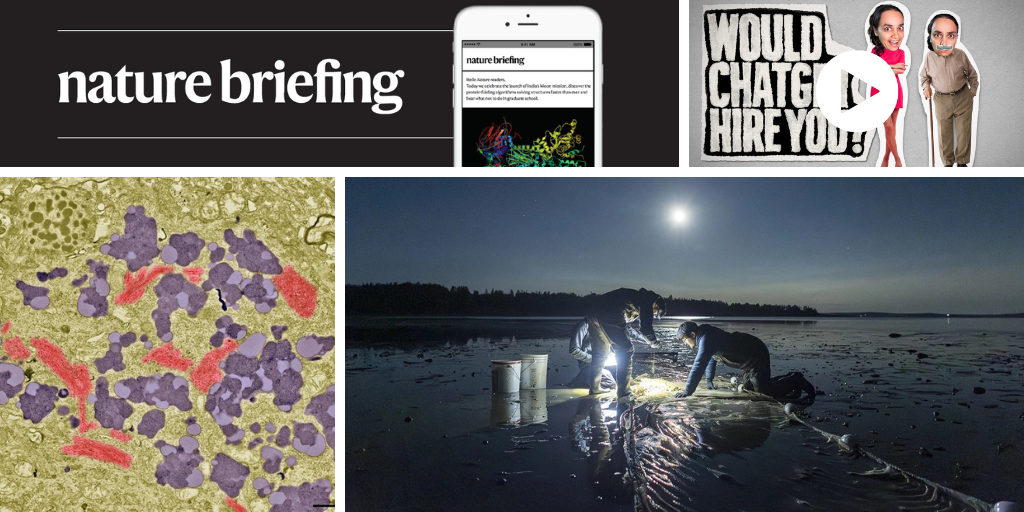
A blood test measuring levels of tau protein is almost 98% accurate in ruling out Alzheimer’s disease in individuals with cognitive impairments.Credit: Thomas Deerinck, NCMIR/Science Photo Library
The US Food and Drug Administration has approved a blood test to aid in the diagnosis of Alzheimer’s disease — the second such test and the first cleared for use in primary-care settings, such as a doctor’s office. The test measures Alzheimer’s-related proteins to rule out the disease in people with cognitive decline. Last week, pharma company Roche announced that the test was correctly able to rule out Alzheimer’s 97.9% of the time. But without access to the full trial data, it’s difficult to independently assess the test’s accuracy, says neurologist Ashvini Keshavan.
Read more: Faster, cheaper, better — the rise of blood tests for Alzheimer’s (Nature | 12 min read, from April)
Passing the Turing test — a thought experiment that asks whether a computer’s written conversation can pass as a person’s — is a piece of cake for the best artificial intelligence (AI) models. First proposed by mathematician Alan Turing 75 years ago, some researchers want to see an upgraded test to use as a benchmark for progress towards artificial general intelligence — models with the resourcefulness to match human cognitive ability. Others say the test should be scrapped altogether, and that developers should instead focus on evaluating AI safety and building specific capabilities that could be of benefit to the public.
Peanut allergies in children under three years old in the United States dropped by 43% after the introduction of guidelines that recommend feeding peanuts to babies. The guidelines followed a landmark trial in which hundreds of infants with severe eczema, egg allergy, or both were randomly assigned to a diet with or without peanuts. The peanut-eating babies were much less likely to have peanut allergies around age five than the peanut-avoiders. The latest study didn’t investigate what children were actually eating, but it attributes the decline in allergies to the influence of the research and subsequent guideline change.
The New York Times | 4 min read
Reference: Pediatrics paper & The New England Journal of Medicine paper (from 2015)
Features & opinion
In Discordance, science writer Jim Baggott takes a fresh look at our understanding of how the Universe emerged. The book is “a masterpiece that combines depth with clarity and comprehensiveness with readability”, says science historian Helge Kragh in his review. Discordance “will be of as much interest to astronomers and physicists as it is to lay readers fascinated by the mysteries of the Universe”, he writes.
For at least 65,000 years, Aboriginal and Torres Strait Islander peoples — the world’s oldest continuous cultures — have adapted to a changing world, including an ice age, dramatic sea-level fluctuations and extreme droughts. A majestic interactive made in collaboration with First Nations knowledge holders takes us from the mega-continent of Sahul, where people shared the land with megafauna such as the hippo-sized marsupial Diprotodon, to present-day Australia.
ABC News | Long tea-break’s worth of exploratory scrolling
Women are represented in online images as much younger than they are in the actual workforce. This bias — also found in online text and in some AI systems — could be contributing to an inaccurate stereotype of women as having fewer skills and less experience than men, especially in occupations with higher status and earnings.
Where I work

Matthew Kim has a degree in marine biology from the University of New Brunswick in Saint John, Canada.Credit: Liam Brennan
As an undergraduate, marine biologist Matthew Kim (right) learnt how to conduct research during long hours of fieldwork in the freezing water of the North Atlantic in New Brunswick, Canada. Despite the hardships, he highly recommends the experience. “Sitting in a lecture hall and taking laboratory courses are not the same as going out into the field and doing it yourself,” he says. (Nature | 3 min read) (Liam Brennan for Nature)
On Friday, our penguin-seeking puzzle took us to the Isle of Mull in Scotland. Did you find Leif Penguinson? When you’re ready, here’s the answer.
Thanks for reading,
Flora Graham, senior editor, Nature Briefing
With contributions by Jacob Smith
• Nature Briefing: Careers — insights, advice and award-winning journalism to help you optimize your working life
• Nature Briefing: Microbiology — the most abundant living entities on our planet — microorganisms — and the role they play in health, the environment and food systems
• Nature Briefing: Anthropocene — climate change, biodiversity, sustainability and geoengineering
• Nature Briefing: AI & Robotics — 100% written by humans, of course
• Nature Briefing: Cancer — a weekly newsletter written with cancer researchers in mind
• Nature Briefing: Translational Research — covers biotechnology, drug discovery and pharma
