

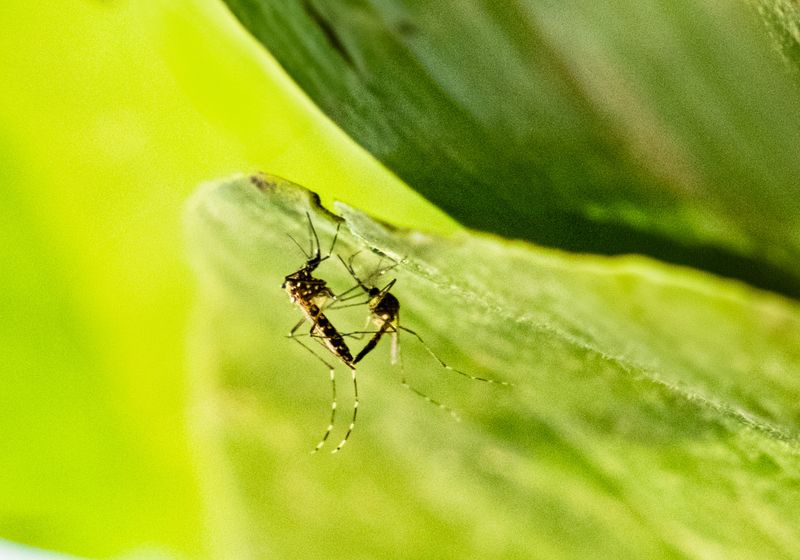
Female mosquitoes decide whether mating will take place or not through a lock-and-key mechanism. However, other mosquito species can lockpick this process.
Image credit:Jacopo Razzauti/The Rockefeller University
Some animals, from puffins and swans to prairie voles, are known to mate for life. For female mosquitoes, mating typically occurs once in their lifetime—lasting under 30 seconds—before the couple go their separate ways. This brief encounter is crucial for both reproductive success and mosquito control efforts, as offspring from parents of different species are sterile.
However, the intimate details that drive mosquito mating and the mechanisms that control cross-species mating remain poorly understood. This motivated neurobiologist Leslie Vosshall from The Rockefeller University and her colleagues to home in on these interactions in two globally invasive mosquitoes, the yellow fever mosquito (Aedes aegypti) and Asian tiger mosquito (A. albopictus).
In a new study, published in Current Biology, they found that female mosquitoes control the mating process by initiating genital interlocking between the male and female genitalia.1 However, the longer male genitalia of A. albopictus can bypass this lock-and-key ability in A. aegypti, rendering the female and the subsequent offspring sterile. These findings demonstrate that female mosquitoes drive mating within their species, though interlopers can interfere. This provides researchers with greater insight into mating, a process that is widely used for control programs.
To study how mosquitoes mate, the researchers bred transgenic A. aegypti males whose sperm either fluoresced green or red. They cohoused male and female mosquitoes for a week and monitored the females’ internal reservoir, which stores sperm, called the spermathecae. Most of the female mosquitoes only mated once, indicated by a single sperm color in this structure.
Then, to get a closer look at the mating interactions, the researchers used high-speed and high-resolution cameras to observe virgin or previously mated female mosquitoes with potential suitors. They found the process occurs in three key steps. First, male mosquitoes initiate courtship through genital contact, particularly via the hook-like structures called the gonostyli, into the female. But this coupling is superficial, unless the female chooses to elongate her tip to about twice its resting length. This results in genital interlocking and successful mating. If the female does not reciprocate, despite the male mosquito’s persistence, mating does not occur.
But how did this behavior translate in another Aedes species, such as A. albopictus, which frequently shares territories with A. aegypti? The researchers found that mating in A. albopictus followed the same behavior: male genital contact, female tip elongation, and genital interlocking. However, there were also notable differences between male genitals.
A. albopictus mosquitoes possess much larger gonostyli than A. aegypti and can use these to their advantage, particularly in cross-species mating. Male A. aegypti did not achieve much success in mating with female A. albopictus, who rarely extended their genital tip. Although the female A. aegypti rarely extended their genital tip either, the researchers found that male A. albopictus could bypass the female’s non-response with their longer gonostyli and initiate genital interlocking themselves.
This cross-species mating is detrimental as the process sterilizes the females of the other species and may explain how A. albopictus can displace other mosquito populations and expand their territories in the wild.
Overall, these findings provide researchers with greater insight into mosquito mating and will help enhance mosquito control programs that rely on mating to reduce mosquito population and reduce disease transmission.
