

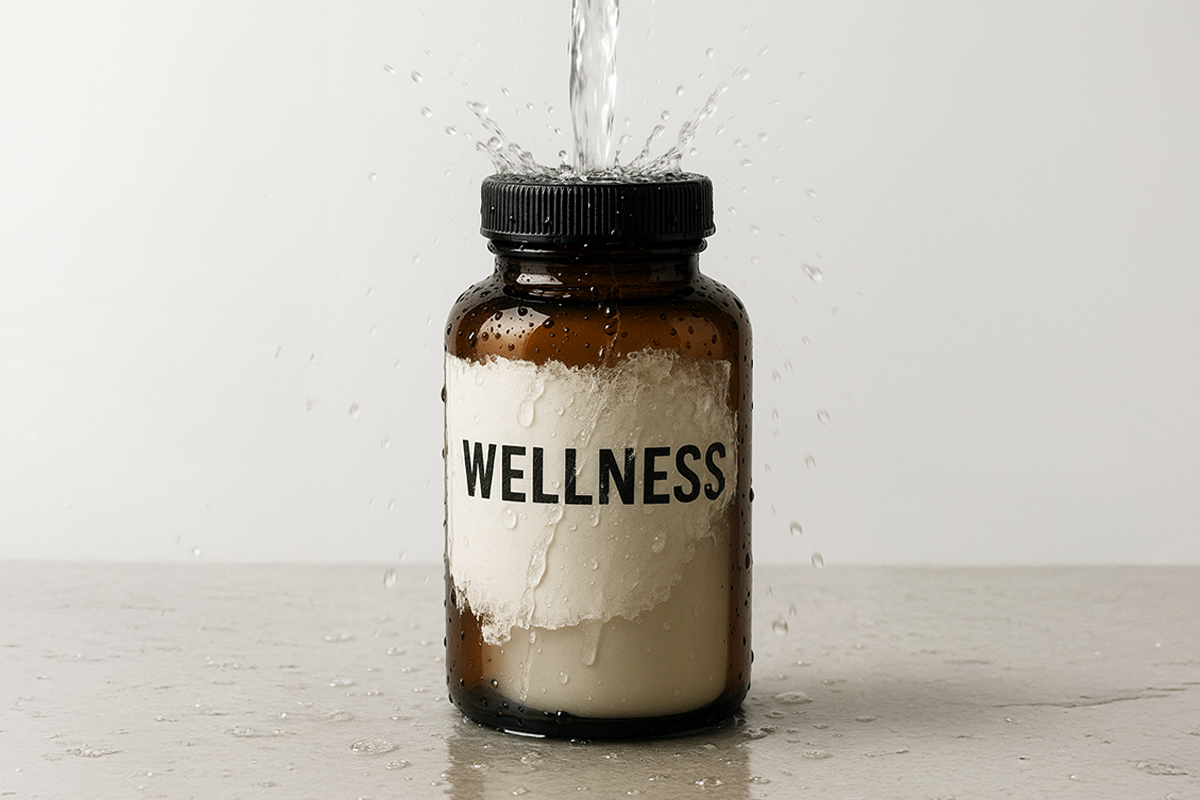
Slow’s Patricia Draghici on why inflated wellness claims erode trust – and why longevity needs evidence, not aesthetics.
As wellness climbs towards $7.3t (Global Wellness Institute), the incentives to stretch ‘healthy’ claims multiply. From gadget-heavy routines to ‘clean’ beauty, wellness is often sold as an aesthetic while outcomes go unverified. The cost: trust erodes, spending is misallocated, and effective interventions are crowded out. Regulators, meanwhile, are tightening the bar for scientific substantiation and honest advertising.
Much like greenwashing hollowed out ‘sustainable’ in the 2010s, wellness-washing now risks emptying ‘wellness’ of meaning. The pattern is familiar: neutral, or sometimes counterproductive, products are wrapped in medical-sounding language. Think supplements with fuzzy benefits, marathon ‘morning routines’ that steal sleep, or ‘clean’ cosmetics that conflate surface aesthetics with health.
With the global wellness economy around $7.3 trillion in 2025 and on a trajectory the Global Wellness Institute projects to nearly $9 trillion by 2028, ‘wellness’ has become a convenient shorthand for premium. In a noisy market, brands and influencers race to differentiate, fueling claim inflation: pseudo-scientific packaging, de-contextualized study snippets, and “healthy” narratives whose real-world impact for consumers is unclear.
How wellness-washing shows up
- Vague or de-contextualized claims. Real science, abstracted beyond recognition (e.g., ‘cellular’ benefits with no human outcomes). Regulators don’t accept that: the EU requires pre-authorized, scientifically substantiated health claims on foods/supplements, and the US FTC expects competent and reliable scientific evidence, typically well-controlled human tests, for health products.’
- Aesthetic over outcome. Routines and gadgets that look high-performance yet don’t show measurable gains in sleep, stress, or function. Some self-tracking can even backfire, see orthosomnia, where chasing perfect sleep metrics worsens sleep-related anxiety and perception of sleep quality, underscoring the need for validated outcomes, not just dashboards.
The industry has grown so fast that some products are force-fit just to wear the ‘wellness’ badge. Wellness is a relationship with health; when it becomes performative, the purpose drains away, and we lose sight of what actually works.
That drift matters for longevity too: when attention and capital flow toward aesthetic wellness rather than validated healthspan interventions or translational biotech, genuine progress in extending healthy years risks being overshadowed by the performance of ‘looking well.’
On social media, wellness often becomes a storefront: gurus prescribing endless morning routines and gadgets that promise to “optimize everything” (often with affiliate codes), while practices like non-indicated fasting or unsupervised IV drips are normalized. The result is a performance-obsessed aesthetic that crowds out rest and turns care into consumption.
The regulatory line (quick map)
When marketing outruns outcomes, trust breaks, spend is diverted to low-impact products, and effective interventions (sleep, movement, nutrition basics, mental hygiene) lose oxygen. For a field that aspires to extend healthspan, that’s not a trivial trade-off. Regulators have drawn clearer lines:
- EU: for foods/supplements, any health claim must be scientifically substantiated and authorized; cosmetic claims must meet common criteria; and medical-scope promises fall under medical device rules; advertising cannot mislead.
- UK: the ASA has pulled campaigns with unproven benefits (e.g., IV drips).
- Spain: high-reach influencers must clearly disclose advertising.
- US: health claims require adequate scientific support.
If well-enforced, these higher standards could do more than police marketing – they might finally tighten the link between lab discoveries and everyday health practice, turning evidence-based longevity from an aspiration into a lived reality.
A better playbook (evidence over aesthetics)
For companies and consumers, a practical lens helps:
Transparency. Clear labels, clear limits: what it does, what it doesn’t, and for whom. If a claim applies only to a subgroup or in a narrow context, say so.
- Mechanism → outcome. What biological pathway is claimed – and where is the human outcome (sleep quality, stress markers, functional capacity)? If there’s no human endpoint, it belongs in R&D, not on a billboard.
- Evidence grade. Anecdotes ≠ trials. Look for peer-reviewed human data with relevant endpoints and adequate design (comparators, sample size), not de-contextualized cell/animal findings.
- Transferability. Can the practice be kept in real life (time, cost, adherence), or does it rely on constant purchase/complex gear? Healthspan improves when behaviors stick.
- Transparency. Clear labels, clear limits: what it does, what it doesn’t, and for whom. If a claim applies only to a subgroup or in a narrow context, say so.
Wellness should feel better from the inside out – body, mind, and mood – built on simple, proven habits rather than ever-longer shopping lists. If the sector pivots from performance theatre to measurable benefit, we gain what matters most: less noise, more health.
About Patricia Draghici
Patricia is Slow‘s founder, a studio crafting transformative experiences through science, well-being, and culture. Through retreats, brand activations, and strategic projects for global clients, she helps reshape how individuals and organizations approach longevity and a healthier, more intentional way of living.
Previously, Patricia built a career in entrepreneurship, community, and innovation – leading founder support at one of Southern Europe’s top VC funds and creating the region’s largest startup summit for young entrepreneurs. Recognized in 2024 as one of the leading women shaping Spain’s business ecosystem, she now focuses on integrating well-being as a strategic lever for innovation, performance, and cultural change.
