

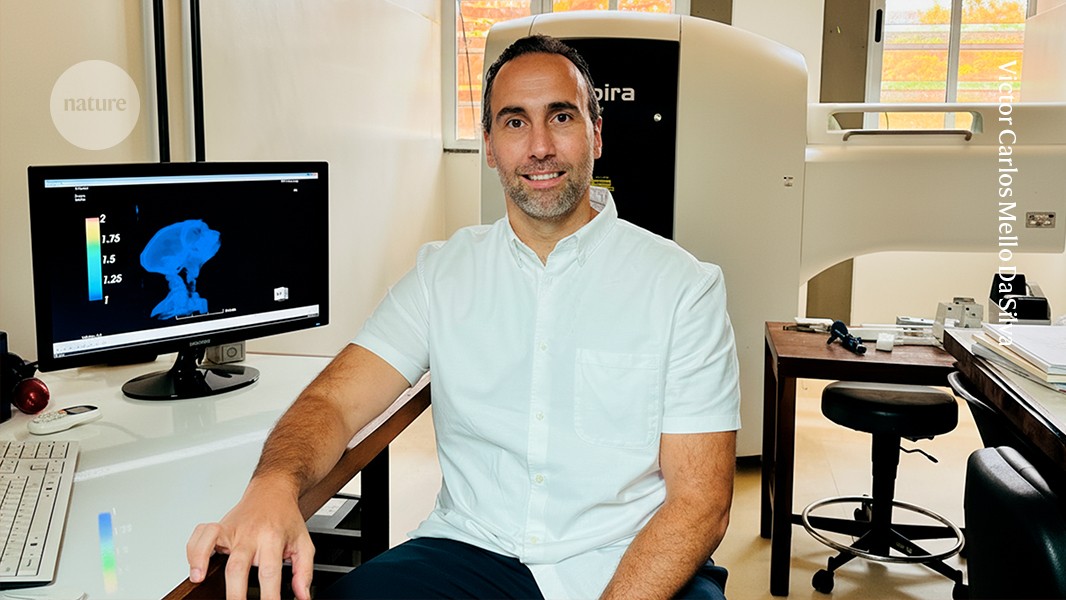
A course in disruptive innovation helped to cement João Paulo Longo’s science-entrepreneur ambitions.Credit: Victor Carlos Mello Da Silva
While earning his dentistry degree at the University of Brasilia, João Paulo Longo joined Brazil’s Institutional Scientific Initiation Scholarship Programme (PIBIC), which gives undergraduates the opportunity to join research projects. The experience ignited a passion for research that led him to quit dentistry and pursue a PhD, during which a cosmetics company director sought his help in product development.
These early career experiences, alongside a course on disruptive innovation at Harvard Business School in Boston, Massachusetts, cemented his ambition to be a science entrepreneur.
Longo is now a nanotechnology researcher at the University of Brasilia, a role he combines with his position as a founder and researcher at Glia Innovation, a cosmetics business in Goiânia.
You pivoted from dentistry to nanotechnology. How and why did that happen?
I worked as a dentist for three years after graduating, but my earlier involvement in the PIBIC, which I took part in in as an undergraduate in 2003, inspired me to start a research career and to undertake both a master’s and a PhD.
My doctoral research was on the application of a photodynamic therapy — a drug activated by light — to treat oral infection in a 12-participant clinical study. It gave me an understanding of how to use basic science to solve practical problems. At that time, translational medicine, the practice of taking scientific discoveries from the laboratory to clinical settings to benefit human health, was not widespread in Brazil.
What led you to combine academia and entrepreneurship?
In 2010, two years into my PhD programme, I was invited by Leila Velez, a founder of Beleza Natural, a cosmetics company in Rio de Janeiro, to develop nanotechnology products, including nanostructured oils developed from biodiverse sources in Brazil. I was recommended by a friend working at the Brazilian National Confederation of Industry in Brasilia. It was an improbable relationship because, at that time, my field was nanotechnology and dentistry. We adapted some technologies for the cosmetics field.
Five years on, I was in an academic role, teaching nanobiotechnology at the University of Brasilia and feeling unfulfilled in my career. Eureka moments were rare, as were opportunities to apply scientific knowledge to solve real-world problems. I felt that academia had grown increasingly competitive: success was tied to metrics, rather than to the practical application of knowledge, and researchers were judged mainly on publication numbers.
So, in 2018, I enrolled in the Academia-Industry Training programme, a joint initiative between the Brazilian and Swiss governments supported by Brazil’s National Council for Scientific and Technological Development and SwissNex, a global network aimed at strengthening Switzerland’s profile as an innovation hotspot. The programme taught me about innovation concepts, such as minimum viable products (MVPs). These are the most basic versions of new products and are released to customers to garner feedback.
I deepened my understanding of innovation through an online course at the Harvard Business School, focused on disruptive strategy and innovation. It was led by Clay Christensen, a business consultant and academic who developed the theory of disruptive innovation — in which a product or service gradually displaces established competitors after starting at the bottom of the market.
I was spending a lot of time interacting with science entrepreneurs and attending industry events, where I first learnt about a problem faced by cosmetics companies in Brazil. They were importing nanoparticles used for the dermal delivery of active ingredients. One company’s German supplier imposed a minimum supply quantity of 50 kilograms. In 2018, Cosmefar, a firm in Aparecida De Goiania, Brazil, contracted me to produce smaller quantities, after a mutual friend introduced me to its co-founder, pharmacist Guilherme Alves Ferreira.
After working on this project and others, I set up Nanoceuticals in 2018 with Nichollas Camargo, a chemist at the University of Brasilia. The company develops nanoparticles for cosmetics, health and pharmaceutical products. It was a low-risk venture, in that we were not depending on venture capital. Instead, we used our own resources, revenue and personal funding to operate and scale up, growing client by client.
How did the COVID-19 pandemic and its aftermath affect the business?
We were starting to expand the team, when our sales suddenly dropped to zero. We innovated by using our technology to develop a polymer to replace Carbopol, the key ingredient in alcohol-based hand gels. It had almost sold out across Brazil. We generated the equivalent of one year’s revenue in four weeks, before Carbopol came back into supply.
As the company expanded, we wanted to get broader expertise in peptide science, because of its key function in human health (peptides are short chains of amino acids that serve as the building blocks of protein).
In 2022, Nanoceuticals merged with Plateinnove Biotechnology, a start-up in Campinas founded five years earlier by molecular biologist Sheila Siqueira Andrade. We named it Glia Innovations, inspired by Glial cells, which are key in supporting neural function — symbolizing the creation of new ideas.
The merger was on an all-share basis, whereby the target company’s owners are paid in the acquiring company’s shares, with no cash involved.
After the merger, we rapidly scaled up and began clinical trials in Brazil, including ones for anti-wrinkle and tooth-whitening treatments. We serve more than 80 cosmetics-industry clients in Brazil, Peru, Colombia, the United States, Indonesia, South Korea and India.
How do your students benefit from your entrepreneurial background?
I combine my Glia position with my academic post, and see my role as a link between research and innovation and industry. The university runs innovation and entrepreneurship courses for undergraduate and graduate students. All my lectures are based on translating science into real-world benefit with the potential to commercialize.
Four new start-up companies were created last year, and three students have collaborated with corporations, developing new patents and creating products for diverse industries. One company is called Cooil, which uses nanotechnology to develop final cosmetic products. Another is BioDev, a software company specializing in custom-made digital solutions using artificial intelligence for the scientific community.
You could say that we are shaping a generation of science entrepreneurs.
