

Shanghai forum brings together international experts as longevity science evolves from measuring decline to testing repair.
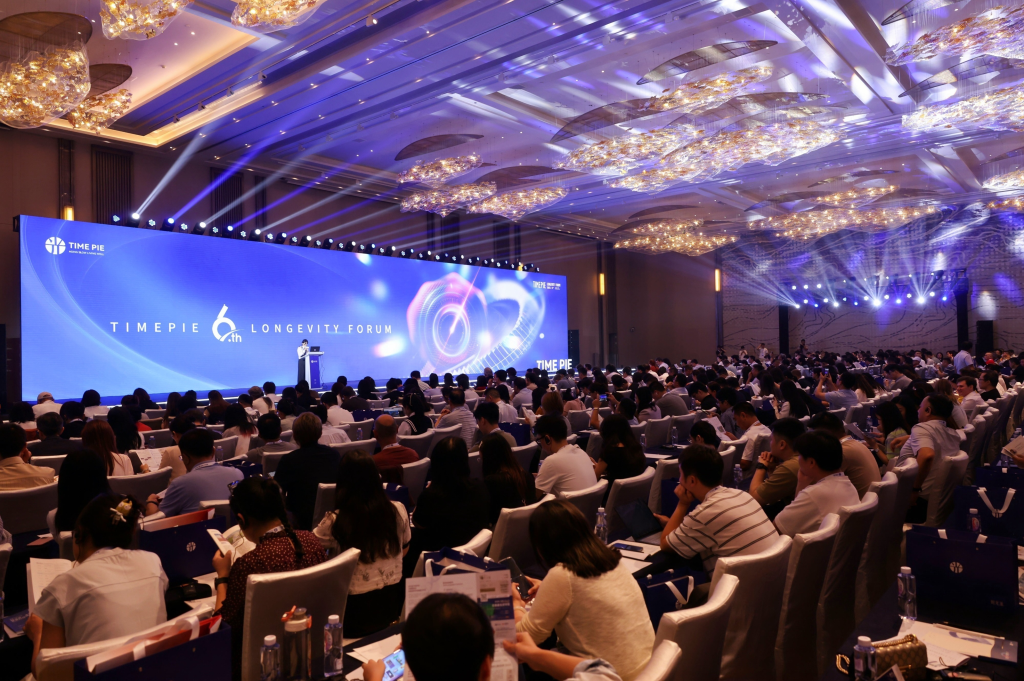
Six years ago, the inaugural TimePie Longevity Forum gathered a handful of scientists and early advocates in a single seminar room to exchange ideas about the biology of aging; in 2025, the conversation has grown considerably. On 20–21 September, more than 1,500 participants from twenty countries convened in Shanghai for the Forum’s sixth edition, confirming its position as one of Asia’s most energetic longevity meetings.
Over two full days, speakers and delegates explored the state of aging science through more than forty presentations. What began as an effort to understand why we age has evolved into a more ambitious pursuit – how, and to what degree, we might intervene. From biological clocks to autophagy, immune remodeling to AI-guided compound discovery, the Forum reflected a field in restless motion.
Longevity.Technology: The 6th TimePie Longevity Forum was less a conference and more a weather vane for a field shifting from observation to intervention. Once preoccupied with cataloguing decline, longevity science is now edging toward something bolder: intervention, amelioration, repair. The conversation has moved beyond whether aging can be influenced to how precisely we might calibrate that influence; biological clocks are no longer parlor curiosities but instruments guiding active experimentation. What’s striking is the diminishing sense of speculation – data are stacking up, cross-species clocks are aligning and the concept of modulating biological age is moving from the margins to the mainstream.
China’s growing presence adds both scale and a quietly pragmatic energy; with a national white paper, an emergent ecosystem of clinics and companies, and a newly minted research grant program, the country is positioning itself not just as a participant but as an architect of the global longevity landscape. It’s a reminder that progress in this field no longer depends on a handful of elite labs or venture hubs, but on a widening coalition of science, policy and capital. If this year’s Forum proved anything, it’s that longevity has outgrown the question of if – the real intrigue now lies in how well we can translate its promise into practice, and how quickly that promise might begin to touch lives beyond the lab.
Clocks that tell more than time
Aging research has long been preoccupied with one deceptively simple question: how old are we, really? The answer, increasingly, lies in the biology rather than the birth certificate. Harvard’s Vadim Gladyshev presented a model distinguishing longevity, aging and rejuvenation as separate biological axes, showing that biological age can fluctuate – rising under stress and receding during recovery. Such plasticity reframes aging not as an inexorable march, but as a dynamic and potentially reparable process.
Steve Horvath, meanwhile, extended the concept beyond species boundaries. His team’s cross-species methylation clock, developed from data spanning 348 mammals, can estimate an organism’s relative age – its age as a fraction of its species’ expected lifespan. Validated in mice, the model could help identify interventions that translate more reliably from animal models to humans.
Others approached the question from immune and morphological angles. David Furman’s iAge clock applies AI to immune data, quantifying inflammaging and even estimating biological age with surprising accuracy – in some cases, from a simple selfie. At Peking University, Jing-Dong Jackie Han’s 3D facial clock tracks subtle age-related changes in facial structure and temperature, with early results suggesting that measurable rejuvenation may occur after lifestyle or exercise interventions.
From clocks to interventions
The forum’s theme extended beyond measurement to manipulation – how these biomarkers might guide therapeutic development. Ana Maria Cuervo of the Einstein Institute for Aging Research presented findings on chaperone-mediated autophagy, showing that enhancing the cell’s recycling machinery through caloric restriction or small-molecule activators restored protein balance and improved cognition and immunity in mice.
Immunosenescence, another key target, was addressed by Guobing Chen of Jinan University. His team’s single-cell and multi-omics analyses chart how T cell populations evolve across the lifespan, revealing declining diversity in naïve CD8⁺ cells – a signature of weakened immune resilience. Understanding and reversing these shifts could improve responses to infection and vaccination in older adults.
At Harvard, Gladyshev’s team continues to mine nature’s longevity outliers, identifying molecular traits shared by long-lived species and screening thousands of compounds that mimic them. Several, including selumetinib and celastrol, extended lifespan in mice. Vera Gorbunova’s group at Rochester explored SIRT6 activation as a DNA-repair enhancer; fucoidan, a compound derived from seaweed, showed promising effects in mice and has now entered human trials.
Beyond the lab bench
While the forum’s foundation remains scientific, its edges are expanding. A biohacker session drew attention to personal experimentation, while an industry forum examined how to translate discovery into scalable intervention. Twenty-eight exhibitors presented diagnostics, compounds and consumer technologies edging closer to real-world application – a sign that longevity is now part of a broader commercial and cultural conversation.
Importantly, this year’s event marked the launch of the TimePie Longevity Research Grant, funded entirely from the forum’s profits and aimed at supporting early-career scientists. The inaugural recipients – Juntao Bie (Hunan University), Dong Lu (National University of Singapore) and Yu-Xuan Lyu (Southern University of Science and Technology) – are pursuing projects that span senescent cell clearance, ovarian health and AI-guided drug discovery. Modest though the grants are, they represent a quiet but meaningful step toward reinvesting community energy into new discovery.
A field finding its form
Longevity science has always been a marriage of data and philosophy – an attempt not just to add years to life, but to understand what it means to do so. The TimePie Forum’s evolution reflects that ambition taking shape; as biology, computation and policy begin to intertwine, the discussion is shifting from the theoretical to the tangible. If Shanghai offered any lesson this year, it’s that the science of aging no longer exists in isolation – it is becoming infrastructure.
