

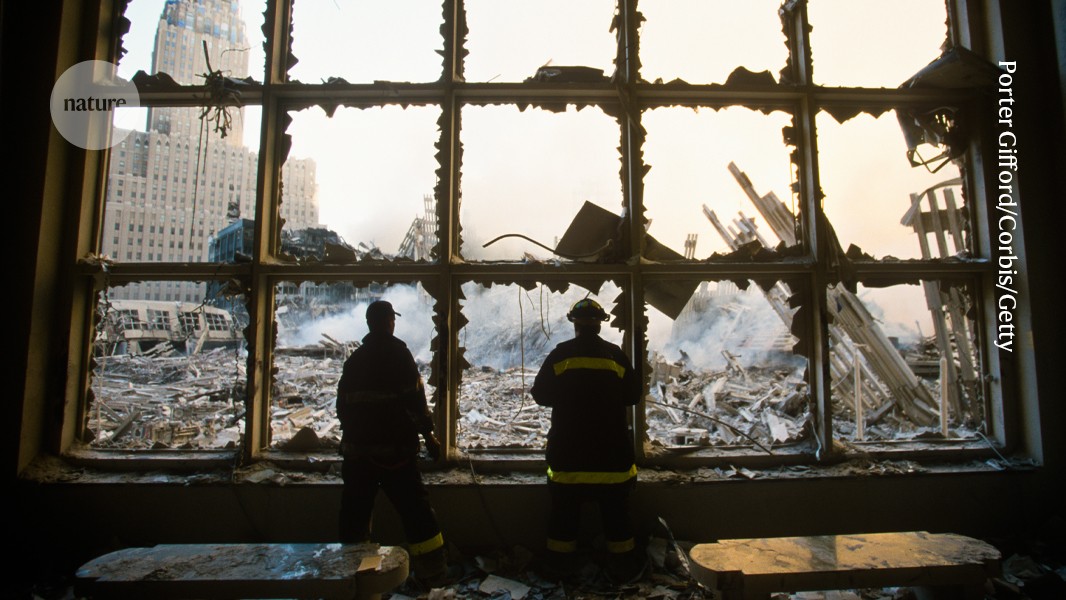
The smoldering rubble after the World Trace Center collapsed on 11 September, 2001. Credit: Porter Gifford/Corbis/Getty
After interviewing health-care workers who had responded to the terrorist attacks on 11 September 2001 in New York City, Erin Smith, a disaster-response researcher at Edith Cowan University in Perth, Australia, noticed her behaviour changing. “I started having nightmares where it was me buried in the rubble and I would wake up gasping for breath,” says Smith. She became anxious about being in crowded spaces and had intrusive thoughts about the stories she had heard during her research.
It was only when she saw a psychiatrist that she realized these changes were signs of vicarious trauma — which can be experienced by individuals who are exposed to other people’s trauma through work, including conducting research.
Vicarious trauma is increasingly being recognized as an occupational risk for researchers, particularly among those whose work involves distressing material. Repeated exposure to traumatic material increases the risk of vicarious trauma, as does a lack of mental-health support and having a history of trauma. Graduate students and early-career researchers are particularly vulnerable, says Smith, because they often lack the support network at work or during their studies of senior academics.
There is evidence on how to reduce its effects. For instance, a study1 published last month found that having a designated person looking after researchers’ wellbeing and policies mandating breaks or time off were effective strategies.
In that vein, Smith is among those calling for workplaces to introduce policies that provide more emotional support and increase resilience for researchers. “Despite its significance, vicarious trauma in academia remains under-addressed,” she says.
Setting boundaries
After receiving a graphic image of a severed foot from one of his sources in Myanmar, Ronan Lee, a genocide researcher at Loughborough University London who studies the ongoing Rohingya massacre in Rakhine State, Myanmar, started looking for literature about the best practices for managing vicarious trauma. He’s learnt that having a routine and setting boundaries between work and everyday life are crucial for managing his risk of traumatization. He says he will do work involving potentially traumatic material for a set period of time, with breaks doing activities that are calming or bring him joy. “I’m notorious for looking at pictures of alpacas on Instagram,” he adds. Lee says setting boundaries around his work is particularly important because technology has made it harder for researchers to disconnect. “I get graphic images sent to me daily,” he adds.
Millan AbiNader, a gender-based violence researcher at the University of Pennsylvania in Philadelphia also sets physical boundaries between work and the spaces where she can disconnect. She says her team does not do trauma-related work — such as interviewing people who have experienced abuse or reading homicide case files — from their bedrooms or living spaces at home. When she was a student and did not have a separate space at home, she would work in coffee shops or libraries instead. AbiNader says she experienced vicarious trauma from her previous work as a victim services advocate for people experiencing sexual violence, family violence or trafficking.
In a 2023 study2, AbiNader and her colleagues found that ‘compartmentalizing’ work that involved traumatic material and processing it later helped to reduce its negative effects, as did having a computer designated for trauma-related work, and restricting such work to the same time each day.
AbiNader says speaking with teammates about traumatic material and other types of social support can prevent trauma and promote resilience. Formal support, such as check-ins during team meetings, and informal bonding with colleagues outside work can also be beneficial. It’s normal for exposure to traumatic material to have an emotional impact, says AbiNader. “If you’re affected, it means your brain’s working, and it doesn’t mean that something’s wrong.”
There are also ways in which universities, research institutes and other workplaces can help researchers to reduce their risk of developing vicarious trauma, says Smith. “This includes offering training on emotional safety and trauma awareness, integrating researcher well-being into ethics review processes and providing access to supervision, peer support and mental-health resources,” she adds.
