

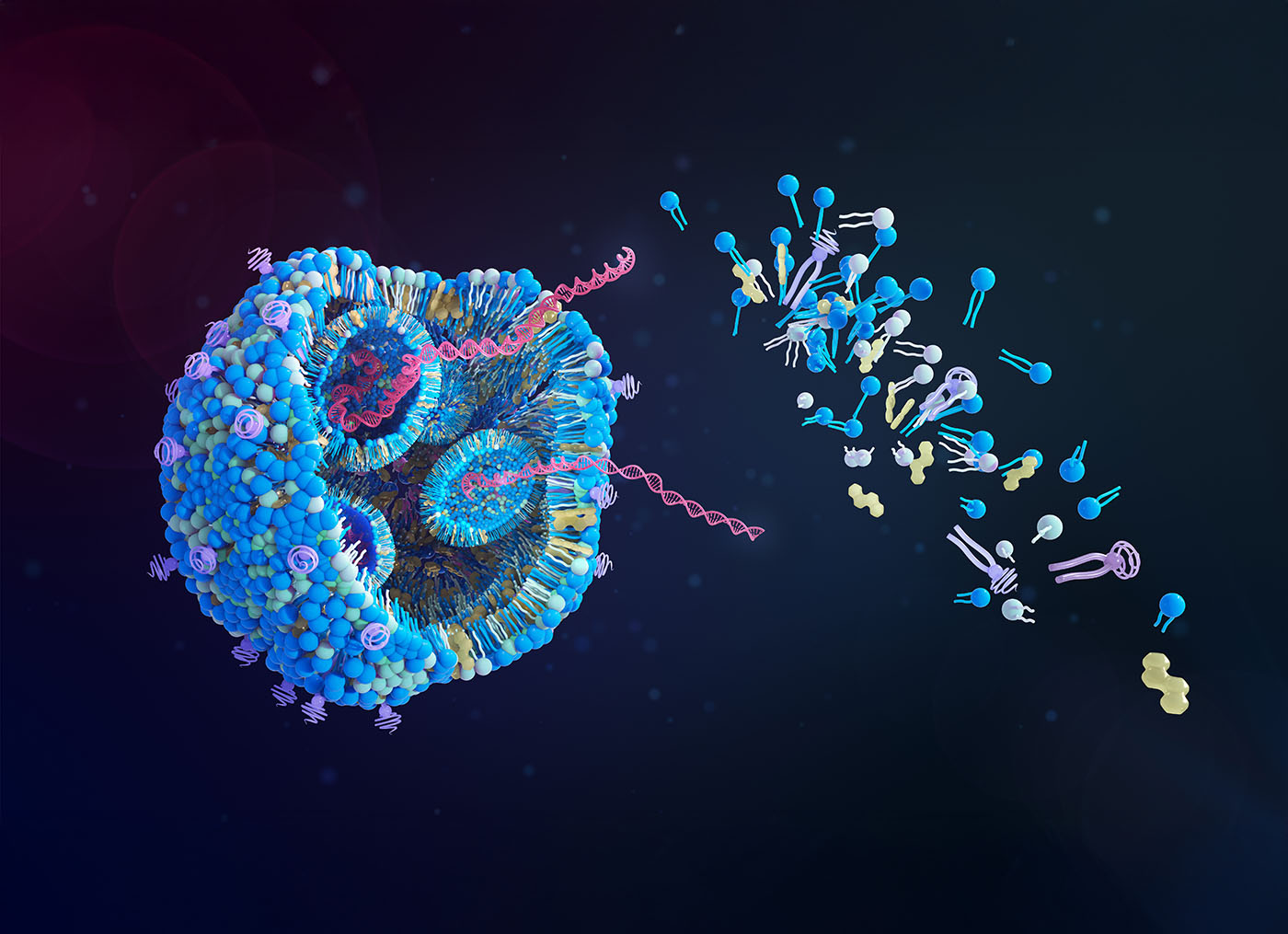
The advent of mRNA vaccination, ignited by the COVID-19 pandemic, has sparked research to build the next generation of vaccine. Specifically, to address limitations of current mRNA vaccines—such as increasing vaccine potency and reducing toxicity. Now, a new delivery LNP, developed through sequential combinatorial chemistry and rational design, and based on a class of degradable, cyclic amino ionizable lipids, has been developed at MIT. The novel LNP could make mRNA vaccines more effective and potentially lower the cost per vaccine dose.
In mouse studies, the researchers showed that an mRNA influenza vaccine delivered with their new LNP could generate the same immune response as mRNA delivered by nanoparticles made with FDA-approved materials, but at around 1/100 the dose.
This work is published in Nature Nanotechnology in the paper, “Degradable cyclic amino alcohol ionizable lipids as vectors for potent influenza mRNA vaccines.”
“One of the challenges with mRNA vaccines is the cost,” says Daniel Anderson, PhD, professor in MIT’s department of chemical engineering and a member of MIT’s Koch Institute for Integrative Cancer Research and Institute for Medical Engineering and Science (IMES). “Our goal has been to try to make nanoparticles that can give you a safe and effective vaccine response but at a much lower dose.”
The team sought to develop particles that can induce an effective immune response, but at a lower dose than the particles currently used to deliver COVID-19 mRNA vaccines. That could not only reduce the costs per vaccine dose, but may also help to lessen the potential side effects, the researchers say.
LNPs typically consist of five elements: an ionizable lipid, cholesterol, a helper phospholipid, a polyethylene glycol lipid, and mRNA. This work focused on the ionizable lipid, which plays a key role in vaccine strength. The researchers designed a library of new ionizable lipids containing cyclic structures which can help enhance mRNA delivery, as well as esters, which the researchers hypothesized could help improve biodegradability.
Using a luciferase reporter, combinations of the structures were screened in mice for effective delivery. A second screen was performed with variants from the top-performing particle. From these screens, AMG1541 was determined to be more effective in dealing with endosomal escape, a major barrier for delivery particles.
Another advantage of the new LNPs is that the ester groups in the tails make the particles degradable once they have delivered their cargo so that they can be cleared from the body quickly. The researchers believe this could reduce side effects from the vaccine.
The team used the AMG1541 LNP to deliver an mRNA influenza vaccine in mice. They compared this vaccine’s effectiveness to a flu vaccine made with the lipid SM-102, which is FDA-approved and was used by Moderna in its COVID-19 vaccine.
Mice vaccinated with the new particles generated the same antibody response as mice vaccinated with the SM-102 particle, but only 1/100 of the dose was needed to generate that response, the researchers found.
“It’s almost a hundredfold lower dose, but you generate the same amount of antibodies, so that can significantly lower the dose. If it translates to humans, it should significantly lower the cost as well,” says Arnab Rudra, PhD, a visiting scientist at the Koch Institute.
In addition, the AMG1541 mRNA LNPs “substantially reduced expression in the liver following intramuscular injection, mitigating the associated toxicity.” In addition, the researchers observed “improved mRNA delivery to antigen-presenting cells at the injection site and the draining lymph node, leading to stronger germinal center reactions.” The new LNPs are also more likely to accumulate in the lymph nodes, where they encounter many more immune cells.
“We have found that they work much better than anything that has been reported so far. That’s why, for any intramuscular vaccines, we think that our LNP platforms could be used to develop vaccines for a number of diseases,” says Akash Gupta, PhD, a Koch Institute research scientist.
