

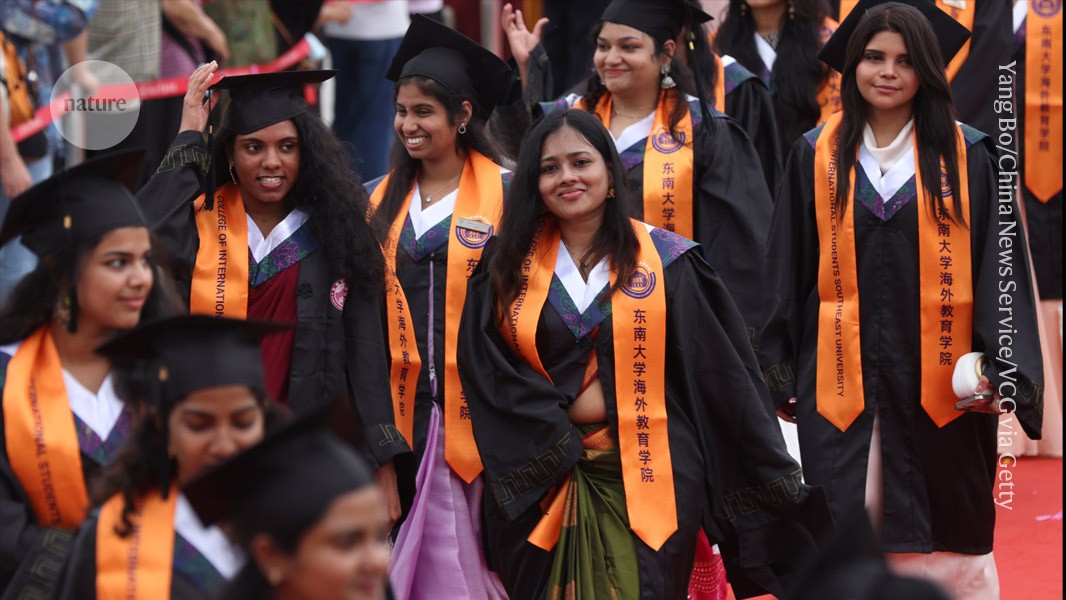
China has seen increasing international enrolments as its universities grow in stature, but this has also brought challenges.Credit: Yang Bo/China News Service/VCG via Getty
In 2018, I argued that China’s meteoric growth in research output masked deeper structural issues, including inconsistent research quality and a ‘publish or perish’ academic culture. Seven years on, that picture has changed.
Research quality in China has improved: in 2023, it overtook the United States as the leading country in the Nature Index, which tracks output in high-quality natural- and health-sciences journals. Since then, the gap between the two countries has only widened.
These gains reflect deliberate policy interventions, including the Chinese government’s Double First-Class Initiative, launched in 2017 to cultivate world-class universities and disciplines by awarding different levels of funding on the basis of performance and strategic goals, with a focus on quality over quantity.
At the institutional level, performance evaluations now place greater weight on originality, quality and international visibility, rather than raw output. Since 2020, in response to a national policy that aimed to address the pervasive focus on research output, rather than quality, some universities have reduced or abolished cash rewards for sheer numbers of publications, replacing them with recognition tied to global impact and peer esteem.
But structural challenges remain. Some universities are using pay bumps, rather than cash payments for papers, as a more indirect way to reward prolific authors1. Progress has been uneven: improvements are concentrated in a small cluster of elite universities and disciplines. Political sensitivities continue to constrain academic openness and freedom.
Earlier this year, I interviewed 10 university administrators and academics and 12 international postgraduate students at two Chinese research universities to gain an understanding of how the country’s increasingly cautious approach to global collaborations is affecting their work.
Changing landscape
One of the biggest changes the interviewees described is the shift away from US and UK collaborations, especially in politically sensitive areas, such as artificial intelligence (AI), aerospace and cybersecurity. Many universities now encourage partnerships with researchers in South and southeast Asia, the Middle East, Africa and continental Europe — regions with which China aims to strengthen trade and economic ties through its Belt and Road Initiative (BRI).
Some universities are using planning tools to manage international partnerships more carefully. A few interviewees mentioned a system that ranks potential research partners by geopolitical and reputational risk — green for low risk, amber for moderate and red for high, which needs approval from senior university leaders. It “has become a routine part of proposal review — even for conference participation or faculty exchanges”, one academic-affairs supervisor said.
This shift also affects international students, especially those from low- and middle-income countries participating in the BRI, who account for a growing share of enrolments at Chinese universities.
Nature Index 2025 Research Leaders
Many of these students face major challenges, including limited institutional support and language barriers. Some interviewees noted that as Chinese universities have shifted their focus from recruiting students from high-income countries, such as South Korea, Japan, the United States and United Kingdom, to students from lower-income regions, the system seems less equipped to accommodate their academic and cultural needs.
For example, interviewees suggested that students from richer countries generally received clearer information and stronger institutional support than did those from low- and middle-income countries, who were frustrated about being enrolled in ‘English-speaking’ classes that, in reality, were not taught in English. “Many assignments are in Chinese,” said a Pakistani student studying English linguistics. “I translate everything myself.”
Some interviewees noted that administrative hurdles, such as delayed visa renewals, have intensified, particularly as enforcement of residency and exit–entry rules has become stricter. China’s regulations on the enrolment of international students — jointly issued in 2020 by the ministries of education, foreign affairs and public security — require universities to coordinate with local public-security bureaus and foreign-affairs offices to process visa and residence-permit approvals, thereby institutionalizing several layers of oversight.
Students sponsored by their home government said that they face strict requirements to return after graduating. “I have to return to Bangladesh and work in a government office for five years, or repay everything,” a student from the country explained. “It blocks career options.”
These rules reflect China’s policy of cultivating foreign talent — especially students from BRI countries who gain local experience and later return to their home countries to work in government or development sectors. The intent of the policy is to foster long-term ties and mutual understanding between China and these countries, as part of a broader strategy of education-driven diplomacy that combines talent development with international influence-building.
Self-funded international students, however, said they have reduced access to institutional support, travel grants and career resources compared with their government-sponsored peers, creating a two-tier system.
Ambiguity and self-censorship
In addition to administrative hurdles, many students described an academic environment in which certain topics were ‘off-limits’, without clear guidelines. “We’re often discouraged from raising questions in class because we’re unsure what is politically acceptable,” said one European student studying international relations.
Different disciplines seem to have different boundaries. Science, technology, engineering and mathematics students reported restricted access to international databases in genomics and biotechnology, for instance; social-science students encountered extended review processes or informal bans on politically sensitive topics.
One European student told me that they wanted to compare Taiwanese and mainland media narratives as part of an assignment, and their adviser told them to avoid “sensitive framing”, including terms such as “independence” and “resistance”.
