

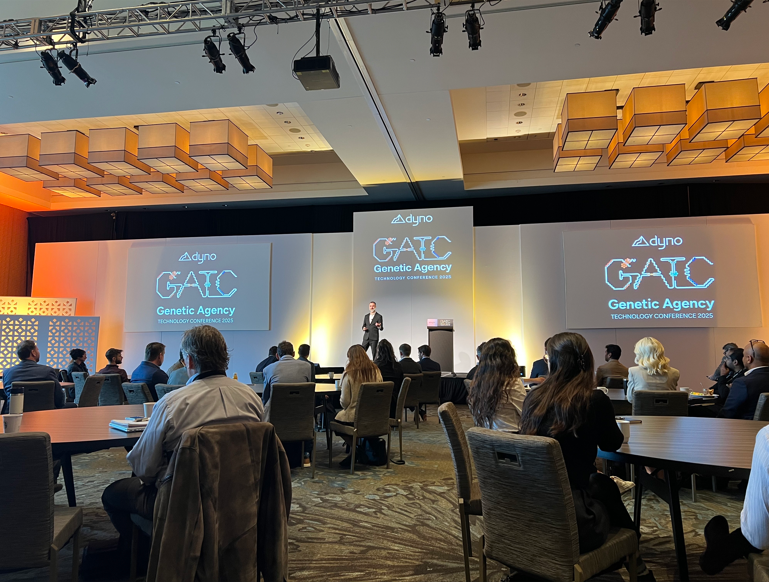
BOSTON – Artificial intelligence (AI) was one of the major themes at the recent Genetic Agency Technology Conference (GATC), hosted by Dyno Therapeutics, which took place in Boston earlier this week. A diverse group of researchers, technologists, and entrepreneurs came together to discuss the mission of “genetic agency,” which Dyno defines as “an individual’s ability to take action at the genetic level to live a healthier life.”
Additionally program highlights included powerful stories of patient advocacy from Sonia Vallabh, PhD, director of protein therapeutic science at the Broad Institute, Victoria Gray, the first sickle cell disease patient to undergo CRISPR therapy in the Vertex/CRISPR Therapeutics exa-cel trial, and Allyson Berent, PhD, chief science officer of the Foundation for Angelman Syndrome Therapeutics (FAST).
In AI, CEO Eric Kelsic, PhD, described Dyno as one of the early “AI-first” companies founded in 2018 with a focus on AI-guided AAV capsid engineering for gene therapy. He attests that AI will have a key role enabling genetic agency by democratizing therapeutic design.
In recent years, Dyno has incorporated both structure-based and large language models for protein design into the company’s platform, and AI agents to automate R&D workflows. These agents address the “last-mile” problem in generative therapeutic design by adding scientific expertise, including molecular biology, experimental design, and discovery decisions, to general-purpose tools. Among the Dyno announcements at GATC included a call for beta testers for the company’s expanded AI agent platform, featuring workflow, knowledge, and protein structure agents, led by David Levy-Booth, PhD, associate director at Dyno.
Dyno was co-founded by Harvard Medical School geneticist George Church, PhD, so it was no surprise to see Church featured in the program. Church’s talk highlighted the wealth of AI companies that he has co-founded over recent years, including JURA Bio (manufacturing aware generative models), Nabla Bio (antibodies and GPCRs), Manifold Bio (multiplex proteins in vivo), Lila Sciences (autonomous labs), among several others.
AI round up
One of the standout breakout sessions at GATC, chaired by Sam Sinai, PhD, co-founder and head of machine learning at Dyno, covered the broad applications of AI in genetic medicines from protein design, the virtual cell, and automation.
Nima Alidoust, PhD, co-founder and CEO of Tahoe Therapeutics, focused on the role of virtual cells for interrogating polygenic characteristics of cancer. The company is one of many players defining the “virtual cell,” as models that predict how cell gene expression changes with genetic perturbations to aid drug discovery. Others include Arc Institute, Chan Zuckerberg Initiative, and Xaira Therapeutics.
Just a few weeks ago, Tahoe announced the open-source release of Tahoe-x1, a foundation model trained on the company’s giga-scale single-cell atlas of 100 million transcriptomic profiles, Tahoe-100M.
Pranam Chatterjee, PhD, assistant professor of bioengineering at University of Pennsylvania, asserted the power of protein language models, without the need for structural information, to achieve design tasks. This summer, Chatterjee published PepMLM, a generalizable language model that designs small peptides validated to hit challenging “undruggable” targets relevant to Huntington’s disease, viral infections, and leukemia.
In a structural contrast, Chatterjee’s presentation was followed by a talk on the latest update to the Boltz series of models, BoltzGen, which makes the advance from structure prediction to generalizable therapeutic design in any format, including nanobodies, mini-binders, and disulfide-bonded peptides. A large network of 26 academic and industry collaborators, including Chatterjee, is conducting wet lab validation of BoltzGen designs with initial results showing nanomolar affinities with therapeutically relevant functions, including antimicrobial action, cancer therapy, and antibody design.
As modern biology is powered by data frameworks, Ava Amini, PhD, principal researcher at Microsoft, presented the Dayhoff Atlas, a centralized collection of both protein sequence data and generative models, with 3.3 billion natural protein sequences and 46 million sequences for structure-based synthetic proteins. Amini’s work emphasizes the impact of scaling sequence diversity on improving protein design and pays tribute to Margaret Dayhoff, who published the Atlas of Protein Sequence and Structure in 1965, a collection of 65 proteins whose amino-acid sequences were then known and one of the earliest publicly available protein datasets.
In automation, Le Cong, PhD, assistant professor of pathology and genetics at Stanford University, spoke on the rise of co-scientists to drive biomedical innovation. Last summer, Cong and colleagues published CRISPR-GPT for agentic automation of gene-editing experiments in Nature Biomedical Engineering, as well as LabOS, an AI co-scientist that unites computational reasoning with physical experimentation through multimodal perception, self-evolving agents, and Entended-Reality(XR)-enabled human-AI collaboration.
While AI reshapes nearly all corners of genetic medicine, impact is just at the beginning. Next year’s GATC will reveal how far the field has progressed toward true genetic agency.
