

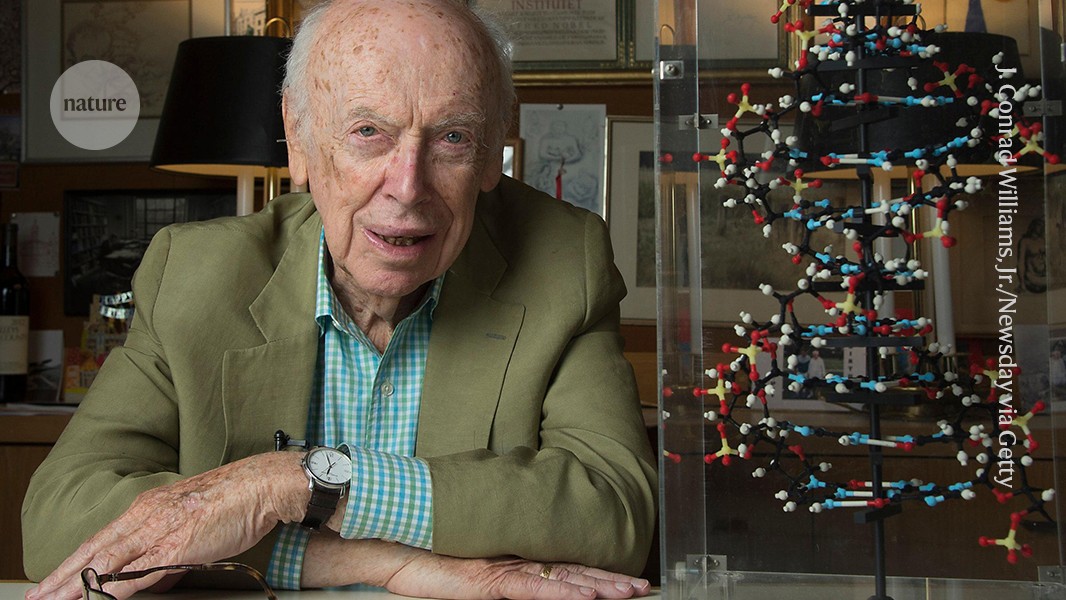
Credit: J. Conrad Williams, Jr/Newsday via Getty
James D. Watson was one of the most influential — and controversial — scientists of the twentieth century. He helped to uncover the structure of the DNA double helix, wrote a textbook that transformed science education, and led institutions that shaped modern biology. Although his later years were marred by contentious remarks about race, his scientific legacy remains immense.
Born in Chicago, Illinois, in 1928, Watson grew up during the Great Depression and identified with the ideals of the New Deal Democrats, who thought that government power should be used to create a fairer, healthier society. A gifted student, he entered the University of Chicago at 15 and graduated in zoology four years later. Although keen on birdwatching and ornithology, reading What Is Life? by physicist Erwin Schrödinger convinced him that genes were the key to understanding life. So he pursued a PhD in genetics with Salvador Luria at Indiana University Bloomington, studying viruses that infect bacteria, and became fixated on finding the structure of DNA.
DNA pioneer James Watson has died ― colleagues wrestle with his legacy
At 23, Watson joined the Medical Research Council’s molecular biology research group at the Cavendish Laboratory in Cambridge, UK. He shared an office with Francis Crick and there was an immediate synergy between them. They decided to build molecular models of DNA by combining X-ray crystallographic data with what was known of DNA’s chemistry.
The crystallographic data came from Rosalind Franklin, Ray Gosling and Maurice Wilkins at King’s College London. Before moving to Birkbeck College in London in 1953, Franklin had given her data — including Photograph 51, the X-ray diffraction image of DNA taken by her PhD student Gosling — to Wilkins, who then showed it to Watson. The image confirmed that the DNA molecule was helical. Working with cardboard cut-outs of the bases, Watson had the crucial insight that the molecule’s building blocks fitted together in specific pairs. This discovery, published in 1953, revealed how genetic information is copied and passed on — one of the most important insights in modern science. Watson, Crick and Wilkins shared the 1962 Nobel Prize in Physiology or Medicine for the work.
Watson’s account of the discovery, The Double Helix (1968), broke all the conventions of the typically staid scientific autobiography. Written in the voice of the brash 25-year-old he was in 1953, and reflecting the attitudes of the time, it provoked accusations that his portrayal of people, especially Rosalind Franklin, was cruel. Despite this, the book became one of the most successful accounts of research, conveying the visceral thrill of scientific discovery.
What Rosalind Franklin truly contributed to the discovery of DNA’s structure
Following a fellowship at the California Institute of Technology in Pasadena, Watson moved in 1956 to the Department of Biology at Harvard University in Cambridge, Massachusetts. There, his laboratory made major discoveries in protein synthesis, including sharing in the discovery of messenger RNA. His textbook Molecular Biology of the Gene (1965), which was based on his Harvard lectures, was revolutionary, changing the style of science texts and attracting generations of students to molecular biology. He considered this and his other writings to be among his greatest achievements.
Watson first visited the Biological Laboratory at Cold Spring Harbor, New York, in 1948 and returned almost every year. He became a trustee and, in 1968, was asked to become director of what is now the Cold Spring Harbor Laboratory (CSHL). In the same year, he married Elizabeth Lewis, a graduate of Radcliffe College in Cambridge, Massachusetts, whose own contributions to the lab cannot be overestimated. In his 26-year tenure, Watson transformed the CSHL into one of the world’s leading institutes, known for its education programmes as much as for its research. Watson’s great success as director came from identifying important problems, recruiting remarkably talented scientists and providing them with an environment in which to flourish.
