

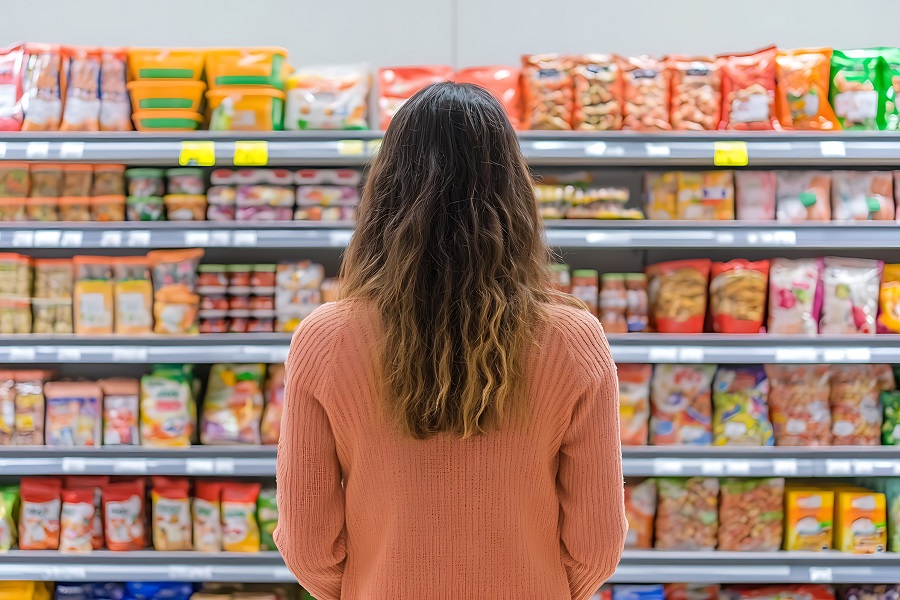
In a women’s health study, researchers have linked a higher consumption of ultra-processed foods (UPFs) to an increased risk of early-onset colorectal cancer precursors. Participants on a diet rich in these foods had a higher likelihood of developing adenomas before the age of 50.
The cohort study examined the dietary habits of 29,105 female nurses under 50 who had undergone a lower endoscopy. Compared to women with the lowest UPF intake, those who consumed the highest amount of UFPs were found to have a 45% increased likelihood of developing conventional colorectal adenomas, a type of polyp that can become cancerous.
Experts not participating in the research have commented on the findings, questioning whether a clear link to cancer can be drawn. Marco Gerlinger, a professor of gastrointestinal cancer medicine and consultant medical oncologist at St Bartholomew’s Hospital in the UK, believes more research is needed to understand mechanisms behind this association.
“This study is purely an association of highly processed food consumption with bowel polyp diagnoses which are precursors to bowel cancer, and as such cannot prove causation — i.e. that UPFs are causing the development of these polyps,” he argues.
“The study is also retrospective in nature, and it could miss other environmental exposures or lifestyle factors that contribute to early polyp development.”
Gerlinger concedes that while the association between UPF consumption and higher bowel cancer risk is already known, a crucial new discovery is that it is also associated with early onset bowel polyps — particularly in the age group where there has been the biggest rise in new bowel cancer diagnoses.
Study parameters
The study examined the files of participants in the Nurses’ Health Study II, an ongoing US prospective cohort of female registered nurses set up in 1989.
The researchers determined UPF intake based on food-frequency questionnaires completed every four years, classifying foods using the Nova system.
The nurses included in the final analysis met several specific criteria: they completed the baseline 1991 food-frequency questionnaire, underwent at least one lower endoscopy before age 50 following the baseline survey, and had no prior history of cancer (excluding nonmelanoma skin cancer), colorectal polyps, or inflammatory bowel disease before their endoscopy procedure.
On average, UPFs accounted for 34.8% of the participants’ total daily caloric intake. The study documented 1,189 cases of early-onset conventional adenomas and 1,598 serrated lesions, another type of polyp.
Compared to those in the lowest consumption group, the highest consumers of UPFs had 45% higher adjusted odds of developing these polyps. Importantly, this higher risk was not observed for serrated lesions.
The results remained consistent even after researchers accounted for other factors like body mass index (BMI), type 2 diabetes, key dietary elements (such as fiber, folate, calcium, and vitamin D intake), and overall diet quality scores.
“The associated risk of developing polyps increased rather constantly with higher UPF consumption. So, there is no cutoff below which consuming UPFs was associated with no effect, according to the data. On the flip side, any reduction in UPF intake was associated with a decrease in polyp risk,” Gerlinger highlights.
Results of this study suggest that reducing UPF intake may be an effective dietary strategy to prevent early-onset colorectal tumorigenesis.
“The study adds to the long list of health problems that have been associated with highly processed food consumption. Although we need more data and it is too early to recommend avoiding UPFs, having a good look at your diet and trying to reduce UPF consumption makes sense,” highlights Gerlinger.
Trouble with UPF classification
The plethora of processed foods — some with higher amounts of detrimental ingredients like salt, fat, sugar, and others with a better health profile — presents a challenge for policymakers.
The complexity makes it difficult to reach a consensus on both what exactly constitutes a UPF and, consequently, how to effectively advise the public on its consumption. The American Heart Association recently issued a bulletin calling for dietary guidance to more specifically focus on reducing nutrient-poor UPFs, while advocating for more research on how they impact the body.
Recently, the Physicians Committee for Responsible Medicine cautioned that few US consumers can identify healthy UPFs, with 39% of respondents to an online poll incorrectly saying all processed foods are unhealthy.
“In order to investigate the effects of UPF intake on health, it is important to be able to measure how much UPFs people consume,” says Gunter Kuhnle, professor of nutrition and food science at the University of Reading, UK, commenting on the study findings.
“This is very difficult — even with very detailed dietary information — because the definition is ambiguous and most methods don’t collect enough information. Study participants might record ‘bread’ — but it is impossible to know whether it is ultra-processed or not.”
Kuhnle highlights that the study relied on food-frequency questionnaires to estimate UPF intake. “By their very nature, they need to combine different foods and collect less information. Many foods that are listed as options have ultra-processed and non-ultra-processed options (e.g. tomato sauce, bread, or breakfast cereals) and it is impossible for the scientist to know what has actually been consumed.”
“A participant consuming porridge, home-made sourdough bread, and home-made tomato sauce will tick the self-same boxes as someone eating coco pops, industrially made bread, and tinned tomato sauce — but only one of them will have consumed UPFs.”
Kuhnle concludes that having unreliable data on UPF intake presents a greater challenge when investigating links with disease. “If we don’t know what someone has consumed, investigating associations with diet is difficult. The results therefore do not necessarily reflect associations between UPF intake and disease risk, but rather the association for specific food groups.”
