

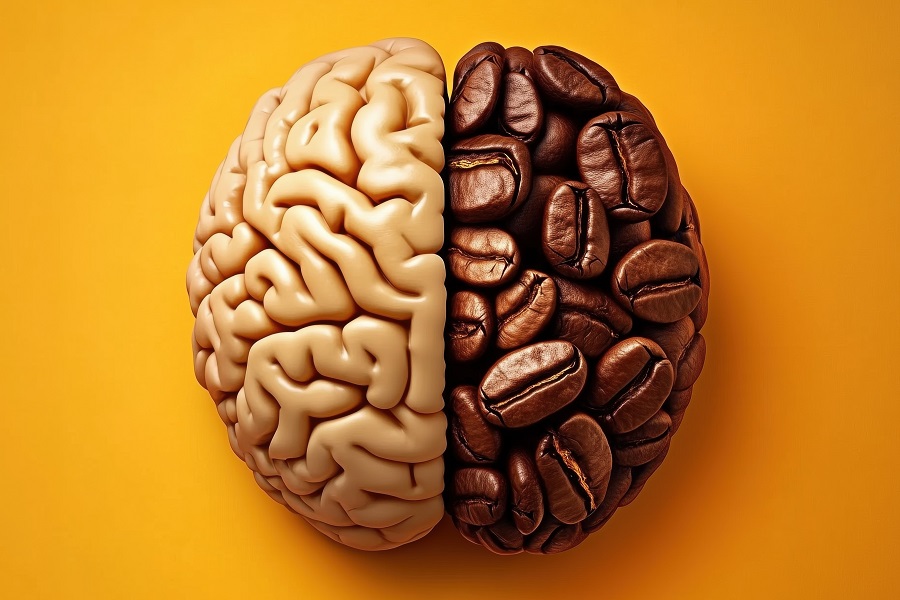
A new scientific commentary discussing a recent paper in Nature explains how the study solved a two-decade-old mystery behind the rapid antidepressant effects of ketamine and electroconvulsive therapy by studying similar effects in coffee. Researchers discovered that these three stimulants trigger surges in adenosine, which may be the mechanism behind the brain benefit.
In the study led by Min-Min Luo, a professor at School of Life Sciences, Tsinghua University, China, blocking adenosine receptors caused the therapeutic effects to vanish. When these were reactivated, the antidepressant response resumed.
Adenosine receptors, the commentary highlights, are also the primary target of caffeine, the world’s most widely consumed psychoactive substance.
“This is where clinical practice meets mechanistic insight,” comments Dr. Julio Licinio, psychiatrist, neuroscientist, and editor-in-chief at Molecular Psychiatry and Translational Psychiatry, in the external review in Brain Medicine.
“Caffeine blocks the same adenosine receptors that Luo’s team showed are essential for ketamine and electroconvulsive therapy to work. We are potentially looking at a major treatment interference that nobody has been systematically tracking.”
Ma-Li Wong, a professor of psychiatry and expert in depression and pharmacogenomics research at Upstate Medical University, US, adds in the commentary: “Patients routinely show up for ketamine infusions or electroconvulsive therapy having consumed their morning coffee. Based on Luo’s mechanistic data, we need to ask whether that is sabotaging their treatment.”
Investigating mechanisms of action
Writing in Nature, Luo’s team notes that despite the therapeutic potential of ketamine and electroconvulsive therapy, investigating role of adenosine in these treatments has been “technically challenging” because of the “transient and dynamic nature” of its signaling and “brain-region-specific and receptor-specific actions.”
Using genetically encoded adenosine sensors in mice, the researchers discovered that administering ketamine and electroconvulsive therapy activated rapid adenosine surges that boosted mood.
For ketamine, the researchers set out to prove that ketamine itself, not its metabolites, was triggering this effect. They used enzyme inhibitors and found that blocking metabolism intensified this adenosine surge.
The researchers observed the same adenosine mechanism in seizures produced through electroconvulsive therapy. Using real-time monitoring in mice, they demonstrated that these caused a quick, high-magnitude surge of adenosine in the brain’s medial prefrontal cortex and hippocampus, similar to the effect of ketamine.
Critically, when the adenosine A1 and A2A receptors were genetically removed, the antidepressant benefits of electroconvulsive therapy in mice were completely blocked, confirming that this signaling pathway is essential for the therapy’s success.
In addition, the researchers showed that acute intermittent hypoxia (brief drops in oxygen) increases brain adenosine levels as well. This non-drug treatment also produces antidepressant effects, according to the study, which parallels the actions of ketamine and electroconvulsive therapy.
Controlling oxygen produces similar benefits
Wong and Licini note that while regular, long term coffee drinking seems to counter depression to some extent, the same mechanism behind its benefit may interfere with fast-acting treatments for depression from working when they are urgently needed.
They believe this adenosine signaling discovery opens doors to “scalable, noninvasive therapeutics in major depressive disorder.”
“What is most intriguing is that Luo showed all three interventions, ketamine, electroconvulsive therapy, and intermittent hypoxia, converge on adenosine,” comments Licinio. “This unified framework helps us understand not just how these treatments work, but how lifestyle factors like coffee consumption might modulate their effectiveness.”
“The convergence of the world’s most prevalent psychoactive drug with the mechanistic lynchpin of our most effective rapid antidepressants is unlikely to be accidental. Understanding this intersection may illuminate both the widespread appeal of caffeine and the optimization of adenosine-targeted therapeutics.”
Morning mood fuel
Expanding on coffee’s health halo, a separate study found caffeine may be effective in helping slow down aging at a cellular level, by tapping into an ancient cellular energy system. By examining fission yeast — a single-celled organism “surprisingly similar” to human cells — researchers determined that caffeine helps cells sustain life.
Previous research also suggested a daily cup of caffeinated coffee may lower all-cause mortality risk by 16%. In particular, black coffee and coffee with low added sugar and saturated fat were linked to a 14% lower risk of mortality.
In new product development, brands are seeing a surge in interest among consumers seeking more than a caffeine boost from coffee. Functional coffee trends in the market are driving demand for calming ingredients like L-theanine and anti-inflammatory mushrooms like chaga.
