

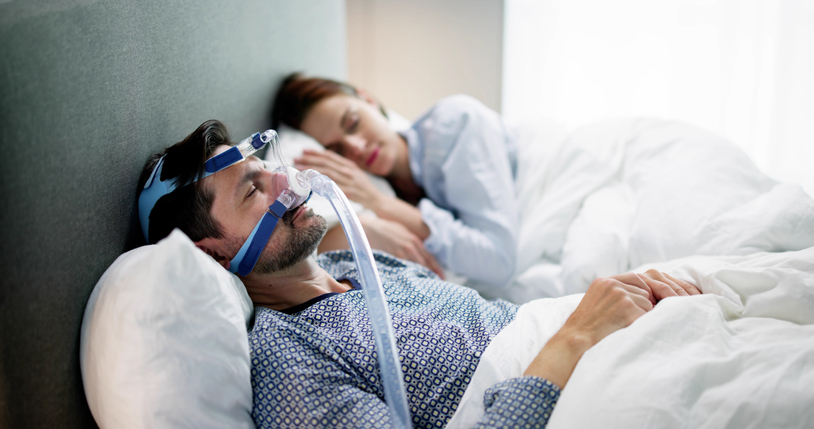
Results from a large study carried out in a group of U.S. veterans show untreated obstructive sleep apnea can increase the risk of Parkinson’s disease, but that this risk is mitigated by treatment with continuous positive airway pressure (CPAP) machines.
As reported in JAMA Neurology, compared to veterans without sleep apnea, those with the condition had a 10-15% increased risk of developing Parkinson’s after adjusting for potential confounding factors like age, sex, smoking and others.
“It’s not at all a guarantee that you’re going to get Parkinson’s, but it significantly increases the chances,” said co-author Gregory Scott, MD, PhD, assistant professor of pathology in the OHSU School of Medicine and a pathologist for at the VA Portland, in a press statement.
Obstructive sleep apnea, a sleep disorder in which a person’s breathing repeatedly stops and starts during sleep due to partial or complete blockage of the upper airway, is very common and is thought to affect around one in three adults in the U.S.
“This obstruction can be sufficient to cause significant intermittent arterial hypoxemia and hypercapnia, which triggers a cascade of hemodynamic, metabolic, and inflammatory events,” write the authors.
“In the brain, this chronic intermittent hypoxia results in mitochondrial dysfunction, a process thought to underlie Parkinson’s disease pathogenesis.”
To investigate possible connections between the two conditions, Scott and colleagues analyzed data from 11, 310,411 U.S. veterans (around 10% female) who were aged an average of 61 years.
In total, 13.7% of the group (1,552,505 people) had obstructive sleep apnea. At an average of six years after diagnosis, veterans with sleep apnea had 1.61 additional cases of Parkinson’s per 1000 people. This translates to an approximate 10–15% increase in relative risk for Parkinson’s in those with sleep apnea versus those without the condition.
Notably, female veterans with untreated sleep apnea had twice as high a risk for developing Parkinson’s than male veterans with the sleep disorder.
Early CPAP use reduced the number of new Parkinson’s cases by about 2.3 per 1,000 people over five years, a 30% relative risk reduction. This means if 439 people with sleep apnea were treated with CPAP it could prevent around one case of Parkinson’s over a five year period.
It can be difficult to persuade people with sleep apnea to use a CPAP machine as it involves wearing a mask and can be quite invasive.
However, “the veterans who use their CPAP love it,” says Scott. “They’re telling other people about it. They feel better, they’re less tired. Perhaps if others know about this reduction in risk of Parkinson’s disease, it will further convince people with sleep apnea to give CPAP a try.”
