

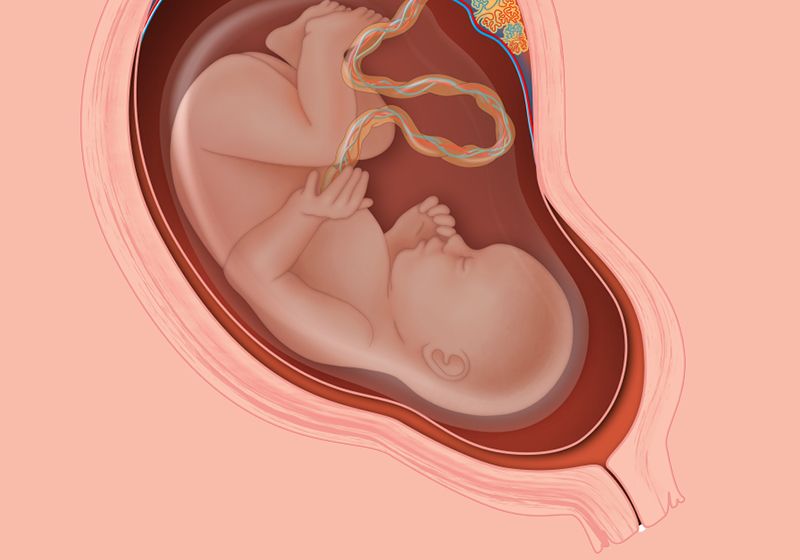
Amniotic fluid surrounds the developing fetus throughout pregnancy, providing nutrients and other support. A new model could help researchers study this material to improve neonatal care.
Many factors, including genetics, stress, and environmental exposure, can shape pregnancy and fetal development. Physicians who care for pregnant patients and their babies before and after birth work to improve the outcomes for both parties throughout gestation and delivery. While scientific advancements have led to many improvements in this area, there are still aspects of pregnancy that remain a black box.
“We all understand how important the placenta is in terms of that prenatal environment and shaping fetal development. What we haven’t really delved into is the amniotic fluid, which is kind of equally important in its role in shaping fetal development,” said Jamie Lo, a maternal-fetal medicine specialist at Oregon Health and Science University (OHSU).
To address this shortcoming, Lo teamed up with neonatologist Brian Scottoline, also at OHSU, to identify the contents of amniotic fluid, how the fluid changes over time, and how physician scientists like themselves can more easily study it. Understanding the components of amniotic fluid throughout gestation could provide improvements in care not only for pregnant patients and their developing offspring but also for infants born prematurely.
Nonhuman Primates Offer a Model for Amniotic Fluid
Jamie Lo studies in utero development and placental biology, and she cares for patients with high-risk pregnancies.
Christine Torres Hicks / Oregon Health & Science University
Amniotic fluid provides nutrition and other growth support to the fetus. The challenge in exploring this fetal environment lies in accessing it: Sampling amniotic fluid requires a procedure called an amniocentesis, typically only performed at a single time point for genetic testing or infection screening in healthy pregnancies; this restricts the ability to study this fluid longitudinally. Because of this, Lo said, “having a really relevant translational model system that really recapitulates human amniotic fluid composition is key.”
Recognizing this limitation, Lo and Scottoline developed a nonhuman primate model for sampling this medium. When they compared this fetal environment over the course of pregnancy, they found that the protein composition between humans and nonhuman primates was highly comparable.1
Lo and Scottoline also saw that the protein abundance in the fluid changed similarly over the course of pregnancy in both species. This suggested that the amniotic fluid supports the developmental needs of the fetus over time. The findings also demonstrated that nonhuman primates could serve as a valuable model to study this medium.
Amniotic Fluid Regulates Coagulation
During gestation and eventual birth, controlling coagulation represents an important balancing act at the maternal-fetal interface. The surrounding tissues must prevent excessive bleeding, which could deprive the fetus of nutrients and increase the risk of pregnancy complications and loss, while also mitigating the formation of thrombosis or an amniotic fluid embolism that could harm the pregnant person. While previous research suggested that amniotic fluid may be involved in these regulatory processes, the limitations in studying this medium prevented thorough investigations.
Using their amniotic fluid model, Scottoline and Lo recently showed that nonhuman primate and human amniotic fluid possess factors to both promote and impede different coagulation processes.2 In particular, they demonstrated that phospholipids present in the fetal environment were important for activating platelets.
Much like their initial proteomic study, they saw that the proteins involved in regulating coagulation changed over the course of pregnancy, again pointing to their role in supporting the needs of the fetus. “It really starts to uncover some of the underlying protective mechanisms of amniotic fluid that we hadn’t really understood at this granular level before,” Lo said.
Improving Neonatal Care with Amniotic Fluid

Brian Scottoline cares for critically ill and premature infants. He is interested in finding ways to improve care for these patients.
OHSU
By studying the composition and unique functions of the amniotic fluid, Scottoline and Lo emphasized that these findings could improve pre- and postnatal care, which would be especially important for improving the health of infants born prematurely. “[Amniotic fluid is] a really rich source of potential therapeutics or nutritional interventions that we might be able to use for the very preterm infant to help their ex utero, or outside the womb, development and make it more like it would be if the baby [were] just staying inside of their parent,” said Scottoline, who takes care of infants born prematurely and other critically ill neonatal patients.
This is important since, as Lo described, right now this care largely consists of supportive measures. “If we’re able to potentially offer [parents] something that might mitigate some of the adverse outcomes, that’s our goal here,” she said. Scottoline added that the findings can also provide a diagnostic window into gestational health if researchers can identify useful biomarkers.
“There could be a lot of potential here, but the only way to find out is to investigate it,” Scottoline said. Using their nonhuman primate model to address limitations in studying this vital tissue in humans, the researchers are motivated to do just that.
