
Close Menu
My Blog

    Subscribe to Updates

    Get the latest creative news from FooBar about art, design and business.

    What's Hot

    Nautilus debuts Voyager platform in push toward next-gen proteomics

    March 1, 2026

    First-in-Human Success for Prenatal Stem Cell Therapy in Spina Bifida

    February 28, 2026

    Pressure-Driven Pathway Links Liver Congestion to Fibrosis and Cancer

    February 28, 2026
    Facebook X (Twitter) Instagram
    X (Twitter) YouTube
    My BlogMy Blog
    Monday, March 2
    • Home
    • About Us
    • Healthy Living
    • DNA & Genetics
    • Podcast
    • Shop
    My Blog
    Home»DNA & Genetics»Polar Tourists Collect Phytoplankton to Help Researchers Study Fjord Ecology
    DNA & Genetics

    Polar Tourists Collect Phytoplankton to Help Researchers Study Fjord Ecology

    adminBy adminDecember 1, 2025No Comments3 Mins Read
    Facebook Twitter Pinterest LinkedIn Tumblr WhatsApp VKontakte Email
    TS Digest Logo
    Share
    Facebook Twitter LinkedIn Pinterest Email

    Phytoplankton are microalgae that are integral to oxygen production and the ocean food web. Studying these organisms in Antarctica can inform researchers about how climate change affects this ecosystem, but its remote location presents many challenges. One of these is access to the study site to collect samples.

    Allison Cusick and Martina Mascioni extracted DNA and RNA from phytoplankton samples to study the species present from the samples.

    Allison Cusick

    “As polar scientists, we have access maybe to one ship or no ships,” said Allison Cusick, a biological oceanographer and postdoctoral researcher at the University of California, San Diego.

    In 2015, polar ecologist Maria Vernet at the University of California, San Diego received an email from polar tour guides wondering how they could help scientists in Antarctica conduct research at one site. After a successful pilot project, Cusick and her colleague, Martina Mascioni, a phytoplankton ecologist, both graduate students in Vernet’s group, expanded this project the next year to include more tour operators, allowing the team to study phytoplankton communities in more fjords. From this, the citizen science project FjordPhyto was born to study how melting glaciers affect phytoplankton communities.

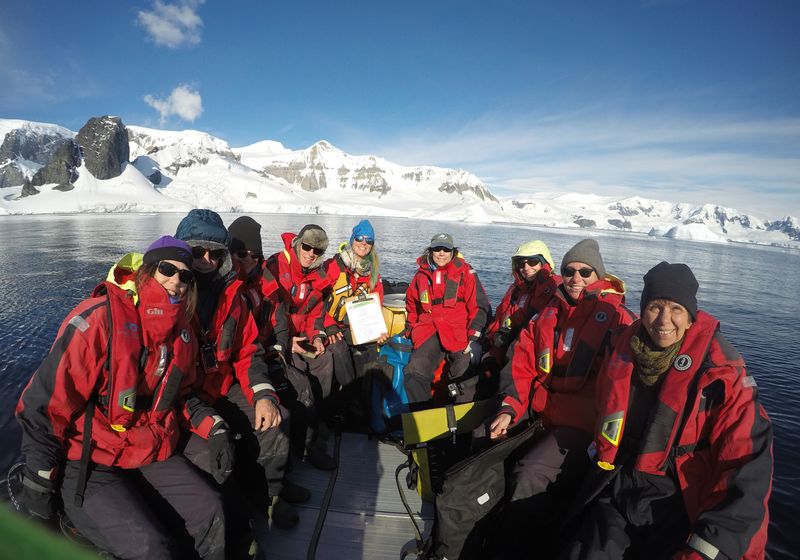
    The team teaches the polar guides about phytoplankton and their role in the region and trains the guides on how to use equipment to collect water samples and take measurements on its salinity, temperature, and phytoplankton density. The guides then invite tourists on the cruises to join them in an inflatable boat to collect samples and tell the visitors about the microbial communities that the researchers are studying. “There’s a lot of things that you can do just with simple equipment, and that’s where FjordPhyto leads,” said Mascioni, currently a postdoctoral researcher at the National University of La Plata.

    After returning to the tour ship, the guides can also put some of the samples under a microscope to show guests the phytoplankton living in the water. “Most of them say they didn’t know that [the citizen science project] was available, but it was [a] highlight on their trip,” Mascioni said.

    Grayscale microscopic image of a cluster of three phytoplankton. They are shaped like long chili peppers and have bumpy exteriors like a raspberry.

    Martina Mascioni uses microscopy to study the physical features of different phytoplankton collected from regions around Antarctica.

    Martina Mascioni

    After the cruise returns, the operators send the water samples to the FjordPhyto team. Mascioni studies the carbon biomass in the water and conducts cell counts with microscopy. Meanwhile, Cusick explores the species’ diversity and behavior using genetic techniques.

    “I don’t think any of us realized how big this program could get and how much impact it would have beyond just our own theses,” Cusick said. Beyond their own research questions, Mascioni and Cusick said that the samples and data collected through FjordPhyto have opened new research avenues and collaborations with other scientists. The repeated collections provided them with time series of these communities that did not exist before. Next, the researchers are also interested in exploring other regions of Antarctica and even other parts of the southern oceans.

    The FjordPhyto team is currently uploading their data to the public domain so that it is accessible for other researchers, and they are also creating materials in Spanish to reach a wider audience. Cusick said that the team hopes that FjordPhyto helps people understand how changes in Antarctica are important beyond the remote ecosystem. In the future, they hope to expand the engagement with citizen scientists by allowing them to track a sample’s progression through the research pipeline.

    Collect ecology Fjord Phytoplankton Polar Researchers Study Tourists
    Share. Facebook Twitter Pinterest LinkedIn Tumblr WhatsApp Email
    Previous ArticleHow to Change Bath Time for Your Child With Atopic Dermatitis (Eczema)
    Next Article 13 Cyber Monday Deals at Their Lowest Prices Ever
    admin
    • Website

    Related Posts

    A Video Report from AGBT

    February 27, 2026

    Novo Nordisk, Vivtex Ink Up to $2.1B Deal to Develop Oral Biologics for Metabolic Conditions

    February 27, 2026

    Increasing Rice Yields with Gene-Informed Selective Breeding

    February 27, 2026

    Mutant p53 Selective Reactivation Demonstrated in Advanced Solid Tumors

    February 27, 2026
    Leave A Reply Cancel Reply

    Our Picks

    9 Time-Saving Kitchen Gadgets for Fall at Amazon

    September 5, 2025

    Why Exercise Is So Important For Heart Health, From An MD

    September 5, 2025

    An Engineered Protein Helps Phagocytes Gobble Up Diseased Cells

    September 5, 2025

    How To Get Rid Of Hangnails + Causes From Experts

    September 5, 2025
    • Facebook
    • Twitter
    • Pinterest
    • Instagram
    • YouTube
    • Vimeo
    Don't Miss
    Longevity

    Nautilus debuts Voyager platform in push toward next-gen proteomics

    By adminMarch 1, 20260

    Company’s new benchtop system promises a clearer view of proteins following validation at a leading…

    First-in-Human Success for Prenatal Stem Cell Therapy in Spina Bifida

    February 28, 2026

    Pressure-Driven Pathway Links Liver Congestion to Fibrosis and Cancer

    February 28, 2026

    A cellular atlas of aging comes into focus

    February 28, 2026

    Subscribe to Updates

    Get the latest creative news from SmartMag about art & design.

    About Us

    At FineGut, our mission is simple: to enhance your self-awareness when it comes to your gut health. We believe that a healthy gut is the foundation of overall well-being, and understanding the brain–gut connection can truly transform the way you live.

    Our Picks

    9 Time-Saving Kitchen Gadgets for Fall at Amazon

    September 5, 2025

    Why Exercise Is So Important For Heart Health, From An MD

    September 5, 2025

    An Engineered Protein Helps Phagocytes Gobble Up Diseased Cells

    September 5, 2025
    Gut Health

    Nautilus debuts Voyager platform in push toward next-gen proteomics

    March 1, 2026

    First-in-Human Success for Prenatal Stem Cell Therapy in Spina Bifida

    February 28, 2026

    Pressure-Driven Pathway Links Liver Congestion to Fibrosis and Cancer

    February 28, 2026
    X (Twitter) YouTube
    • Contact us
    • Privacy Policy
    • Disclaimer
    • Terms and Conditions
    © 2026 finegut.com. Designed by Pro.

    Type above and press Enter to search. Press Esc to cancel.