

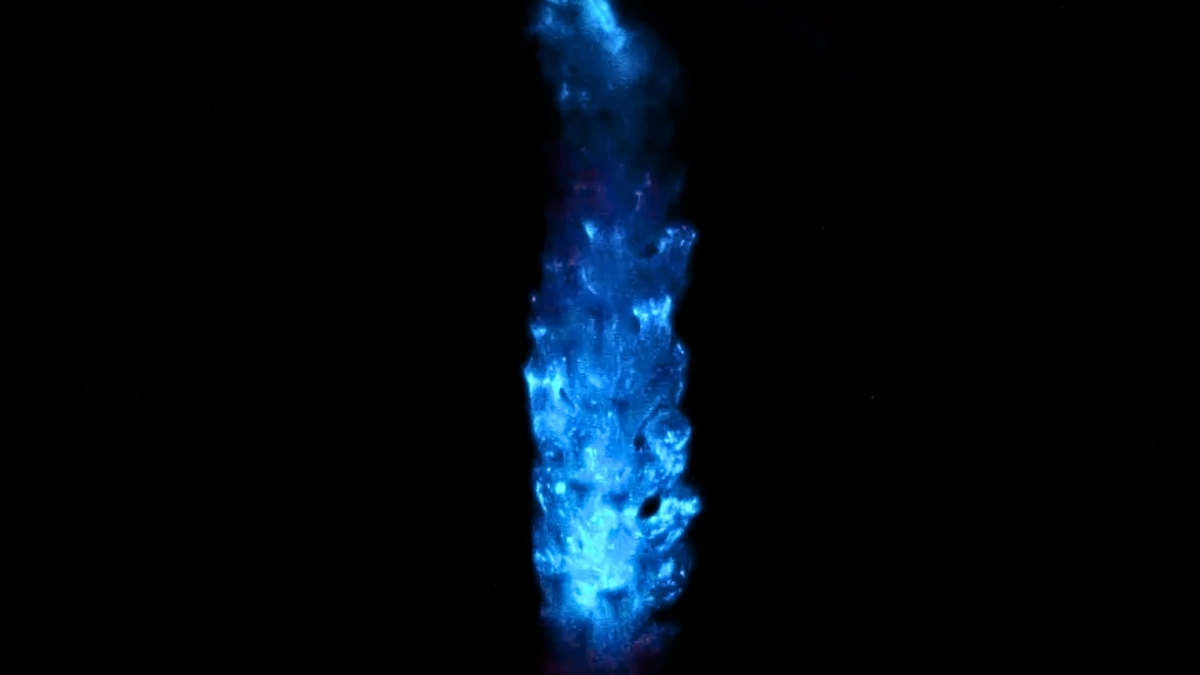
In the darkest corners of the planet, where the light of the Sun never touches, eerie glows can yet be found, illuminating the shadows.
This is bioluminescence, a remarkable ability that has evolved, separately, at least 94 times throughout the history of life on Earth. Bioluminescent organisms can harness chemical reactions to produce a glow of their own, a tool used for various purposes by the different creatures that wield it.
Scientists have traced this tool to its earliest known evolutionary origins: a class of corals called Octocorallia in the depths of the ocean in the Cambrian, some 540 million years ago. This is more than double the age of the previous title holder, a tiny deep-ocean crustacean that lived 267 million years ago.
Subscribe to our free Spark newsletter today and you could win a $10,000 vacation including a bioluminescent night kayaking tour! Sweepstakes ends 11 December 2025 at 11:59pm ET. Full details here.
“We wanted to figure out the timing of the origin of bioluminescence, and octocorals are one of the oldest groups of animals on the planet known to bioluminesce,” said marine biologist and lead author Danielle DeLeo of the Smithsonian Institution, when the study was published in April last year.
“So, the question was when did they develop this ability?”
Octocorals are a fascinating set of creatures.
Like other corals, they are made up of polyps that cluster together to form a colony, often living on a framework made of their calcified secretions.
However, octocorals, which get their name from the eightfold symmetry of the polyps, have softer skeletons than their rigid relatives.
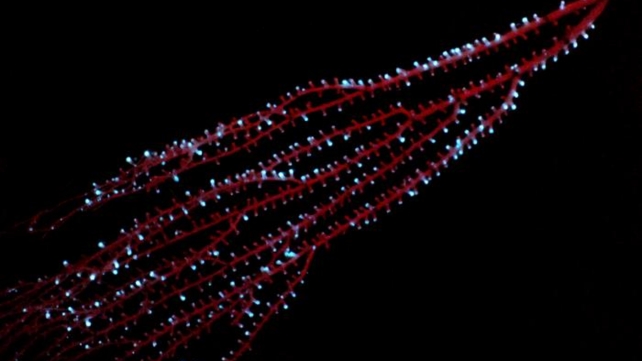
Some of them are also known to glow with bioluminescence, but the reason for it is a bit of a mystery, since they only do so when they’re disturbed.
Scientists think that it might be a lure for prey, or for predators to come and eat the smaller fish that feed on and damage the coral.
Because corals are some of the oldest organisms on the planet, and octocorals are known to glow, DeLeo and her colleagues thought these organisms might be the best place to look for the early origins of bioluminescence.
The groundwork was already in place, with a detailed octocoral family tree published in 2022, using genetic data from 185 octocoral taxa.
The next step was to identify and trace the lineages of known species of bioluminescent octocorals, collected as part of fieldwork conducted by marine biologists Manabu Bessho-Uehara of Nagoya University in Japan and Andrea Quattrini of the Smithsonian Institution.
 frameborder=”0″ allow=”accelerometer; autoplay; clipboard-write; encrypted-media; gyroscope; picture-in-picture; web-share” referrerpolicy=”strict-origin-when-cross-origin” allowfullscreen>
Their seafloor forays identified previously unknown bioluminescence in five octocoral types – a discovery they could use for the next step, an analysis called ancestral state reconstruction.
“If we know these species of octocorals living today are bioluminescent, we can use statistics to infer whether their ancestors were highly probable to be bioluminescent or not,” Quattrini explained.

“The more living species with the shared trait, the higher the probability that as you move back in time, those ancestors likely had that trait as well.”
The team deployed several different statistical analyses, and they all returned a similar result: Bioluminescence first emerged in the common ancestor of all octocorals some 540 million years ago.
At this time, multicellular life was still in its infancy, but there were marine invertebrates with eyes capable of detecting light sharing the Cambrian ocean.
The emergence of bioluminescence at the same time suggests an interspecies interaction of some kind, and could help figure out why the ability evolved.
Related: Scientists Have Created Glow-in-The-Dark Succulents (And We Want One)
But there’s another huge question remaining.
If the common ancestor of the thousands of octocoral species alive today had bioluminescence, why do so few have it now? And how did they lose it?
That’s the next step, and it could shed more light on the strange ecology of the Cambrian ocean.
The research was published in Proceedings of the Royal Society B Biological Sciences.
An earlier version of this article was published in April 2024.
Subscribe to our free Spark newsletter today and you could win a $10,000 vacation including a bioluminescent night kayaking tour! Sweepstakes ends 11 December 2025 at 11:59pm ET. Full details here.
