

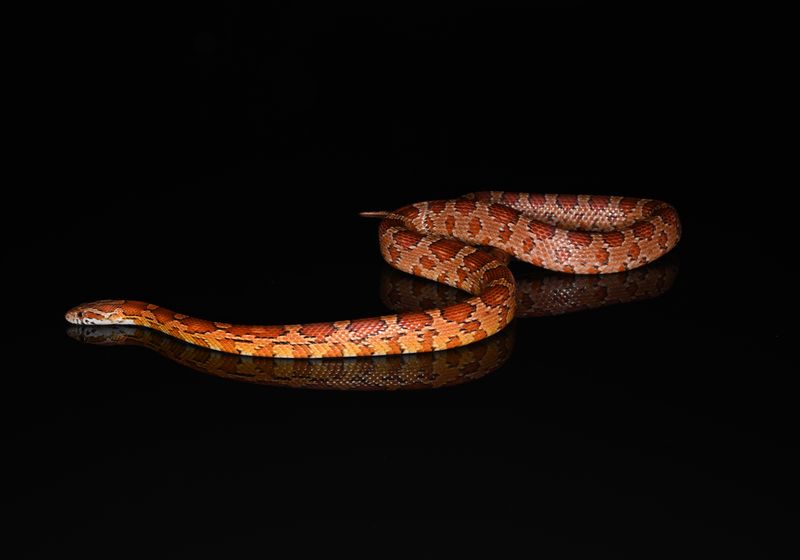
Corn snakes exhibit characteristic dorsal blotches, serving as an important model organism for investigating the genetic and developmental pathways underlying skin coloration in reptiles. Using comparative genomics and CRISPR-Cas9, researchers identified the genes that give the corn snake its characteristic dorsal blotches
As a graduate student at the Free University of Brussels nearly 20 years ago, Athanasia Tzika analyzed the genomes of several animals to better understand their diversity. During this time, the striking, distinct patterns on reptile skin caught her attention.
“Out of curiosity, you start looking at [the animals], and you start seeing…interesting characters,” said Tzika, now an evolutionary developmental biologist at the University of Geneva. “The coloration is one of the first things that someone notices.”
This led to a long-term project investigating why reptiles—such as snakes and lizards—of the same species display different color patterns on their skin. Using comparative genomic analyses, Tzika and her team have identified several genes and their variants that are associated with blotches, spots, stripes, or labyrinths on reptile skin.1 By pioneering a CRISPR-Cas9 approach to generate gene-edited snakes, the researchers obtained deeper insights into the mechanisms governing coloration patterning in reptiles.2
DNA Isolation from Snakes
Tzika and her team have characterized several different color morphs of corn snakes. A dorsal view of the morphs is shown here.
LANE laboratory (https://www.lanevol.org/)
Among snakes, Tzika and her team study corn snakes (Pantherophis guttatus), a popular model for animal coloration studies because of the various color morphs—genetically determined phenotypes—they exhibit. “The advantage [of studying these snakes] is that many people keep them as pets at home,” said Tzika. As soon as pet owners notice these color morphs and put the information on the internet, the researchers obtain these snakes and breed them in the lab.
They then compare the genomes of the various corn snake color morphs to pinpoint the genetic variants underlying the respective phenotypes. For genomic analyses, Tzika and her team obtain DNA from either the shed snakeskin or the animals’ red blood cells (RBCs), which have nuclei, unlike RBCs in humans. “The sampling of DNA is actually very easy for snakes,” said Tzika. “I mean, it’s difficult working with reptiles, but for [DNA sampling], it’s much easier actually.”
Using this pipeline, the researchers compared the genomes of the Terrazzo morph whose skin pattern is characterized by stripes with wild type (WT) corn snakes that display blotches. They discovered a mutation in the premelanosome protein (PMEL) gene, leading to its reduced expression in Terrazzo embryonic tissues.3
While PMEL-expressing cells form aggregates that eventually give way to blotches in WT corn snake embryos, Terrazzo embryos cannot form such aggregates, giving rise to a striped phenotype. “Before doing these experiments and seeing that, I could not imagine how you can change the circles to lines on a snake,” said Tzika. “Now we know.”
To further confirm that PMEL was responsible for the color phenotype, Tzika and her team generated gene-edited PMEL-knockout snakes using CRISPR-Cas9. These gene-edited snakes showed stripes similar to the Terrazzo morph, indicating PMEL’s involvement in influencing coloration patterning. But developing a CRISPR-Cas9-mediated gene editing method for snakes was no small feat.
Generating CRISPR-Cas9 Gene-Edited Snakes
For obtaining snakes with genetic alterations, Tzika and her team built on a method previously developed for generating CRISPR-Cas-9 gene-edited lizards.4 They adapted this protocol for corn snakes, based on the animals’ breeding season.

In addition to snakes, Tzika and her team study leopard geckos. These reptiles, with their characteristic spotted pattern, act as a valuable model for studying chromatophore distribution in reptiles.
LANE laboratory (https://www.lanevol.org/)
The researchers could not inject the gene-editing machinery into a freshly laid snake egg because, by then, the embryo is already too far along in its development. Moreover, the eggshell is soft, so “if you inject [anything], you’re just going to burst the whole thing,” explained Tzika.
To circumvent these problems, the researchers operated on female snakes and injected CRISPR-Cas9 gene-editing tools into their oocytes. The team standardized their method such that the edited gene expression would be maintained throughout the snake’s life after birth. “That was a big challenge, and we were very happy to have it working,” said Tzika.
Genes Underlying Reptile Skin Patterns Highlight the Diversity of Animals on Earth
As challenging as working with reptiles has been, Tzika appreciates the lessons it has taught her, especially about the diversity of creatures on the planet. “We take many things for granted because it works like that in the mouse,” she said. “We think that everything around us, all the biodiversity around us can be explained by whatever we learn [through] mice.”
For instance, mutations in CLCN2, a gene encoding a voltage-gated chloride channel protein in mice and humans, results in severe brain white matter diseases, as well as retinal and testes degeneration. In contrast, Tzika and her colleagues discovered that CLCN2 mutations in corn snakes give rise to a distinct color pattern: While WT animals show blotches on their backs, those carrying a CLCN2 mutation exhibit elongated blotches that fuse together.5
“That was a very surprising finding that again [shows] how much there is flexibility in the genome,” said Tzika. “[It shows] how the same elements can be used in completely different ways to actually give the amazing biodiversity around us.”
