

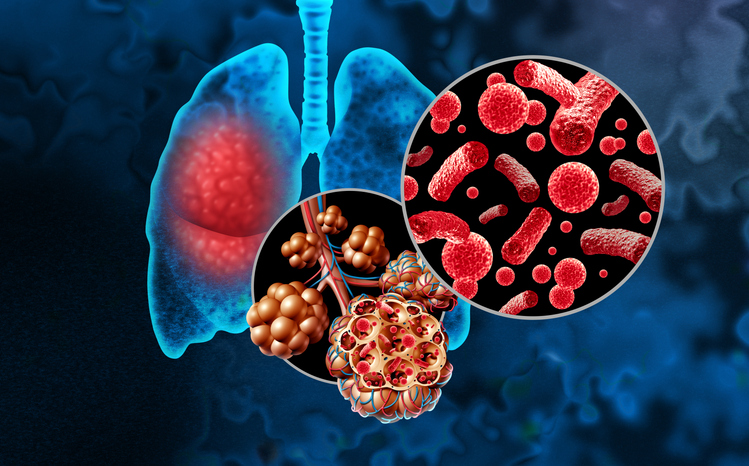
Scientists from the University of Maryland School of Medicine (UMSOM) and the University of Alabama at Birmingham’s Heersink School of Medicine say they have identified a bacterial enzyme that may be the reason some people get heart complications with pneumonia, while others do not.
Since enzymes create chemical reactions to help bacteria survive, grow, and sometimes attack tissues, the researchers understood this particular enzyme, named zmpB, could become a target for future vaccines or drug therapies. They published their findings in Cell Reports.
“About one in five people hospitalized with pneumonia will suffer a life-threatening adverse cardiac event and, even in the years following, are at least twice as likely to experience some form of heart failure,” said the study’s lead author, Carlos J. Orihuela, PhD, professor of microbiology at the University of Alabama at Birmingham.
Pneumonia burdens the healthcare system with more than 1.2 million emergency room visits each year and more than 41,000 adult deaths in the United States. Worldwide, more than one million children under the age of five die of the disease annually. But while past research has focused on the lungs, it can trigger heart complications, such as heart failure, arrhythmias, or heart attacks, that cause death.
While there are several bacteria and viruses causing pneumonia, the team looked specifically at Streptococcus pneumoniae, the leading cause of community-acquired pneumonia. They used bacterial genome-wide association studies (bGWAS), mouse models, and cardiac organoids to confirm and make the discovery that S. pneumoniae can directly damage the heart and that zmpB potentiates the invasion of S. pneumoniae into the heart, respectively.
“This role for zmpB is totally new, and this information now makes it a potential treatment target,” said Orihuela.
“When we examined hundreds of strains isolated from patients who developed heart complications and compared those with bacteria from patients who only experienced pneumonia, a pattern immediately jumped out at us,” added Adonis D’Mello, PhD, bioinformatics analyst in the group of Hervé Tettelin, PhD, professor of microbiology and immunology at UMSOM and the Institute for Genome Sciences, both authors on the study.
“Patients with heart failure were more frequently infected with a version of S. pneumoniae that carried the gene zmpB with a distinctive genetic trait, FIVAR domains, which are special segments that help the bacteria invade and survive within heart cells and cause pockets of infection. In fact, it turns out that we found the more FIVAR domains this gene has, which so far have no characterized function, the more damage to the heart it causes.”
Mouse experiment
The researchers infected mice with either a regular pneumonia strain or with a genetically modified strain where they knocked out the zmpB gene and monitored disease progression. They found that mice infected with the normal strain developed numerous cardiac microlesions and cell death that damaged the heart, but those who had the knocked-out strain had few or no microlesions or cell death around their hearts.
Next, they exposed heart organoids—beating cardiac cells grown from human stem cells in a petri dish—to one of three tests: infecting them with pneumococcal strains with and without the zmpB gene, as well as different versions of zmpB. Those with zmpB with FIVAR domains attached invaded heart cells, whereas those that lacked the FIVAR domains had reduced heart tissue cell death and bacterial entry.
“With the mouse models, we learned that injury to the heart depended on the zmpB expressed by the strain, and with the organoids, we learned that it happens because the proteins equipped with FIVAR domains help bacteria invade heart cells and damage them,” noted Tettelin.
“Our hope is that by understanding these molecular fingerprints we can better protect patients against the risk of heart damage during an illness with pneumonia or at least minimize the severity,” said Orihuela.
“Although more work needs to be done before it’s ready for the clinic, it may be possible that with a simple genetic test, doctors could identify high-risk strains of the bacteria early in an infection for closer cardiac monitoring or a targeted treatment to prevent heart damage.”
“These are extremely important findings,” according to Mogens Kilian, DSc, professor emeritus of medical microbiology at Aarhus University in Denmark, who is an expert in the field but did not participate in this research. “Not only does the study identify a function of an enigmatic enzyme in Streptococcus pneumoniae, but it also explains the pathogenesis of serious complications associated with infections caused by some strains of this pathogen, and thereby, opens a potential route to prevention.”
