
Close Menu
My Blog

    Subscribe to Updates

    Get the latest creative news from FooBar about art, design and business.

    What's Hot

    Nautilus debuts Voyager platform in push toward next-gen proteomics

    March 1, 2026

    First-in-Human Success for Prenatal Stem Cell Therapy in Spina Bifida

    February 28, 2026

    Pressure-Driven Pathway Links Liver Congestion to Fibrosis and Cancer

    February 28, 2026
    Facebook X (Twitter) Instagram
    X (Twitter) YouTube
    My BlogMy Blog
    Sunday, March 1
    • Home
    • About Us
    • Healthy Living
    • DNA & Genetics
    • Podcast
    • Shop
    My Blog
    Home»DNA & Genetics»Muscle Stem Cells Bolstered by ECM Protein Tenascin-C
    DNA & Genetics

    Muscle Stem Cells Bolstered by ECM Protein Tenascin-C

    adminBy adminDecember 5, 2025No Comments3 Mins Read
    Facebook Twitter Pinterest LinkedIn Tumblr WhatsApp VKontakte Email
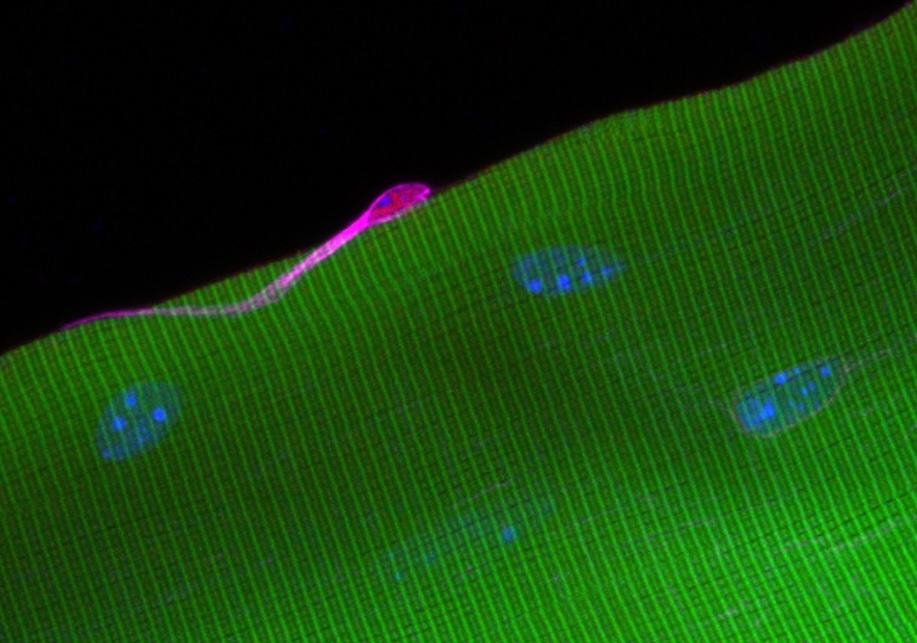
    Muscle stem cell on myofiber.
    Share
    Facebook Twitter LinkedIn Pinterest Email

    Sarcopenia—reduced muscle mass, strength, and function—is often associated with aging and frequently impacts quality of life in the elderly. Individuals with sarcopenia are also prone to further injury that can lead to drastic health declines.

    “It is absolutely crucial that we are able to develop strategies to maintain muscle as we age,” proclaimed Alessandra Sacco, PhD, the dean of the Sanford Burnham Prebys Graduate School of Biomedical Sciences and a professor in the Center for Cardiovascular and Muscular Diseases. “The progressive loss of skeletal muscle mass and function are indicators of poor survival in patients.”

    Sacco is the senior author of a new study exploring how the protein composition of muscular extracellular matrix impacts the function of muscular stem cells in the repair and regeneration of muscles during aging.

    The paper was published in Communications Biology under the title, “Tenascin-C from the tissue microenvironment promotes muscle stem cell maintenance and function through Annexin A2.”

    Prior research out of the Sacco lab explored the prenatal development of muscle cells, exposing the role of tenascin-C (TnC), a large protein found in the extracellular matrix. First co-author Alessandra (Lale) Cecchini, PhD, a scientist in the Sacco lab, shared that “TnC was one of the genes we found that are specifically elevated at the prenatal stage.”

    “TnC normally is not really expressed in healthy adult muscle, but it goes up rapidly after an injury to reactivate the programs needed for regeneration and repair,” continued Sacco. “We wanted to understand how TnC influenced stem cells that are primarily responsible for muscle regeneration, and how this relationship was affected by aging.”

    To do this, Tenascin-C knockout (TnC-KO) mice were compared to wildtype mice histologically. The TnC-KO mice had fewer muscle stem cells overall, and those present had defects in self-renewal. Further, the mice lacking TnC showed a reduced ability to repair muscular damage compared to controls. “The stem cells also were less able to make new stem cells and maintain an adequate population, and this resulted in defects in their ability to repair injured muscle,” said Cecchini.

    The team also identified the source of TnC during regeneration. “We found that support cells called fibroadipogenic progenitors were secreting TnC, which made sense given the known role of these [cells] during muscle regeneration,” Sacco said. Additionally, the team determined that following secretion, TnC acts upon muscle stem cells through a receptor known as Annexin A2.

    With these data revealing a clearer understanding of adult function of TnC, the team pursued their initial questions regarding the role of TnC in aging. They found that older mice had lower levels of TnC, and muscle stem cells were also less mobile with increased age, reducing their ability to regenerate at muscle injury sites. However, treating muscle stem cells with TnC corrected these defects.

    “We’ve shown that mice lacking TnC exhibit a premature aging phenotype, and that restoring TnC may be a therapeutic strategy for age-related muscle loss,” said Sacco.

    While treatment with TnC may be a path to treating sarcopenia, delivery of the extracellular protein presents a challenge. Orally taken or injectable methods may not be the most effective modes of delivery, but the researchers are exploring potential solutions to this problem.

    “Advances in science, medicine, and public health have considerably extended the average lifespan,” Sacco pointed out. “Now we need to make the same improvements to the healthspan, beginning by addressing frailty, falls, and fractures.”

    “Our overall goal is to contribute to a greater quality of life as we age,” Cecchini concluded.

    Bolstered Cells ECM muscle Protein Stem TenascinC
    Share. Facebook Twitter Pinterest LinkedIn Tumblr WhatsApp Email
    Previous ArticleDuplicated Genes Point to an Earlier Start to Complex Life
    Next Article The Ice is Alive: Uncovering the Vanishing World of Glacial Microbes
    admin
    • Website

    Related Posts

    First-in-Human Success for Prenatal Stem Cell Therapy in Spina Bifida

    February 28, 2026

    A Video Report from AGBT

    February 27, 2026

    Novo Nordisk, Vivtex Ink Up to $2.1B Deal to Develop Oral Biologics for Metabolic Conditions

    February 27, 2026

    Increasing Rice Yields with Gene-Informed Selective Breeding

    February 27, 2026
    Leave A Reply Cancel Reply

    Our Picks

    9 Time-Saving Kitchen Gadgets for Fall at Amazon

    September 5, 2025

    Why Exercise Is So Important For Heart Health, From An MD

    September 5, 2025

    An Engineered Protein Helps Phagocytes Gobble Up Diseased Cells

    September 5, 2025

    How To Get Rid Of Hangnails + Causes From Experts

    September 5, 2025
    • Facebook
    • Twitter
    • Pinterest
    • Instagram
    • YouTube
    • Vimeo
    Don't Miss
    Longevity

    Nautilus debuts Voyager platform in push toward next-gen proteomics

    By adminMarch 1, 20260

    Company’s new benchtop system promises a clearer view of proteins following validation at a leading…

    First-in-Human Success for Prenatal Stem Cell Therapy in Spina Bifida

    February 28, 2026

    Pressure-Driven Pathway Links Liver Congestion to Fibrosis and Cancer

    February 28, 2026

    A cellular atlas of aging comes into focus

    February 28, 2026

    Subscribe to Updates

    Get the latest creative news from SmartMag about art & design.

    About Us

    At FineGut, our mission is simple: to enhance your self-awareness when it comes to your gut health. We believe that a healthy gut is the foundation of overall well-being, and understanding the brain–gut connection can truly transform the way you live.

    Our Picks

    9 Time-Saving Kitchen Gadgets for Fall at Amazon

    September 5, 2025

    Why Exercise Is So Important For Heart Health, From An MD

    September 5, 2025

    An Engineered Protein Helps Phagocytes Gobble Up Diseased Cells

    September 5, 2025
    Gut Health

    Nautilus debuts Voyager platform in push toward next-gen proteomics

    March 1, 2026

    First-in-Human Success for Prenatal Stem Cell Therapy in Spina Bifida

    February 28, 2026

    Pressure-Driven Pathway Links Liver Congestion to Fibrosis and Cancer

    February 28, 2026
    X (Twitter) YouTube
    • Contact us
    • Privacy Policy
    • Disclaimer
    • Terms and Conditions
    © 2026 finegut.com. Designed by Pro.

    Type above and press Enter to search. Press Esc to cancel.