
Close Menu
My Blog

    Subscribe to Updates

    Get the latest creative news from FooBar about art, design and business.

    What's Hot

    Nautilus debuts Voyager platform in push toward next-gen proteomics

    March 1, 2026

    First-in-Human Success for Prenatal Stem Cell Therapy in Spina Bifida

    February 28, 2026

    Pressure-Driven Pathway Links Liver Congestion to Fibrosis and Cancer

    February 28, 2026
    Facebook X (Twitter) Instagram
    X (Twitter) YouTube
    My BlogMy Blog
    Sunday, March 1
    • Home
    • About Us
    • Healthy Living
    • DNA & Genetics
    • Podcast
    • Shop
    My Blog
    Home»DNA & Genetics»Plant Hormone Controls Protein Levels in Living Worm, Improves Aging Model
    DNA & Genetics

    Plant Hormone Controls Protein Levels in Living Worm, Improves Aging Model

    adminBy adminDecember 16, 2025No Comments3 Mins Read
    Facebook Twitter Pinterest LinkedIn Tumblr WhatsApp VKontakte Email
    Plant Hormone Controls Protein Levels in Living Worm, Improves Aging Model
    Share
    Facebook Twitter LinkedIn Pinterest Email

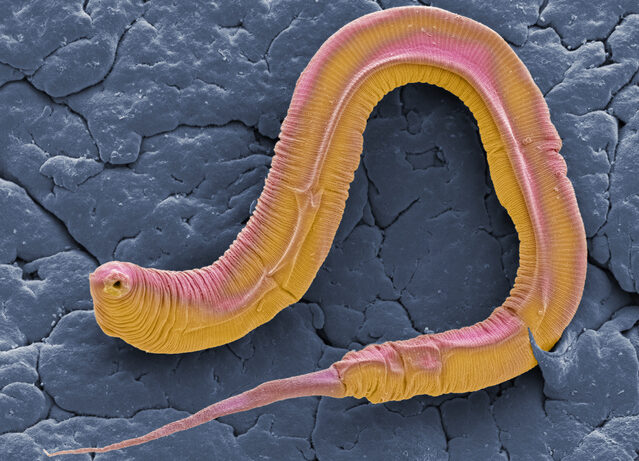
    Caenorhabditis elegans, colored scanning electron micrograph. Through a single mutation to their insulin signaling pathway, scientists can increase the lifespan of C. elegans worms by up to 10-fold. [Steve Gschmeissner/Science Photo Library/Getty Images]

    The causal role of a gene is interrogated by experimentally perturbing its function, often using interventions that produce strong protein knockouts. However, biological systems possess complex quantitative dynamics, with strong knockdowns being less informative than more subtle, quantitative perturbations. 

    In a new study published in Nature Communications titled, “Engineering the auxin-inducible degron system for tunable in vivo control of organismal physiology,” researchers from the Centre for Genomic Regulation in Barcelona and the University of Cambridge have leveraged the auxin-inducible degron (AID) system to tune protein levels with precision in the model worm, Caenorhabditis elegans. The advance has applications in uncovering the molecular underpinnings of aging and disease. 

    The AID system evolved in plants as a mechanism through which the hormone auxin regulates proteins required for growth and development and possesses many practical advantages over other methods, including rapid and reversible degradation. Notably, the involvement of an easily-deliverable, small-molecule activating compound makes the AID system a particularly promising technology for quantitative control over protein abundance in vivo. 

    “No protein acts alone. Our new approach lets us study how multiple proteins in different tissues cooperate to control how the body functions and ages,” said Nicholas Stroustrup, PhD researcher at the Centre for Genomic Regulation and corresponding author of the paper. 

    The lack of precise, lifelong, tissue-by-tissue control has been a bottleneck to understanding how subtle molecular changes impact an entire organism over time. The new method has implications for studying whole-body, systemic processes, such as aging, that are shaped by interactions across different organs.   

    “To unpick nuance in biology, sometimes you need half the concentration of a protein here and a quarter there, but all we’ve had up till now are techniques focused on wiping a protein out. We wanted to be able to control proteins like you turn the volume up or down on a TV, and now we can now ask all sorts of new questions,” explained Stroustrup.  

    The AID system identifies a protein with a degron tag for recognition by TIR1 for degradation when auxin is present. The researchers genetically engineering worms to produce a TIR1 enzyme in specific tissues only. When the worms are fed auxin-containing food, TIR1 is activated, causing the cell to remove the appropriate amount of protein. The technique allows scientists to control how much of a protein remains, where in the body it is controlled, and when the change happens while the worm continues its normal living functions. 

    Notably, the study combined two different TIR1 enzymes, each triggered by a separate auxin compound. By placing the system in separate tissues, the researchers independently controlled the same protein in the worm’s intestine and neurons or controlled two different proteins at the same time

    “Getting this to work was quite an engineering challenge. We had to test different combinations of synthetic switches to find the perfect pair that didn’t interfere with one another. Now that we’ve cracked it, we can control two separate proteins simultaneously with incredible precision. It’s a powerful tool that we hope will open up new possibilities for biologists everywhere,” said Jeremy Vicencio, PhD postdoctoral researcher at the Centre for Genomic Regulation and first author of the study. 

    Aging controls Hormone Improves levels Living model Plant Protein Worm
    Share. Facebook Twitter Pinterest LinkedIn Tumblr WhatsApp Email
    Previous ArticleHundred Health launches integrated proactive care platform
    Next Article One in Three AI Cancer Diagnoses Vulnerable to Demographic Bias
    admin
    • Website

    Related Posts

    A cellular atlas of aging comes into focus

    February 28, 2026

    Mapping the Cellular Architecture of Aging Across 21 Organs

    February 28, 2026

    A Video Report from AGBT

    February 27, 2026

    Novo Nordisk, Vivtex Ink Up to $2.1B Deal to Develop Oral Biologics for Metabolic Conditions

    February 27, 2026
    Leave A Reply Cancel Reply

    Our Picks

    9 Time-Saving Kitchen Gadgets for Fall at Amazon

    September 5, 2025

    Why Exercise Is So Important For Heart Health, From An MD

    September 5, 2025

    An Engineered Protein Helps Phagocytes Gobble Up Diseased Cells

    September 5, 2025

    How To Get Rid Of Hangnails + Causes From Experts

    September 5, 2025
    • Facebook
    • Twitter
    • Pinterest
    • Instagram
    • YouTube
    • Vimeo
    Don't Miss
    Longevity

    Nautilus debuts Voyager platform in push toward next-gen proteomics

    By adminMarch 1, 20260

    Company’s new benchtop system promises a clearer view of proteins following validation at a leading…

    First-in-Human Success for Prenatal Stem Cell Therapy in Spina Bifida

    February 28, 2026

    Pressure-Driven Pathway Links Liver Congestion to Fibrosis and Cancer

    February 28, 2026

    A cellular atlas of aging comes into focus

    February 28, 2026

    Subscribe to Updates

    Get the latest creative news from SmartMag about art & design.

    About Us

    At FineGut, our mission is simple: to enhance your self-awareness when it comes to your gut health. We believe that a healthy gut is the foundation of overall well-being, and understanding the brain–gut connection can truly transform the way you live.

    Our Picks

    9 Time-Saving Kitchen Gadgets for Fall at Amazon

    September 5, 2025

    Why Exercise Is So Important For Heart Health, From An MD

    September 5, 2025

    An Engineered Protein Helps Phagocytes Gobble Up Diseased Cells

    September 5, 2025
    Gut Health

    Nautilus debuts Voyager platform in push toward next-gen proteomics

    March 1, 2026

    First-in-Human Success for Prenatal Stem Cell Therapy in Spina Bifida

    February 28, 2026

    Pressure-Driven Pathway Links Liver Congestion to Fibrosis and Cancer

    February 28, 2026
    X (Twitter) YouTube
    • Contact us
    • Privacy Policy
    • Disclaimer
    • Terms and Conditions
    © 2026 finegut.com. Designed by Pro.

    Type above and press Enter to search. Press Esc to cancel.