

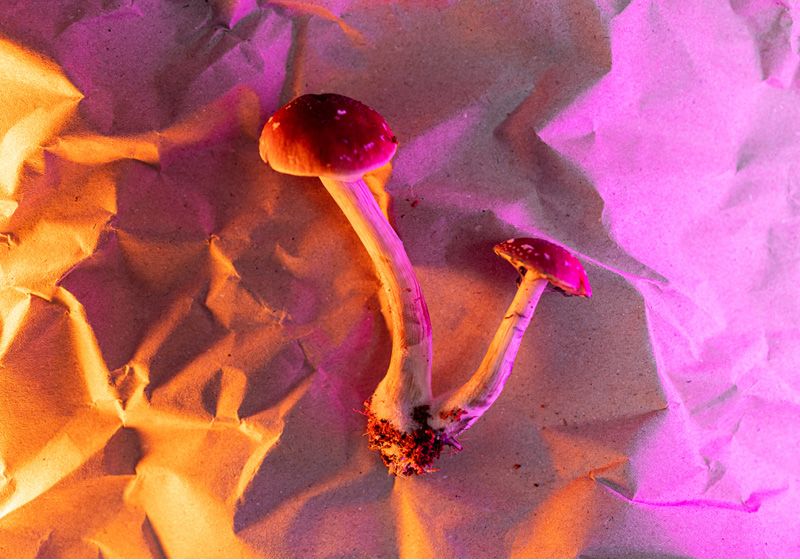
Breakthroughs in psychedelic research could lead to better treatments for mental health conditions and neurological disorders.
From magic mushrooms to peyote, psychedelics have made a name for themselves in recent years as potential therapeutics for a range of different conditions, including post-traumatic stress disorder, depression, anxiety, hearing loss, and more. These hallucinogenic molecules can alter a person’s mood and thoughts by tapping into neural circuits in the brain, but researchers are still delving into the molecular mechanisms that underlie how these drugs work. Take a trip through the latest psychedelic research to see where this mind-bending science stands.
Over the past twenty years, research on psychedelics has exploded. Scientists have tested psychoactive compounds, including psilocybin and 3,4-methylenedioxymethamphetamine (MDMA), in clinical trials with positive outcomes. However, much is still unknown about how different psychoactive molecules affect the brain, including their influence on neural plasticity and the growth of new neurons. To address some of these questions, researchers are performing systems- and cognitive-level analyses of how these molecules affect brain function, often by evaluating data from functional magnetic resonance imaging (fMRI) studies. They are also studying how psychedelics affect learning and memory formation. While scientists have learned a lot about psychedelics over the years, there are still many open questions.
Psychedelics can have anti-anxiety effects, spurring research into creating a non-hallucinogenic version of the drugs to treat mood disorders.
© iStock.com, Jay Yuno
Anxiety medications, while moderately effective, can have significant side effects. Since psychedelics can help relieve anxiety, chemical neuroscientist David Olson at the University of California, Davis wondered if it would be possible to isolate psychedelics’ hallucinogenic effects from their anxiety-reducing ones to develop a better anxiety drug. He and his team found that in mice, different neural circuits control these two outcomes. They identified specific neurons in the prefrontal cortex that, when activated by the psychedelic drug, led to an anti-anxiety effect without hallucinations. The findings could be a start to creating useful psychedelic-based drugs without needing to monitor patients while they’re taking them.
As people age, the body begins to lose synapses, the connections between neurons. This loss can lead to neurodegenerative diseases as well as hearing loss. Uri Manor, a cell biologist at the University of California, San Diego who studies hearing loss, stumbled upon a conference report showing that people had improved hearing after taking lysergic acid diethylamide (LSD). He wondered if psychedelics could help restore synapses in the cochlea, the part of the inner ear responsible for hearing. He and his team found that a single dose of psilocin led to both a significant increase in synapse number and the level of signal transmission between those synapses in the mouse cochlea. “This is the first time someone has reported an effect [of psychedelics] on neurons outside the brain,” said Manor.
Chronic pain often comes hand-in-hand with depression and anxiety, leading researchers to hypothesize that perhaps one treatment could simultaneously target both conditions. Interested in finding non-addictive alternatives to opioids, scientists at the University of Pennsylvania led by anesthesiologist Joseph Cichon wondered if psilocybin might be up for the job. Using two different mouse models of chronic pain, the team discovered that when they injected the psychedelic into the brain region associated with pain and emotions, the mice showed both reduced anxiety and depressive behaviors as well as less sensitivity to pain. “This new study offers hope,” said Cichon. “These findings open the door to developing new, non-opioid, non-addictive therapies as psilocybin and related psychedelics are not considered addictive.”

Like fungi, humans naturally produce psychedelic molecules.
© iStock.com, wildpixel
Fungi and plants are well-known psychedelic producers, but it turns out that humans naturally produce psychedelic compounds too. Researchers have found these endogenous psychedelic molecules in both the brain and the gut. A growing collection of research suggests that endogenous psychedelic molecules act as neurotransmitters. Steven Barker, a professor emeritus at Louisiana State University who studies psychedelics, hypothesizes that these human-produced molecules may protect neurons from dying due to hypoxia during physical trauma. Scientists have also noted that gut microbes may be a source of endogenous psychedelics that can alter mood by signaling along the gut-brain axis. “Everything is connected in some way through patterns of information encoded by chemical messages,” said Barker.
In his almost half-a-century career, Barker has studied how psychedelics produced by the human body affect everyday human activities such as imagination, creativity, and dreaming. He has seen the field of psychedelic research evolve over the decades: from it being illegal to conduct research on these compounds in the 1960s to that finally changing in the 1990s when researchers started studying dimethyltryptamine (DMT). He and his team have since discovered endogenous DMT present in the rat brain and found indirect evidence for DMT’s building blocks in the human brain. “New information is emerging about the previously unrecognized roles of psychedelics, but their acceptance will take time given the history and myths surrounding hallucinogens,” he said.
